. 2018 Jan;9(1):83-90.
doi: 10.1111/jdi.12674. Epub 2017 May 18.

Subcutaneous injection of hydrogen gas is a novel effective treatment for type 2 diabetes

Affiliations

Subcutaneous injection of hydrogen gas is a novel effective treatment for type 2 diabetes

Xiaolong Zhang et al. J Diabetes Investig. 2018 Jan.

Abstract

Aims/introduction: In previous studies, hydrogen gas (H2) administration has clearly shown effectiveness in inhibiting diabetes. Here, we evaluated whether subcutaneous injection of H2 shows enhanced efficacy against type 2 diabetes mellitus induced in mice by a high-fat diet and low-dose streptozotocin treatment.

Material and methods: H2 was injected subcutaneously at a dose of 1 mL/mouse/week for 4 weeks. Type 2 diabetes mellitus-associated parameters were then evaluated to determine the effectiveness of subcutaneous H2 administration.

Results: The bodyweight of H2 -treated mice did not change over the course of the experiment. Compared with the untreated control animals, glucose, insulin, low-density lipoprotein and triglyceride levels in the serum were significantly lower in treated mice, whereas high-density lipoprotein cholesterol in the serum was significantly higher. Glucose tolerance and insulin sensitivity were both improved in H2 -treated mice. Diabetic nephropathy analysis showed significant reductions in urine volume, urinary total protein and β2-microglobulin, kidney/bodyweight ratio, and kidney fibrosis associated with subcutaneous injection of H2 .

Conclusions: Subcutaneous injection of H2 significantly improves type 2 diabetes mellitus and diabetic nephropathy-related outcomes in a mouse model, supporting further consideration of subcutaneous injection as a novel and effective route of clinical H2 administration.

Keywords: Diabetic nephropathy; Hydrogen; Subcutaneous administration.


Figures

Figure 1
Figure 1
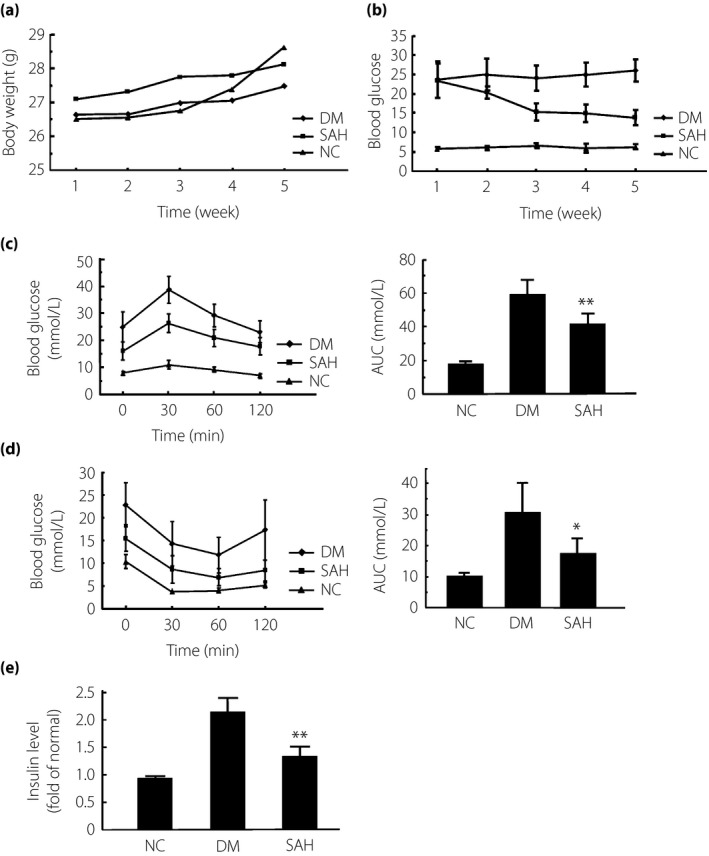
Subcutaneous administration of hydrogen gas (H2) suppressed hyperglycemia in mice with diabetes mellitus (DM) induced by a high‐fat diet and a low dose of streptozotocin. Diabetic mice were subcutaneously injected H2 at 1 mL/mouse/week for 4 weeks. The same dose of air was given as a control. Biochemical analysis was carried out to obtain plasma parameters. (a) Bodyweight after H2 treatment for each group was recorded weekly. There was no significant difference in bodyweight between the SAH group and DM group. (b) The level of blood glucose after H2 treatment for each group was recorded weekly. At the 4‐week time‐point, the level of blood glucose was significantly reduced in the subcutaneous administration of H2 group (SAH) compared with the DM group. (c,d) At day 28, the glucose tolerance test and insulin tolerance test were carried out to check the levels of blood glucose for each group at the time‐points of 0, 30, 60 and 120 min. The area under the curve (AUC) for each group is also shown. (e) The level of plasma insulin was measured after 4‐week H2 treatment. The data are expressed as mean ± SD (n = 8–16). *P < 0.05, **P < 0.01. NC, normal control group.
Figure 2
Figure 2
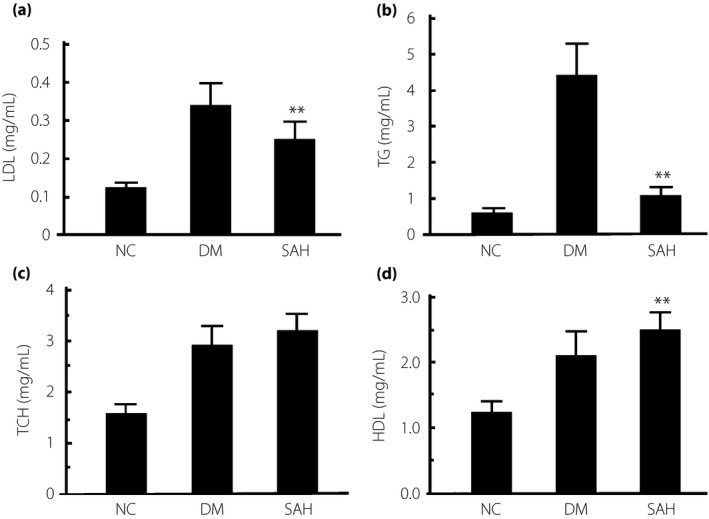
Subcutaneous administration of hydrogen gas (H2) suppressed hyperlipemia in the mice with diabetes mellitus (DM) induced by a high‐fat diet and a low dose of streptozotocin. After 4 weeks of H2 treatment, plasma samples were collected from each group to measure the levels of plasma lipids including (a) low‐density lipoprotein (LDL), (b) triglyceride (TG), (c) total cholesterol (TCH) and (d) high‐density lipoprotein (HDL). The levels of plasma LDL and TG in the subcutaneous administration of H2 group (SAH) group were significantly lower than those in the DM group. The data are expressed as mean ± SD (n = 8–16). **P < 0.01. NC, normal control group.
Figure 3
Figure 3
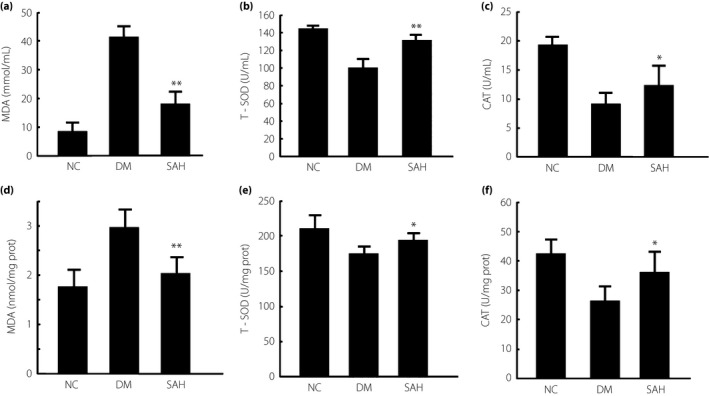
Levels of malondialdehyde (MDA), total superoxide dismutase (T‐SOD) and catalase (CAT) activity in the plasma and kidney of mice with diabetes mellitus (DM) induced by a high‐fat diet and a low dose of streptozotocin. Subcutaneous administration of hydrogen gas (H2) to the mice (a) decreased the levels of MDA, and promoted the activities of (b) T‐SOD and (c) CAT in plasma. After 4 weeks of H2 treatment, the plasma samples from each group were collected to detect the levels of indicators for plasma oxidative stress. The oxidative stress was significantly reduced in the subcutaneous administration of H2 group (SAH) group compared with the DM group. Subcutaneous administration of H2 (d) reduced the content of MDA and promoted the activities of (e) T‐SOD and (f) CAT in the kidney. Renal tissues were homogenized to examine T‐SOD and CAT activity, and MDA content. bicinchoninic acid assay was used to determine protein levels in renal samples to normalize oxidative parameters. The data are expressed as mean ± SD (n = 8–16). *P < 0.05; **P < 0.01. NC, normal control group.
Figure 4
Figure 4
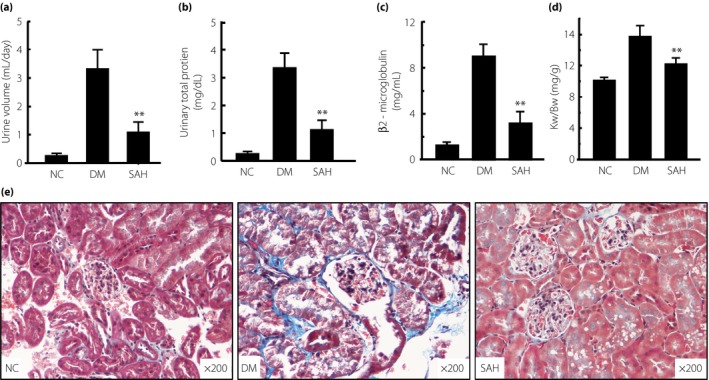
Subcutaneous administration of hydrogen gas (H2) reduced 24‐h urine volume, urinary total protein, β2‐microglobulin, kidney weight/bodyweight ratio (Kw/Bw) and renal fibrosis resulting from diabetes. After 4 weeks of H2 treatment, (a) 24‐h urine volume, (b) urinary total protein, (c) β2‐microglobulin and (d) Kw/Bw were detected, and (e) kidney tissues were fixed for Masson staining. The 24‐h urine volume, urinary total protein, β2‐microglobulin, Kw/Bw and renal fibrosis in the group with H2 treatment were significantly reduced, compared with the diabetes mellitus (DM) group (n = 16 for each group). The data are expressed as mean ± SD (n = 8–16). **P < 0.01. NC, normal control group; SAH, subcutaneous administration of H2 group.

References

    1. Brem H, Tomic‐Canic M. Cellular and molecular basis of wound healing in diabetes. J Clin Invest 2007; 117: 1219–1222. - PMC - PubMed
    1. Death rates fall for 8 of 10 top causes; Alzheimer's up to no. 6. Hosp Health Netw 2008; 82: 127. - PubMed
    1. Mansor LS, Gonzalez ER, Cole MA, et al Cardiac metabolism in a new rat model of type 2 diabetes using high‐fat diet with low dose streptozotocin. Cardiovasc Diabetol 2013; 12: 136. - PMC - PubMed
    1. L'Heveder R, Nolan T. International Diabetes Federation. Diabetes Res Clin Pract 2013; 101: 349–351. - PubMed
    1. Ohsawa I, Ishikawa M, Takahashi K, et al Hydrogen acts as a therapeutic antioxidant by selectively reducing cytotoxic oxygen radicals. Nat Med 2007; 13: 688–694. - PubMed