


An exploratory analysis of the competing effects of aggressive decongestion and high-dose loop diuretic therapy in the DOSE trial
- PMID: 28392080
- PMCID: PMC5471358
- DOI: 10.1016/j.ijcard.2017.03.114
An exploratory analysis of the competing effects of aggressive decongestion and high-dose loop diuretic therapy in the DOSE trial
Abstract
Background: Effective decongestion of heart failure patients predicts improved outcomes, but high dose loop diuretics (HDLD) used to achieve diuresis predict adverse outcomes. In the DOSE trial, randomization to a HDLD intensification strategy (HDLD-strategy) improved diuresis but not outcomes. Our objective was to determine if potential beneficial effects of more aggressive decongestion may have been offset by adverse effects of the HDLD used to achieve diuresis.
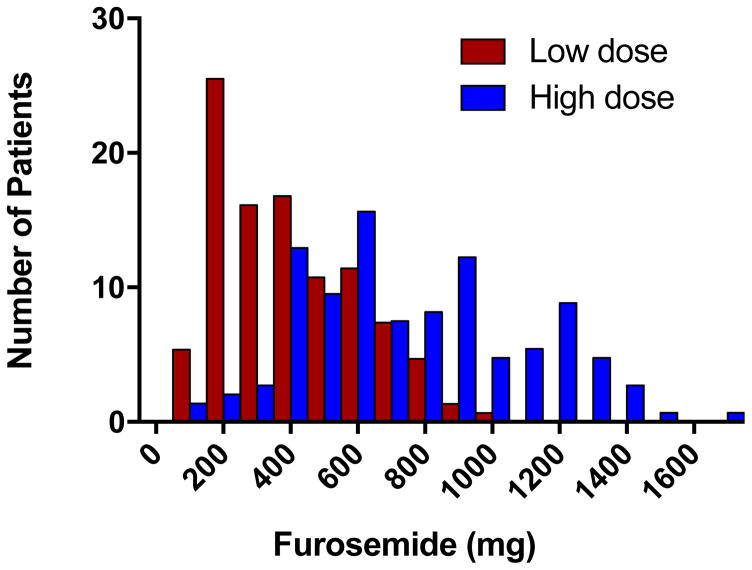
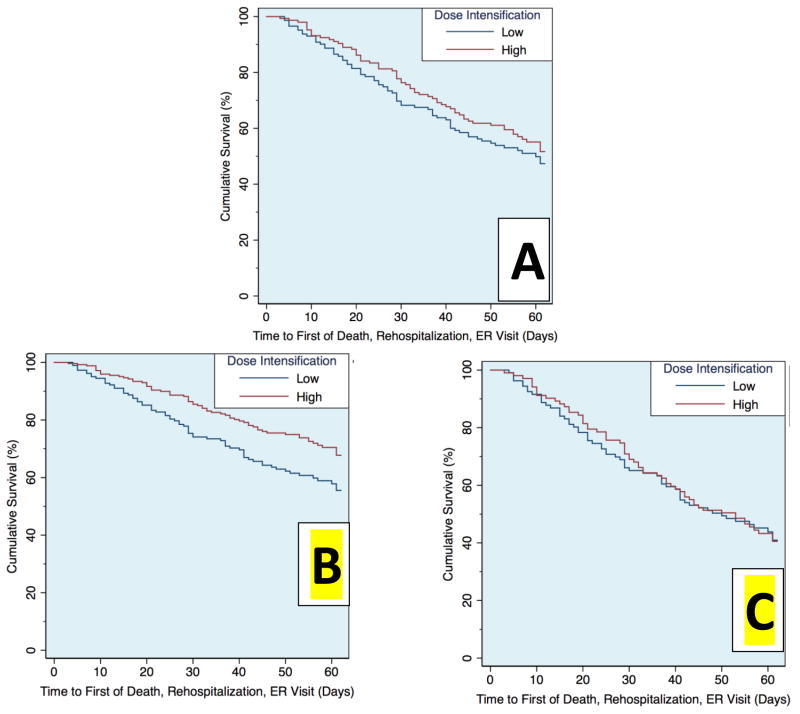
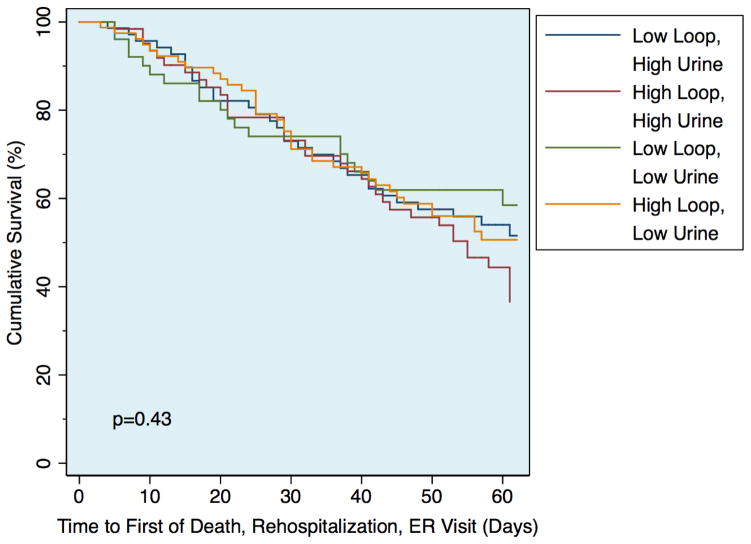
Methods and results: A post hoc analysis of the DOSE trial (n=308) was conducted to determine the influence of post-randomization diuretic dose and fluid output on the rate of death, rehospitalization or emergency department visitation associated with the HDLD-strategy. Net fluid output was used as a surrogate for beneficial decongestive effects and cumulative loop diuretic dose for the dose-related adverse effects of the HDLD-strategy. Randomization to the HDLD-strategy resulted in increased fluid output, even after adjusting for cumulative diuretic dose (p=0.006). Unadjusted, the HDLD-strategy did not improve outcomes (p=0.28). However, following adjustment for cumulative diuretic dose, significant benefit emerged (HR=0.64, 95% CI 0.43-0.95, p=0.028). Adjusting for net fluid balance eliminated the benefit (HR=0.95, 95% CI 0.67-1.4, p=0.79).
Conclusions: A clinically meaningful benefit from a randomized aggressive decongestion strategy became apparent after accounting for the quantity of loop diuretic administered. Adjusting for the diuresis resulting from this strategy eliminated the benefit. These hypothesis-generating observations may suggest a role for aggressive decongestion in improved outcomes.
Keywords: Acute heart failure; Loop diuretics; Outcomes.
Copyright © 2017 Elsevier B.V. All rights reserved.
Conflict of interest statement
Figures
References
-
- Giamouzis G, Kalogeropoulos A, Georgiopoulou V, Laskar S, Smith AL, Dunbar S, Triposkiadis F, Butler J. Hospitalization epidemic in patients with heart failure: risk factors, risk prediction, knowledge gaps, and future directions. Journal of Cardiac Failure. 2011;17(1):54–75. - PubMed
-
- Fonarow GC, Corday E. Overview of acutely decompensated congestive heart failure (ADHF): a report from the ADHERE registry. Heart Fail Rev. 2004;9(3):179–85. - PubMed
-
- Bradley SM, Levy WC, Veenstra DL. Cost-consequences of ultrafiltration for acute heart failure: a decision model analysis. Circulation Cardiovascular quality and outcomes. 2009;2(6):566–73. - PubMed
-
- Gheorghiade M, Filippatos G, De Luca L, Burnett J. Congestion in acute heart failure syndromes: an essential target of evaluation and treatment. The American Journal of Medicine. 2006;119(12 Suppl 1):S3–S10. - PubMed
-
- Gheorghiade M, Follath F, Ponikowski P, Barsuk JH, Blair JE, Cleland JG, Dickstein K, Drazner MH, Fonarow GC, Jaarsma T, Jondeau G, Sendon JL, Mebazaa A, Metra M, Nieminen M, Pang PS, Seferovic P, Stevenson LW, van Veldhuisen DJ, Zannad F, Anker SD, Rhodes A, McMurray JJ, Filippatos G. Assessing and grading congestion in acute heart failure: a scientific statement from the acute heart failure committee of the heart failure association of the European Society of Cardiology and endorsed by the European Society of Intensive Care Medicine. Eur J Heart Fail. 2010;12(5):423–33. - PubMed
Publication types
MeSH terms
Substances
Grants and funding
LinkOut - more resources
Full Text Sources
Other Literature Sources
Medical
