Comparative Study
. 2017 Nov-Dec;46(6):402-409.
doi: 10.1067/j.cpradiol.2017.02.006. Epub 2017 Feb 20.

Radiofrequency vs Microwave Ablation After Neoadjuvant Transarterial Bland and Drug-Eluting Microsphere Chembolization for the Treatment of Hepatocellular Carcinoma

Affiliations
Comparative Study

Radiofrequency vs Microwave Ablation After Neoadjuvant Transarterial Bland and Drug-Eluting Microsphere Chembolization for the Treatment of Hepatocellular Carcinoma

Lindsay M Thornton et al. Curr Probl Diagn Radiol. 2017 Nov-Dec.

Abstract

Aim: To retrospectively compare the initial response, local recurrence, and complication rates of radiofrequency ablation (RFA) vs microwave ablation (MWA) when combined with neoadjuvant bland transarterial embolization (TAE) or drug-eluting microsphere chemoembolization (TACE) for the treatment of hepatocellular carcinoma (HCC).

Methods: A total of 35 subjects with Barcelona Clinic Liver Cancer (BCLC) very early and early-stage HCC (range: 1.2-4.1cm) underwent TAE (23) or TACE (12) with RFA (15) or microwave ablation (MWA) (20) from January 2009 to June 2015 as either definitive therapy or a bridge to transplant. TAE and TACE were performed with 40-400μm particles and 30-100μm plus either doxorubicin- or epirubicin-eluting microspheres, respectively. Initial response and local progression were evaluated using modified response evaluation criteria in solid tumors. Complications were graded using common terminology criteria for adverse events version 5.0.

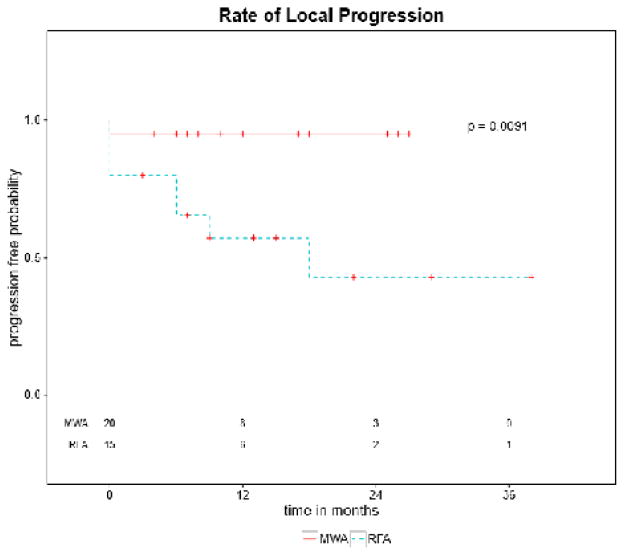
Results: Complete response rates were 80% (12/15) for RFA + TAE/TACE and 95% (19/20) for MWA + TAE/TACE (P = 0.29). Local recurrence rate was 30% (4/12) for RFA + TAE/TACE and 0% (0/19) for MWA + TAE/TACE. Durability of response, defined as local disease control for duration of the study, demonstrated a significant difference in favor of MWA (P = 0.0091). There was no statistical difference in complication rates (3 vs 2).

Conclusions: MWA and RFA when combined with neoadjuvant TAE or TACE have similar safety and efficacy in the treatment of early-stage HCC. MWA provided more durable disease control in this study; however, prospective data remain necessary to evaluate superiority of either modality.


Conflict of interest statement

Conflict of Interest: Beau Toskich became a consultant for Neuwave Medical subsequent to the collection and analysis of this data. All other authors have no conflicts of interest to disclose.

Figures

Figure 1
Figure 1
One hundred twenty six percutaneous ablation cases were reviewed. Forty-five of these cases were ablations for HCC. One case was excluded due to palliative abdominal wall HCC metastasis. Of the 9 intrahepatic HCC ablations, 9 were excluded from this cohort due to lack of neoadjuvant embolization (3), insufficient follow up (4), technically unsuccessful procedure (1), and subject request (1).
Figure 2
Figure 2
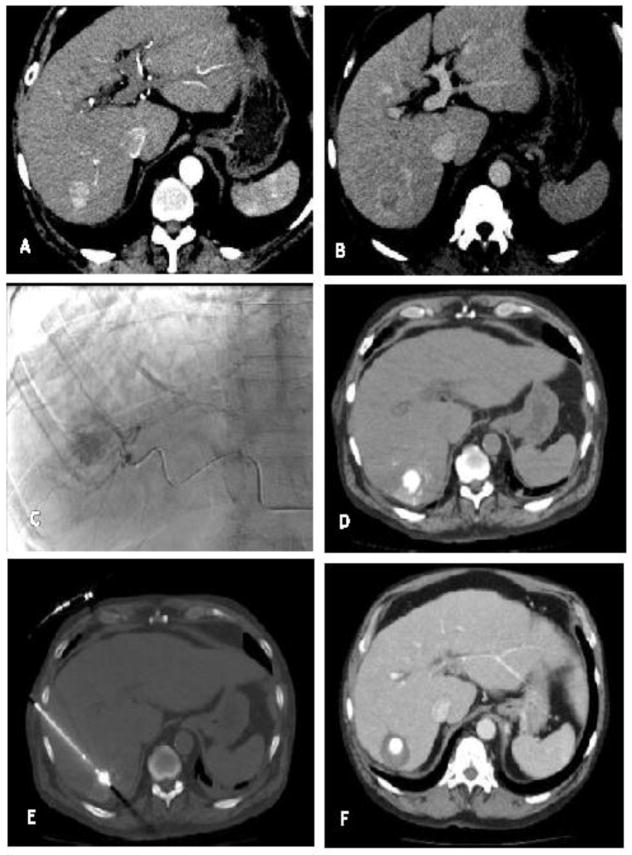
A) Arterially enhancing hepatic tumor with B) venous washout consistent with HCC C) Conventional transarterial angiography post superselective embolization of a hepatic artery branch feeding the vessel with doxorubicin eluting beads and micellated lipiodol. D) Non-contrast post procedure exam demonstrates deposition of lipiodol within the tumor. E) RFA probe was placed under ultrasound guidance with CT confirmation. F) CT performed approximately 1 month post procedure demonstrates complete response with clear ablation margin.
Figure 3
Figure 3
A) Arterially enhancing hepatic tumor with B) venous washout consistent with HCC C) Conventional transarterial angiography post superselective embolization of a hepatic artery branch feeding the vessel with bland beads and micellated lipiodol. D) Non-contrast post procedure exam demonstrates deposition of lipiodol within the tumor. E) MWA probe was placed under ultrasound guidance with CT confirmation. F) CT performed approximately 1 month post procedure demonstrates complete response with clear ablation margin.
Figure 4
Figure 4
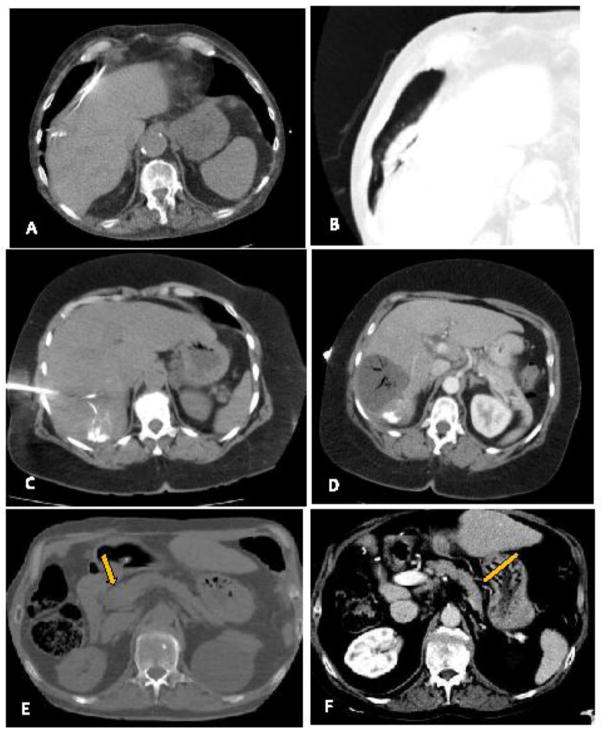
A) The RFA probe tine is seen puncturing the pleura during placement, B) causing a pneumothorax. C) The RFA ablation caused larger than intended ablation zone causing severe right upper quadrant pain and prolonged stay in the hospital. D) On follow up imaging, a hepatic infarction can be seen as non-enhancing liver. E) During a left hepatic lobe RFA ablation, the RFA tine punctured the gastric mucosa. This was repositioned prior to ablation. F) However, there was seeding of the gastric mucosa seen on follow up imaging.
Figure 5
Figure 5
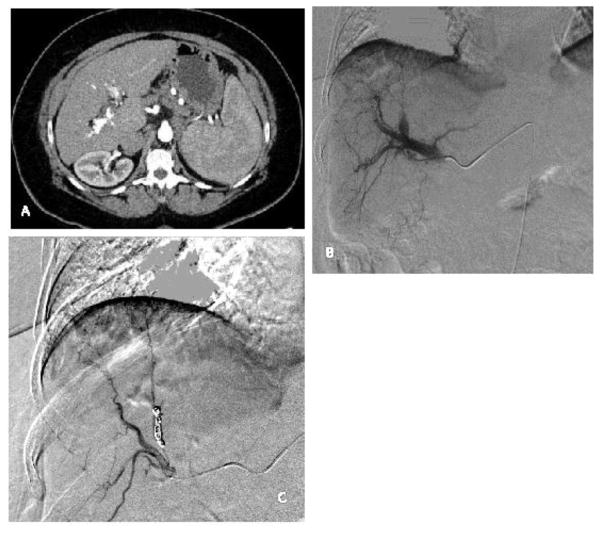
A) There is a hyperdense arterial phase contrast filling the portal vein and the hepatic arteries consistent an arterioportal fistula secondary to ablation. B) On the subsequent hepatic arteriogram, contrast is seen filling the portal vein. C) Coil embolization of the fistula has been performed. Follow up hepatic arteriogram does not opacity the portal vein.
Figure 6
Figure 6
Kaplan Meier curve demonstrates local progression over time in the MWA group and the RFA group. There were three incomplete initial responses within the RFA group and 1 incomplete initial response in the MWA group. These are plotted at time point zero. The curves denote rates of local progression with a statistically significant difference between the MWA group vs the RFA group (p= 0.0091).

References

    1. Altekruse SF, Henley SJ, Cucinelli JE, McGlynn KA. Changing hepatocellular carcinoma incidence and liver cancer mortality rates in the United States. Am J Gastroenterol. 2014;109(4):542–53. doi: 10.1038/ajg.2014.11. - DOI - PMC - PubMed
    1. Kirk A. Textbook of organ transplantation. Chichester, West Sussex: John Wiley & Sons, Inc; 2014.
    1. Cabrera R, Dhanasekaran R, Caridi J, Clark V, Morelli G, Soldevila-Pico C, et al. Impact of transarterial therapy in hepatitis C-related hepatocellular carcinoma on long-term outcomes after liver transplantation. Am J Clin Oncol. 2012;35(4):345–50. doi: 10.1097/COC.0b013e31821631f6. - DOI - PMC - PubMed
    1. Bruix J, Sherman M Practice Guidelines Committee AeAftSoLD. Management of hepatocellular carcinoma. Hepatology. 2005;42(5):1208–36. doi: 10.1002/hep.20933. - DOI - PubMed
    1. Liver EAFTSOT, Cancer EOFRATO. EASL-EORTC clinical practice guidelines: management of hepatocellular carcinoma. J Hepatol. 2012;56(4):908–43. doi: 10.1016/j.jhep.2011.12.001. - DOI - PubMed

Publication types