


Routine molecular point-of-care testing for respiratory viruses in adults presenting to hospital with acute respiratory illness (ResPOC): a pragmatic, open-label, randomised controlled trial
- PMID: 28392237
- PMCID: PMC7164815
- DOI: 10.1016/S2213-2600(17)30120-0
Routine molecular point-of-care testing for respiratory viruses in adults presenting to hospital with acute respiratory illness (ResPOC): a pragmatic, open-label, randomised controlled trial
Abstract
Background: Respiratory virus infection is a common cause of hospitalisation in adults. Rapid point-of-care testing (POCT) for respiratory viruses might improve clinical care by reducing unnecessary antibiotic use, shortening length of hospital stay, improving influenza detection and treatment, and rationalising isolation facility use; however, insufficient evidence exists to support its use over standard clinical care. We aimed to assess the effect of routine POCT on a broad range of clinical outcomes including antibiotic use.
Methods: In this pragmatic, parallel-group, open-label, randomised controlled trial, we enrolled adults (aged ≥18 years) within 24 h of presenting to the emergency department or acute medical unit of a large UK hospital with acute respiratory illness or fever higher than 37·5°C (≤7 days duration), or both, over two winter seasons. Patients were randomly assigned (1:1), via an internet-based allocation sequence with random permuted blocks, to have a molecular POC test for respiratory viruses or routine clinical care. The primary outcome was the proportion of patients who received antibiotics while hospitalised (up to 30 days). Secondary outcomes included duration of antibiotics, proportion of patients receiving single doses or brief courses of antibiotics, length of stay, antiviral use, isolation facility use, and safety. Analysis was by modified intention to treat, excluding patients who declined intervention or were withdrawn for protocol violations. This study is registered with ISRCTN, number 90211642, and has been completed.
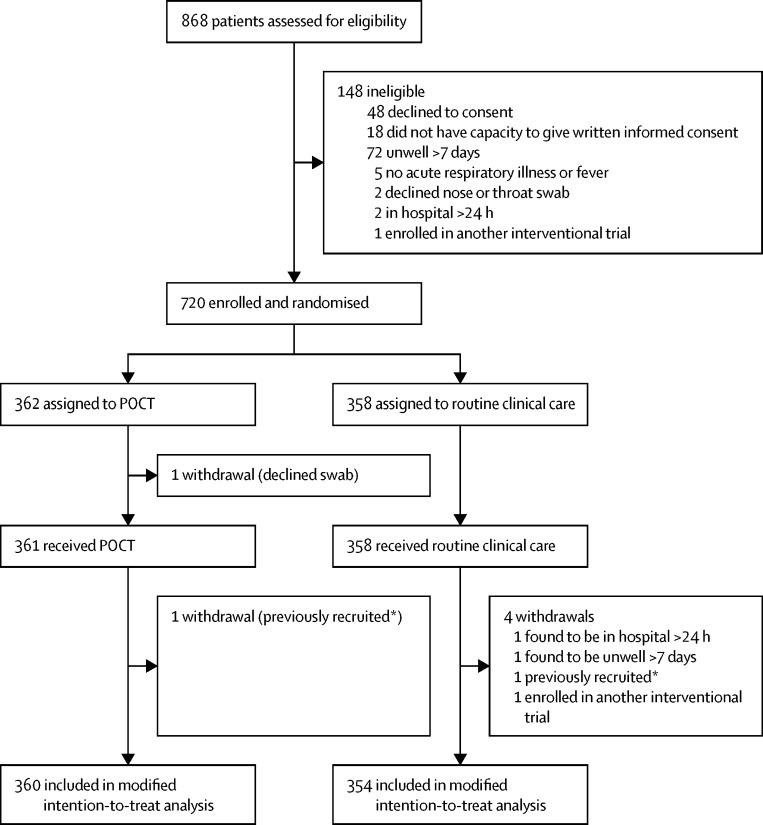
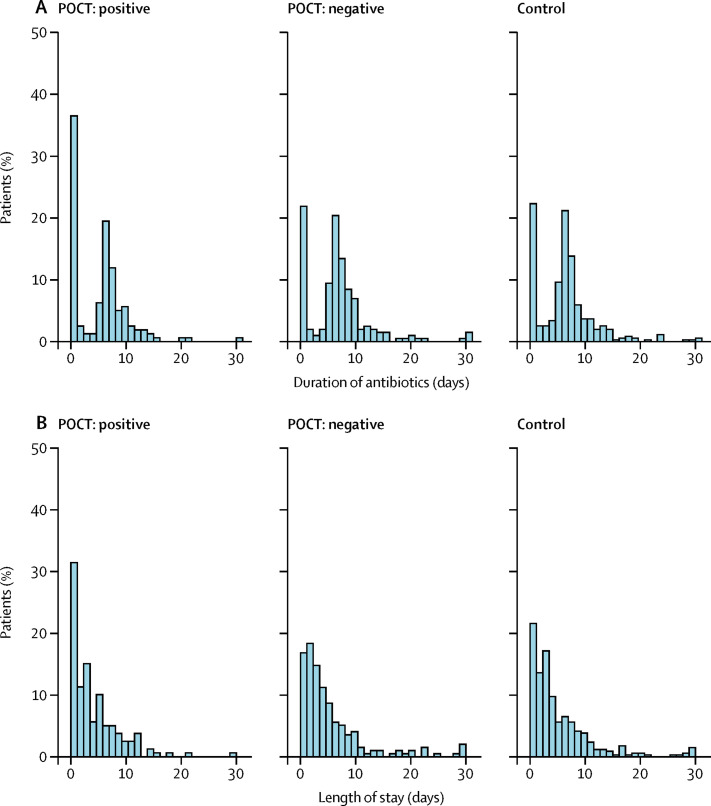
Findings: Between Jan 15, 2015, and April 30, 2015, and between Oct 1, 2015, and April 30, 2016, we enrolled 720 patients (362 assigned to POCT and 358 to routine care). Six patients withdrew or had protocol violations. 301 (84%) of 360 patients in the POCT group received antibiotics compared with 294 (83%) of 354 controls (difference 0·6%, 95% CI -4·9 to 6·0; p=0·84). Mean duration of antibiotics did not differ between groups (7·2 days [SD 5·1] in the POCT group vs 7·7 days [4·9] in the control group; difference -0·4, 95% CI -1·2 to 0·4; p=0·32). 50 (17%) of 301 patients treated with antibiotics in the POCT group received single doses or brief courses of antibiotics (<48 h) compared with 26 (9%) of 294 patients in the control group (difference 7·8%, 95% CI 2·5 to 13·1; p=0·0047; number needed to test=13). Mean length of stay was shorter in the POCT group (5·7 days [SD 6·3]) than in the control group (6·8 days [7·7]; difference -1·1, 95% CI -2·2 to -0·3; p=0·0443). Appropriate antiviral treatment of influenza-positive patients was more common in the POCT group (52 [91%] of 57 patients) than in the control group (24 [65%] of 37 patients; difference 26·4%, 95% CI 9·6 to 43·2; p=0·0026; number needed to test=4). We found no differences in adverse outcomes between the groups (77 [21%] of 360 patients in the POCT group vs 88 [25%] of 354 patients in the control group; -3·5%, -9·7 to 2·7; p=0·29).
Interpretation: Routine use of molecular POCT for respiratory viruses did not reduce the proportion of patients treated with antibiotics. However, the primary outcome measure failed to capture differences in antibiotic use because many patients were started on antibiotics before the results of POCT could be made available. Although POCT was not associated with a reduction in the duration of antibiotics overall, more patients in the POCT group received single doses or brief courses of antibiotics than did patients in the control group. POCT was also associated with a reduced length of stay and improved influenza detection and antiviral use, and appeared to be safe.
Funding: University of Southampton.
Copyright © 2017 Elsevier Ltd. All rights reserved.
Figures
Comment in
-
Reducing diagnostic uncertainty to improve treatment of respiratory infections.Lancet Respir Med. 2017 May;5(5):364-365. doi: 10.1016/S2213-2600(17)30126-1. Epub 2017 Apr 6. Lancet Respir Med. 2017. PMID: 28392236 No abstract available.
References
-
- World Health Organization Fact sheet 310: the top 10 causes of death. http://www.who.int/mediacentre/factsheets/fs310/en (accessed Oct 21, 2016).
Publication types
MeSH terms
Substances
Associated data
Grants and funding
LinkOut - more resources
Full Text Sources
Other Literature Sources
Medical
Miscellaneous
