. 2017 Apr 4:8:18.
doi: 10.1186/s13229-017-0131-2. eCollection 2017.

Shared genetic influences between dimensional ASD and ADHD symptoms during child and adolescent development

Affiliations

Shared genetic influences between dimensional ASD and ADHD symptoms during child and adolescent development

Evie Stergiakouli et al. Mol Autism. .

Abstract

Background: Shared genetic influences between attention-deficit/hyperactivity disorder (ADHD) symptoms and autism spectrum disorder (ASD) symptoms have been reported. Cross-trait genetic relationships are, however, subject to dynamic changes during development. We investigated the continuity of genetic overlap between ASD and ADHD symptoms in a general population sample during childhood and adolescence. We also studied uni- and cross-dimensional trait-disorder links with respect to genetic ADHD and ASD risk.

Methods: Social-communication difficulties (N ≤ 5551, Social and Communication Disorders Checklist, SCDC) and combined hyperactive-impulsive/inattentive ADHD symptoms (N ≤ 5678, Strengths and Difficulties Questionnaire, SDQ-ADHD) were repeatedly measured in a UK birth cohort (ALSPAC, age 7 to 17 years). Genome-wide summary statistics on clinical ASD (5305 cases; 5305 pseudo-controls) and ADHD (4163 cases; 12,040 controls/pseudo-controls) were available from the Psychiatric Genomics Consortium. Genetic trait variances and genetic overlap between phenotypes were estimated using genome-wide data.

Results: In the general population, genetic influences for SCDC and SDQ-ADHD scores were shared throughout development. Genetic correlations across traits reached a similar strength and magnitude (cross-trait rg ≤ 1, pmin = 3 × 10⁻⁴) as those between repeated measures of the same trait (within-trait rg ≤ 0.94, pmin = 7 × 10⁻⁴). Shared genetic influences between traits, especially during later adolescence, may implicate variants in K-RAS signalling upregulated genes (p-meta = 6.4 × 10⁻⁴). Uni-dimensionally, each population-based trait mapped to the expected behavioural continuum: risk-increasing alleles for clinical ADHD were persistently associated with SDQ-ADHD scores throughout development (marginal regression R2 = 0.084%). An age-specific genetic overlap between clinical ASD and social-communication difficulties during childhood was also shown, as per previous reports. Cross-dimensionally, however, neither SCDC nor SDQ-ADHD scores were linked to genetic risk for disorder.

Conclusions: In the general population, genetic aetiologies between social-communication difficulties and ADHD symptoms are shared throughout child and adolescent development and may implicate similar biological pathways that co-vary during development. Within both the ASD and the ADHD dimension, population-based traits are also linked to clinical disorder, although much larger clinical discovery samples are required to reliably detect cross-dimensional trait-disorder relationships.

Keywords: ADHD symptoms; ALSPAC; Clinical ADHD; Genetic overlap; Social communication.


Figures
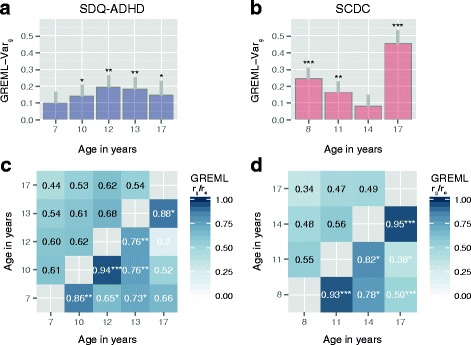
Fig. 1
Fig. 1
Genetic architecture of SDQ-ADHD and SCDC scores. Genetic-relationship-matrix restricted maximum likelihood (GREML) genetic variance (Varg), genetic (r g) and residual correlations (r e) are shown for SDQ-ADHD scores (a, c) and SCDC scores (b, d) in ALSPAC; grey bars (a, b) indicate one GREML-h2 standard error; r g estimates for each trait (b, d) are shown in the lower triangle, r e estimates (b, d) in the upper triangle. ALSPAC Avon Longitudinal Study of Parents and Children, SCDC Social and Communication Disorders Checklist at 8, 11, 14 and 17 years (rank-transformed), SDQ-ADHD ADHD subscale of the Strength and Difficulties Questionnaire at 7, 10 12, 13 and 17 years (rank-transformed); note that for rank-transformed traits, estimates of SNP-h2 are equivalent to estimates of Varg, as the phenotypic variance has been standardised to one. r g p values: *p ≤ 0.05, **p ≤ 0.01 and ***p ≤ 0.001 (uncorrected for multiple testing, experiment-wise error rate p = 0.01)
Fig. 2
Fig. 2
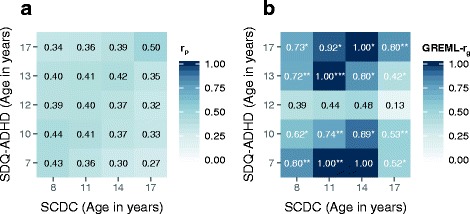
Cross-trait phenotypic (a) and genetic correlations (b) between SDQ-ADHD and SCDC scores during childhood and adolescence. Using the ALSPAC cohort, cross-trait phenotypic correlations (r p) were estimated using Pearson product moment correlation coefficients (p ≤ 0.001) and cross-trait genetic correlations (r g) were estimated with bivariate GREML. ALSPAC Avon Longitudinal Study of Parents and Children, GREML genetic-relationship-matrix restricted maximum likelihood, GREML-r g bivariate genetic correlation, SCDC Social and Communication Disorders Checklist at 8, 11, 14 and 17 years (rank-transformed), SDQ-ADHD ADHD subscale of the Strength and Difficulties Questionnaire at 7, 10 12, 13 and 17 years (rank-transformed). r g (p values): *p ≤ 0.05, **p ≤ 0.01 and ***p ≤ 0.001 (uncorrected for multiple testing, experiment-wise error rate p = 0.01)
Fig. 3
Fig. 3
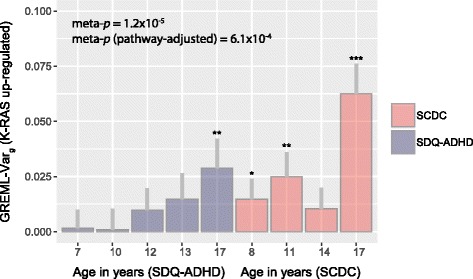
Genetic variance in SDQ-ADHD and SCDC scores due to variation within K-RAS signalling upregulated genes. The genetic variance composition for SCDC and SDQ-ADHD scores in ALSPAC was dissected according to genetic variation within molecular signatures database (MSigDB) hallmark gene set collections [53]. For each measure, the genetic variance is shown for the pathway of K-RAS signalling upregulated genes including one standard error (grey bar) and measurement-specific p values (*p ≤ 0.05, **p ≤ 0.01 and ***p ≤ 0.001). Statistical evidence across measures was combined using a homogeneity statistic [55], accounting for phenotypic overlap among traits. The meta-analysis p value (meta-p) reflects four SCDC scores (at 8, 11, 14 and 17 years) and five SDQ-ADHD scores (7, 10 12, 13 and 17 years) and is Bonferroni-adjusted for 50 analysed pathways (pathway-adjusted). ALSPAC Avon Longitudinal Study of Parents and Children, SCDC Social and Communication Disorders Checklist at 8, 11, 14 and 17 years (rank-transformed), SDQ-ADHD ADHD subscale of the Strength and Difficulties Questionnaire at 7, 10 12, 13 and 17 years (rank-transformed)
Fig. 4
Fig. 4
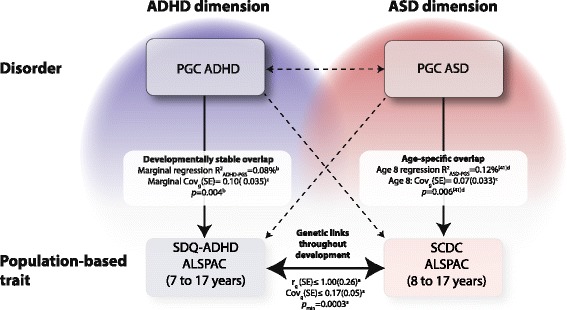
Genetic relationships between ASD and ADHD symptoms in clinical and population-based samples (as tagged by common variation). Cross-disorder genetic overlap: The Psychiatric Genomics Consortium (PGC) has previously reported [22] genetic correlations (r g) and covariances (Covg) between PGC-ASD and PGC-ADHD (r g(SE) = −0.13 (0.09), Covg(SE) = −0.026 (0.017), p = 0.13) using genetic-relationship-matrix restricted maximum likelihood (GREML) analyses that provided little evidence for cross-disorder genetic overlap. Cross-trait genetic overlap: Genetic correlations and covariances between standardised SCDC (at 8, 11, 14 and 17 years) and SDQ-ADHD scores (at 7, 10, 12, 13 and 17 years) in ALSPAC, as estimated using bivariate GREML (a), provided evidence for shared genetic links throughout childhood and adolescence (see the ‘Results’ section). Uni-dimensional trait-disorder genetic overlap: The association between SDQ-ADHD scores in ALSPAC and ADHD-PGS (polygenic risk scores (PGS)) was developmentally stable across development, as predicted by linear mixed models (b). A marginal estimate of regression R 2 and a marginal estimate of the expected genetic covariance, as estimated with the Avengeme software (c), are shown (see the ‘Results’ section). As previously reported [41], the association between ASD risk-increasing alleles and SCDC scores in ALSPAC was strongest at age 8 years. Regression R 2 estimates at age 8 years are shown, based on an age-specific analysis using standardised scores and linear regression models (d) [41]. The expected genetic covariance was estimated with Avengeme software (c) (Covg(95% CI) = 0.072 (0.0082,0.14) (approximated SE = 0.033)). Cross-dimensional trait-disorder genetic overlap: There was little support for association between ASD-PGS and SDQ-ADHD or association between ADHD-PGS and SCDC scores in ALSPAC (see the ‘Results’ section, p > experiment-wise error rate p = 0.01). All polygenic scoring analyses are shown for a PGS threshold (P T) of 0.5. Genetic relationships reaching statistical significance are shown as solid lines and as dashed lines otherwise. Previous reports based on linkage disequilibrium score genetic correlations [23, 28] are omitted for clarity. ADHD attention deficit hyperactivity disorder, ALSPAC Avon Longitudinal Study of Parents and Children, ASD autism spectrum disorder, PGC-ADHD ADHD collection of the PGC, PGC-ASD ASD collection of the PGC, SCDC Social and Communication Disorders Checklist, SDQ-ADHD ADHD subscale of the Strength and Difficulties Questionnaire

References

    1. Nijmeijer JS, Hoekstra PJ, Minderaa RB, Buitelaar JK, Altink ME, Buschgens CJM, et al. PDD symptoms in ADHD, an independent familial trait? J Abnorm Child Psychol. 2008;37:443–53. doi: 10.1007/s10802-008-9282-0. - DOI - PubMed
    1. Mulligan A, Anney RJL, O’Regan M, Chen W, Butler L, Fitzgerald M, et al. Autism symptoms in attention-deficit/hyperactivity disorder: a familial trait which correlates with conduct, oppositional defiant, language and motor disorders. J Autism Dev Disord. 2008;39:197–209. doi: 10.1007/s10803-008-0621-3. - DOI - PubMed
    1. Reiersen AM, Constantino JN, Grimmer M, Martin NG, Todd RD. Evidence for shared genetic influences on self-reported ADHD and autistic symptoms in young adult Australian twins. Twin Res Hum Genet Off J Int Soc Twin Stud. 2008;11:579–85. doi: 10.1375/twin.11.6.579. - DOI - PMC - PubMed
    1. Ronald A, Larsson H, Anckarsäter H, Lichtenstein P. Symptoms of autism and ADHD: a Swedish twin study examining their overlap. J Abnorm Psychol. 2014;123:440–51. doi: 10.1037/a0036088. - DOI - PubMed
    1. Ronald A, Simonoff E, Kuntsi J, Asherson P, Plomin R. Evidence for overlapping genetic influences on autistic and ADHD behaviours in a community twin sample. J Child Psychol Psychiatry. 2008;49:535–42. doi: 10.1111/j.1469-7610.2007.01857.x. - DOI - PubMed

Publication types

MeSH terms