. 2017 Apr 10;12(4):e0173190.
doi: 10.1371/journal.pone.0173190. eCollection 2017.

A novel RNA-based in situ hybridization to detect Seneca Valley virus in neonatal piglets and sows affected with vesicular disease

Affiliations

A novel RNA-based in situ hybridization to detect Seneca Valley virus in neonatal piglets and sows affected with vesicular disease

Talita P Resende et al. PLoS One. .

Abstract

Seneca Valley virus (SVV) is the causative agent of an emerging vesicular disease in swine, which is clinically indistinguishable from other vesicular diseases such as foot-and-mouth disease. In addition, SVV has been associated with neonatal mortality in piglets. While a commercial SVV qRT-PCR is available, commercial antibodies are lacking to diagnose SVV infections by immunohistochemistry (IHC). Thus, a novel in situ hybridization technique-RNAscope (ISH) was developed to detect SVVRNA in infected tissues. From a total of 78 samples evaluated, 30 were positive by qRT-PCR and ISH-RNA, including vesicular lesions of affected sows, ulcerative lesions in the tongue of piglets and various other tissues with no evidence of histological lesions. Nineteen samples were negative for SVV by qRT-PCR and ISH-RNA. The Ct values of the qRT-PCR from ISH-RNA positive tissues varied from 12.0 to 32.6 (5.12 x 10⁶ to 5.31 RNA copies/g, respectively). The ISH-RNA technique is an important tool in diagnosing and investigating the pathogenesis of SVV and other emerging pathogens.


Conflict of interest statement

Competing Interests: The authors have declared that no competing interests exist.

Figures

Fig 1
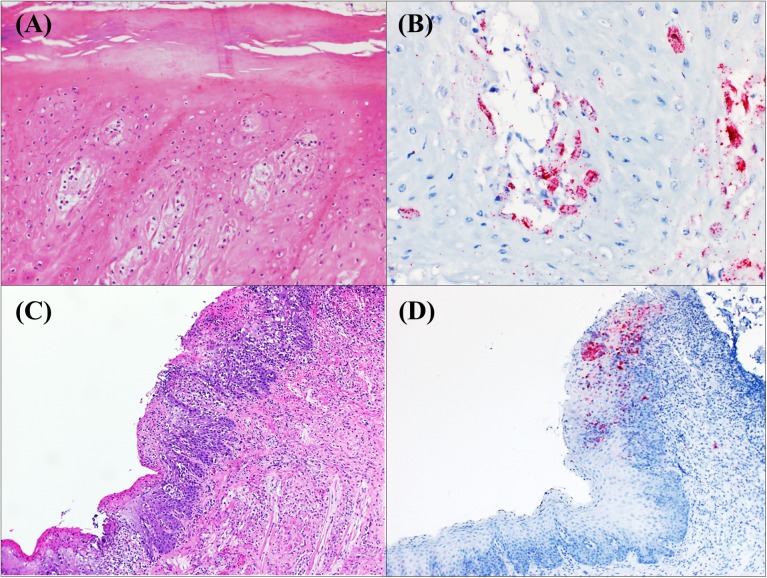
Fig 1. SVV distribution in vesicular lesions in the snout of an affected sow and in necrotizing lesions in tongue of an affected piglet.
a) Skin from infected sow. Ballooning degeneration (intracellular edema) of keratinocytes in the stratum spinosum with formation of intraepidermal vesicles. H&E, 20x; b) Skin from infected sow. Intraepidermal vesicle showing strong SVV positive staining within the cytoplasm of keratinocytes. ISH-RNA, 40x; c) Tongue from infected piglet. Necrotizing glossitis. H&E, 20x; d) Tongue from the infected piglet shown in (c). Red dots and clusters represent the presence of SVV mRNA within an erosive lesion. ISH-RNA, 40x.
Fig 2
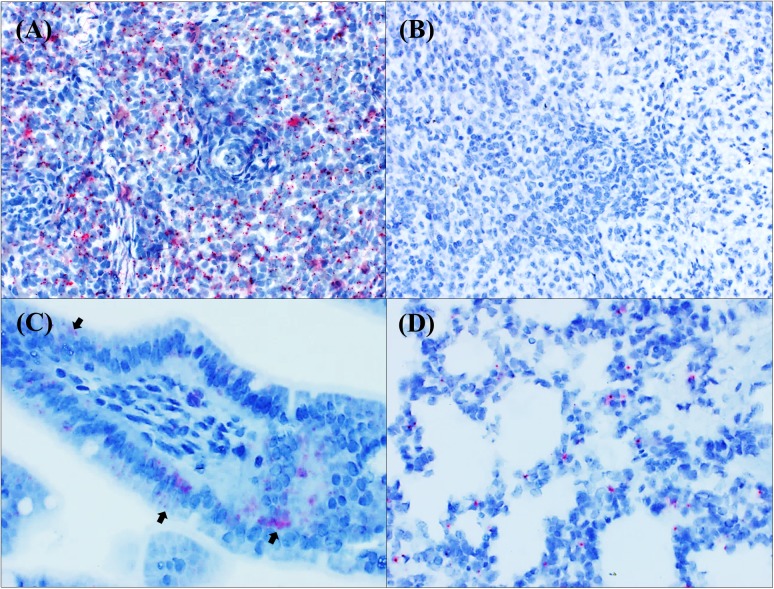
Fig 2. SVV distribution in tissues without evidence of histological lesions.
Swine, ISH-RNA. a) Piglet, spleen (central arteriole). Strong SVV positive staining diffusely distributed throughout the splenic parenchyma. ISH-RNA, 20x.; b) Piglet, spleen. Negative control. ISH-RNA, 20x; c) Piglet, small intestine. SVV mRNA was multifocally distributed within enterocytes (black arrows) and lamina propria. ISH-RNA, 20x; d) Piglet, lung, SVV positive signals were found in alveolar septum. ISH-RNA, 20x.

References

    1. Reddy PS, Burroughs KD, Hales LM, Ganesh S, Jones BH, Idamakanti N, et al. Seneca Valley virus, a systemically deliverable oncolytic picornavirus, and the treatment of neuroendocrine cancers. J Natl Cancer Inst. 2007;99: 1623–1633. 10.1093/jnci/djm198 - DOI - PMC - PubMed
    1. Hales LM, Knowles NJ, Reddy PS, Xu L, Hay C, Hallenbeck PL. Complete genome sequence analysis of Seneca Valley virus-001, a novel oncolytic picornavirus. J Gen Virol. 2008;89: 1265–1275. 10.1099/vir.0.83570-0 - DOI - PubMed
    1. Vannucci FA, Linhares DC, Barcellos DE, Lam HC, Collins J, Marthaler D. Identification and Complete Genome of Seneca Valley Virus in Vesicular Fluid and Sera of Pigs Affected with Idiopathic Vesicular Disease, Brazil. Transbound Emerg Dis. 2015;62: 589–593. 10.1111/tbed.12410 - DOI - PubMed
    1. Leme RA, Zotti E, Alcantara BK, Oliveira MV, Freitas LA, Alfieri AF, et al. Senecavirus A: An Emerging Vesicular Infection in Brazilian Pig Herds. Transbound Emerg Dis. 2015;62: 603–611. 10.1111/tbed.12430 - DOI - PubMed
    1. Leme RA, Oliveira TE, Alcantara BK, Headley SA, Alfieri AF, Yang M, et al. Clinical Manifestations of Senecavirus A Infection in Neonatal Pigs, Brazil, 2015. Emerg Infect Dis. 2016;22: 1238–1241. 10.3201/eid2207.151583 - DOI - PMC - PubMed

MeSH terms

LinkOut - more resources