


Depression in breast cancer patients who have undergone mastectomy: A national cohort study
- PMID: 28394909
- PMCID: PMC5386257
- DOI: 10.1371/journal.pone.0175395
Depression in breast cancer patients who have undergone mastectomy: A national cohort study
Abstract
Objective: The objective of this study was to compare the incidence of post-operative depression in breast cancer patients who have undergone mastectomy with the incidence of post-operative depression in non-breast cancer participants (controls).
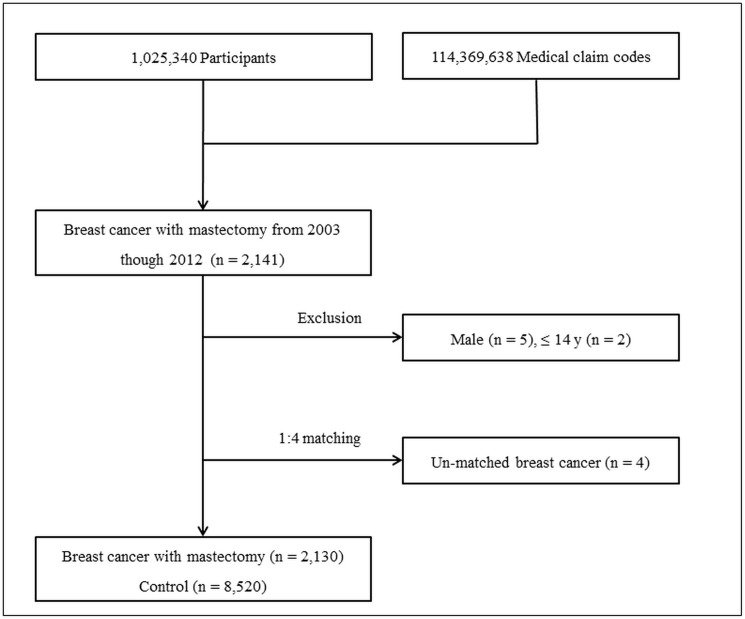
Methods: Using data from the Korean Health Insurance Review and Assessment Service (HIRA), we selected 2,130 patients with breast cancer who have undergone mastectomy for this national cohort study and matched these patients 1:4 with 8,520 control participants according to age, sex, income, region, and pre-operative depression. The incidence of post-operative depression was measured from mastectomy year to post-op year 10. The Mann-Whitney U test was used for data analysis, and the false-discovery rate was applied to determine statistical significance (P < 0.05).
Results: The incidence of depression was higher in the breast cancer with mastectomy group than in the control group up to 3 years after mastectomy). However, there was no difference in the incidence of depression between the breast cancer with mastectomy group and the control group after post-op 4 years. The incidence of depression was higher in the breast cancer with mastectomy group than in the control group up to 2 years after mastectomy, and there was no difference in the incidence of depression between the two groups after post-op 3 years in middle-aged and older adults (≥ 40 years old). In young adults (≤ 39 years old), the incidence of depression was significantly higher in the breast cancer with mastectomy group than in the control group in mastectomy year.
Conclusion: Patients undergoing mastectomy for breast cancer experience depression more frequently than healthy people. However, patients overcome their depressive mood symptoms during the postoperative period. Young adults overcome their symptoms more quickly than middle-aged and older adults.
Conflict of interest statement
Figures

References
-
- McGuire A, Brown JA, Malone C, McLaughlin R, Kerin MJ. Effects of age on the detection and management of breast cancer. Cancers. 2015;7(2):908–29. Epub 2015/05/27. PubMed Central PMCID: PMCPMC4491690. doi: 10.3390/cancers7020815 - DOI - PMC - PubMed
-
- Stewart BaW, C.P. World Cancer Report 2014: International Agency for Research on Cancer, WHO; 2014.
-
- Jung KW, Won YJ, Kong HJ, Oh CM, Cho H, Lee DH, et al. Cancer statistics in Korea: incidence, mortality, survival, and prevalence in 2012. Cancer research and treatment: official journal of Korean Cancer Association. 2015;47(2):127–41. Epub 2015/03/13. PubMed Central PMCID: PMCPMC4398120. - PMC - PubMed
-
- Maass SW, Roorda C, Berendsen AJ, Verhaak PF, de Bock GH. The prevalence of long-term symptoms of depression and anxiety after breast cancer treatment: A systematic review. Maturitas. 2015;82(1):100–8. Epub 2015/05/23. doi: 10.1016/j.maturitas.2015.04.010 - DOI - PubMed
-
- Zainal NZ, Nik-Jaafar NR, Baharudin A, Sabki ZA, Ng CG. Prevalence of depression in breast cancer survivors: a systematic review of observational studies. Asian Pacific journal of cancer prevention: APJCP. 2013;14(4):2649–56. Epub 2013/06/04. - PubMed
MeSH terms
LinkOut - more resources
Full Text Sources
Other Literature Sources
Medical
Miscellaneous
