


Prophylactic Indomethacin Compared with Delayed Conservative Management of the Patent Ductus Arteriosus in Extremely Preterm Infants: Effects on Neonatal Outcomes
- PMID: 28396025
- PMCID: PMC5533630
- DOI: 10.1016/j.jpeds.2017.03.021
Prophylactic Indomethacin Compared with Delayed Conservative Management of the Patent Ductus Arteriosus in Extremely Preterm Infants: Effects on Neonatal Outcomes
Abstract
Objective: To determine whether prophylactic indomethacin (PINDO) has more or less morbidity than delayed conservative management of the moderate-to-large patent ductus arteriosus (PDA).
Study design: We performed a prospective double cohort controlled study of infants delivered at ≤276/7 weeks gestation (n = 397). From January 2005 through April 2011, all infants were treated with PINDO (n = 247). From May 2011 through August 2016, no infant was treated with indomethacin until at least 8 postnatal days (conservative epoch, n = 150). Echocardiograms were performed on day 7 and at planned intervals until the PDA was small or closed. A single neonatologist prospectively collected all data.
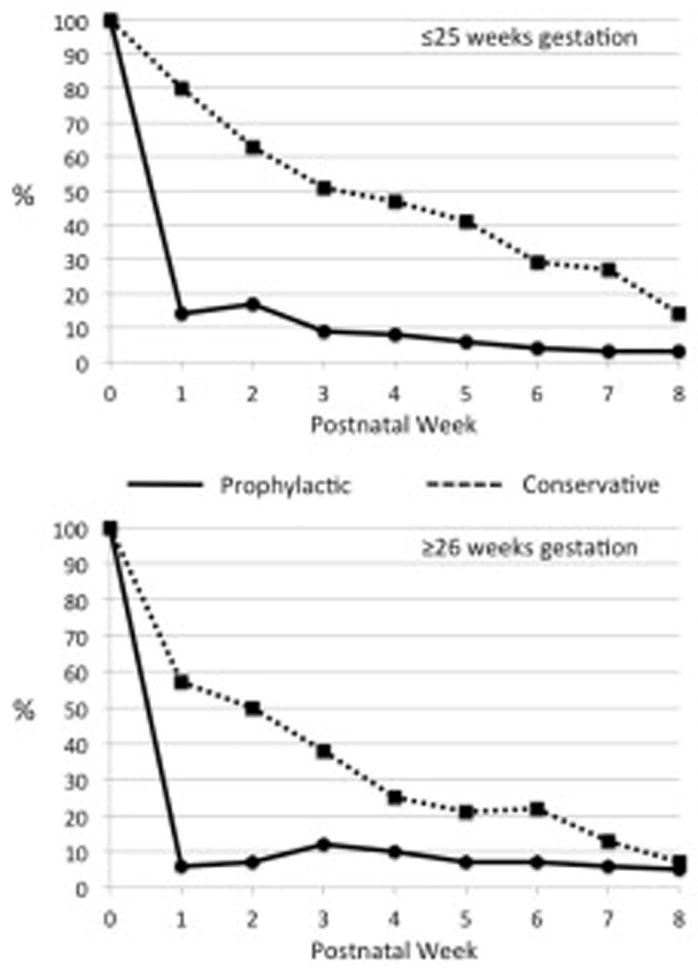
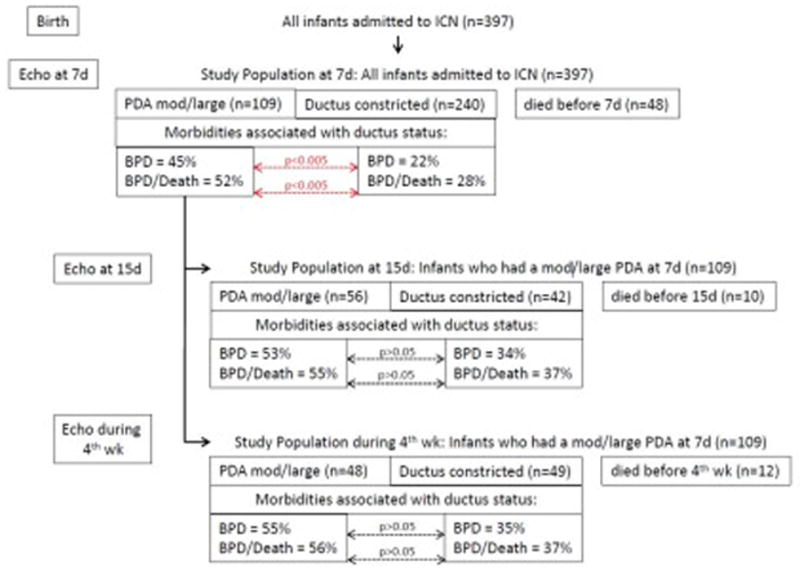
Results: The incidence of moderate-to-large PDA on day 7 and duration of exposure to moderate-to-large PDA were significantly less in the PINDO epoch (incidence = 10%, median = 2 days) than the conservative epoch (incidence = 67%, median = 14 days). Ligation rates were low in both epochs (PINDO = 14%, conservative = 5%). In multivariate analyses, PINDO infants had a significantly lower incidence of bronchopulmonary dysplasia (BPD) (risk ratio = 0.68, CI: 0.46-0.89) and BPD or death (risk ratio= 0.78, CI: 0.62-0.95) than conservative infants. There were no differences between the epochs in death, intraventricular hemorrhage grades 3 and 4, necrotizing enterocolitis, or retinopathy of prematurity receiving treatment. The effects of PINDO on BPD and BPD or death were no longer significant when analyses were adjusted for presence of a moderate-to-large PDA on day 7. The significant effects of PINDO were independent of whether or not a ligation was performed.
Conclusions: PINDO decreases BPD and BPD or death compared with delayed conservative PDA management. These effects are mediated by closure of the PDA.
Keywords: bronchopulmonary dysplasia; necrotizing enterocolitis; newborn; premature birth; retinopathy of prematurity.
Copyright © 2017 Elsevier Inc. All rights reserved.
Figures
Comment in
-
Prophylactic Indomethacin-Is It Time to Reconsider?J Pediatr. 2017 Aug;187:8-10. doi: 10.1016/j.jpeds.2017.04.066. Epub 2017 May 25. J Pediatr. 2017. PMID: 28552451 No abstract available.
References
-
- Al Faleh K, Smyth J, Roberts R, Solimano A, Asztalos E, Schmidt B. Prevention and 18-month outcome of serious pulmonary hemorrhage in extremely low birth weight infants: results from the triall of indomethacin prophylaxis in preterms. Pediatrics. 2008;121(2):e233–8. - PubMed
-
- Kluckow M, Jeffery M, Gill A, Evans N. A randomised placebo-controlled trial of early treatment of the patent ductus arteriosus. Arch Dis Child Fetal Neonatal Ed. 2014;99(2):F99–F104. - PubMed
-
- Aranda JV, Clyman R, Cox B, Van Overmeire B, Wozniak P, Sosenko I, et al. A randomized, double-blind, placebo-controlled trial on intravenous ibuprofen L-lysine for the early closure of nonsymptomatic patent ductus arteriosus within 72 hours of birth in extremely low-birth-weight infants. Am J Perinatol. 2009;26(3):235–45. - PubMed
Publication types
MeSH terms
Substances
Grants and funding
LinkOut - more resources
Full Text Sources
Other Literature Sources
Medical
Miscellaneous
