. 2017 Jun 13;199(13):e00135-17.
doi: 10.1128/JB.00135-17. Print 2017 Jul 1.

Association of the Cold Shock DEAD-Box RNA Helicase RhlE to the RNA Degradosome in Caulobacter crescentus

Affiliations

Association of the Cold Shock DEAD-Box RNA Helicase RhlE to the RNA Degradosome in Caulobacter crescentus

Angel A Aguirre et al. J Bacteriol. .

Abstract

In diverse bacterial lineages, multienzyme assemblies have evolved that are central elements of RNA metabolism and RNA-mediated regulation. The aquatic Gram-negative bacterium Caulobacter crescentus, which has been a model system for studying the bacterial cell cycle, has an RNA degradosome assembly that is formed by the endoribonuclease RNase E and includes the DEAD-box RNA helicase RhlB. Immunoprecipitations of extracts from cells expressing an epitope-tagged RNase E reveal that RhlE, another member of the DEAD-box helicase family, associates with the degradosome at temperatures below those optimum for growth. Phenotype analyses of rhlE, rhlB, and rhlE rhlB mutant strains show that RhlE is important for cell fitness at low temperature and its role may not be substituted by RhlB. Transcriptional and translational fusions of rhlE to the lacZ reporter gene and immunoblot analysis of an epitope-tagged RhlE indicate that its expression is induced upon temperature decrease, mainly through posttranscriptional regulation. RNase E pulldown assays show that other proteins, including the transcription termination factor Rho, a second DEAD-box RNA helicase, and ribosomal protein S1, also associate with the degradosome at low temperature. The results suggest that the RNA degradosome assembly can be remodeled with environmental change to alter its repertoire of helicases and other accessory proteins.IMPORTANCE DEAD-box RNA helicases are often present in the RNA degradosome complex, helping unwind secondary structures to facilitate degradation. Caulobacter crescentus is an interesting organism to investigate degradosome remodeling with change in temperature, because it thrives in freshwater bodies and withstands low temperature. In this study, we show that at low temperature, the cold-induced DEAD-box RNA helicase RhlE is recruited to the RNA degradosome, along with other helicases and the Rho protein. RhlE is essential for bacterial fitness at low temperature, and its function may not be complemented by RhlB, although RhlE is able to complement for rhlB loss. These results suggest that RhlE has a specific role in the degradosome at low temperature, potentially improving adaptation to this condition.

Keywords: Caulobacter crescentus; DEAD-box RNA helicase; RNA degradosome; RhlE; cold shock.


Figures

FIG 1
FIG 1
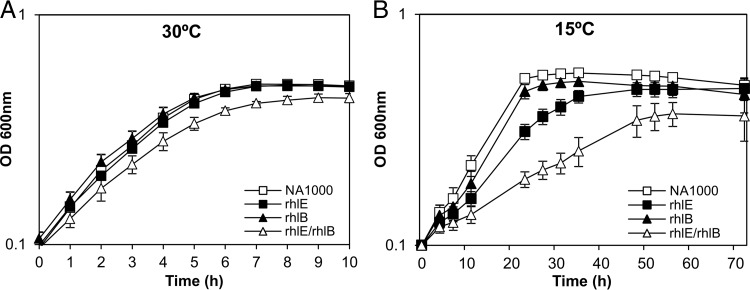
Growth of C. crescentus RNA helicase mutant strains at low temperature. The cultures were grown in PYE medium, and growth was monitored by measuring the OD at different time points. The following strains were used: NA1000, MM74 (rhlE), MM50 (rhlB), and MM82 (rhlE/rhlB). The curves are the means of the results from four experiments, and the standard deviation is indicated by vertical bars.
FIG 2
FIG 2
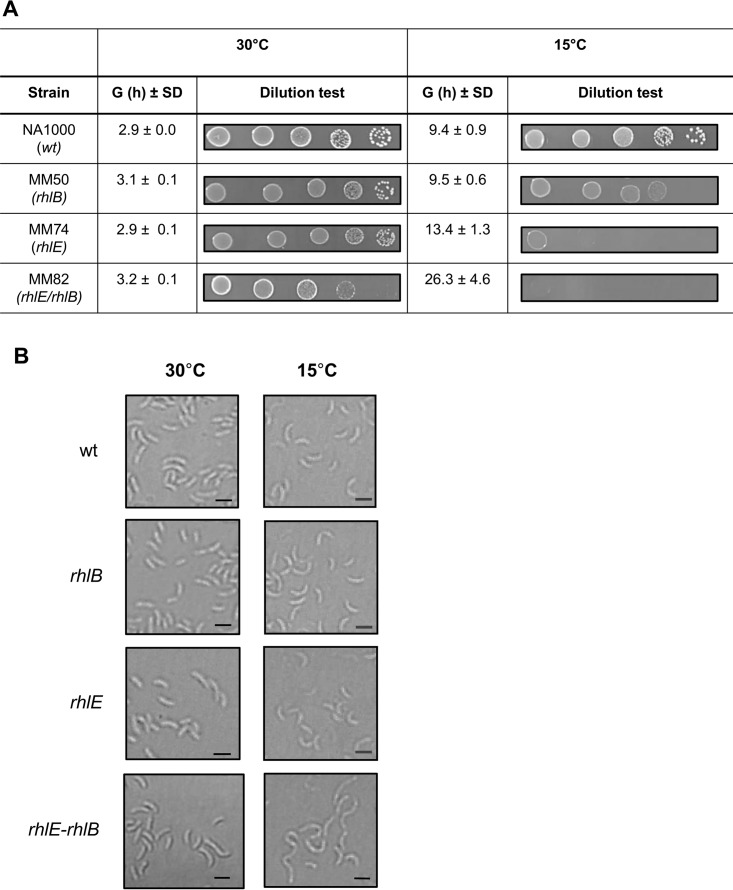
Cell viability and morphology of C. crescentus RNA helicase mutant strains at low temperature. (A) Serial dilutions of the cultures at an OD of 0.1 (10−1 to 10−5 in 10 μl) were plated in PYE medium and plates were incubated at the indicated temperatures. All strains were incubated at 15°C for 5 days, except for MM82, which was incubated at 15°C for 8 days. The average generation times (G) for four replicates of each culture with the respective standard deviation (SD) are indicated. (B) Cultures were grown in PYE medium at either 30°C or 15°C up to mid-log phase, and the cell morphology was evaluated by light microscopy. The strains used are as follows: NA1000 (wt), MM50 (rhlB), MM74 (rhlE), and MM82 (rhlE-rhlB). Bars indicate 2 μm.
FIG 3
FIG 3
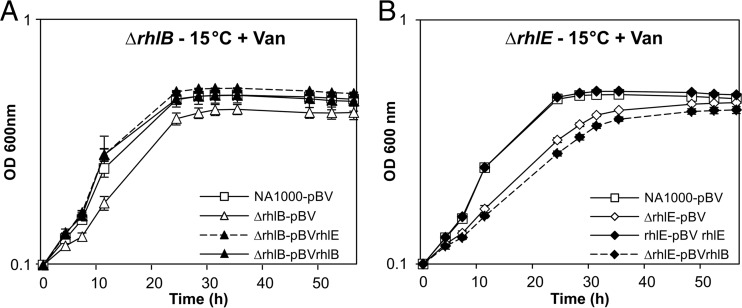
Complementation of C. crescentus mutant growth deficiency at low temperature. ΔrhlB (MM50) (A) and rhlE::mini-Tn5 (MM74) (B) mutant strains harboring either the empty vector pBV-MCS4 (pBV) or the vector containing a copy of the indicated gene were grown in PYE-gentamicin medium containing 0.5 mM vanillate (Van) at 15°C, and growth was monitored by measuring the OD at different time points. The wild-type NA1000 strain harboring the empty vector pBV-MCS4 (NA1000-pBV) was included as a control. The curves represent the means of results from three experiments, and the standard deviation is indicated by vertical bars.
FIG 4
FIG 4
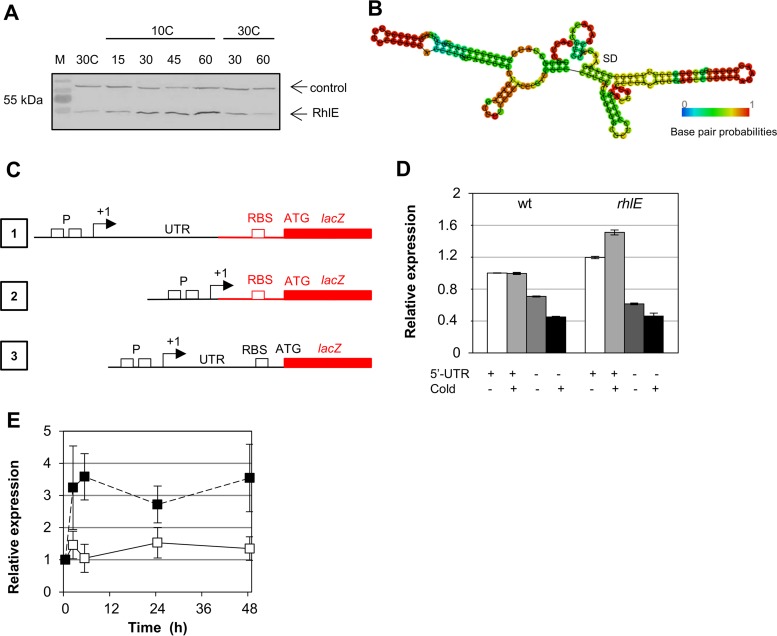
Regulation of RhlE in response to low temperature. (A) C. crescentus strain MM84, containing a tagged FLAG-RhlE protein, was incubated at 30°C to mid-log phase and then transferred to 10°C for 1 h. After this time, the culture was returned to 30°C for 2 h. Aliquots were taken at the indicated times, and protein accumulation was evaluated sequentially by immunoblotting using an anti-FLAG antibody and the anti-Fur antiserum. The arrows indicate the RhlE protein and a nonspecific protein that reacts with the anti-Fur serum as a control. M, prestained molecular mass marker. (B) Minimal free energy prediction of secondary structure of the rhlE 5′ UTR. (C) Schematic representation of the transcriptional and translational fusions to lacZ: 1, transcriptional fusion in pRKlacZ290 containing the promoter region (P) and the 5′ UTR; 2, transcriptional fusion in pRKlacZ290 containing only the promoter region; 3, translational fusion in pJBZ281 containing the promoter region, the 5′ UTR, the ribosome binding site (RBS), and the first codon of RhlE fused to lacZ in frame. In black are the elements that came from the rhlE locus, and in red are the vector sequences. (D) Expression of transcriptional fusions of the rhlE promoter in the presence or absence of the 5′ UTR to the lacZ reporter gene. Cultures were grown at 30°C to mid-log phase and then incubated at 10°C for 6 h, and expression was determined by β-galactosidase activity assays at these times. Results shown are the means of results from two experiments, and the range is indicated by vertical bars. (E) C. crescentus NA1000 harboring a translational fusion of the rhlE promoter and 5′ UTR to the lacZ reporter gene was grown at 30°C up to mid-log phase. Culture samples continued to grow at 30°C (white squares) or were incubated at 10°C (black squares), and expression was determined by β-galactosidase activity assays at the times indicated. Results shown are the means of results from two experiments, and standard deviation is indicated by vertical bars.
FIG 5
FIG 5
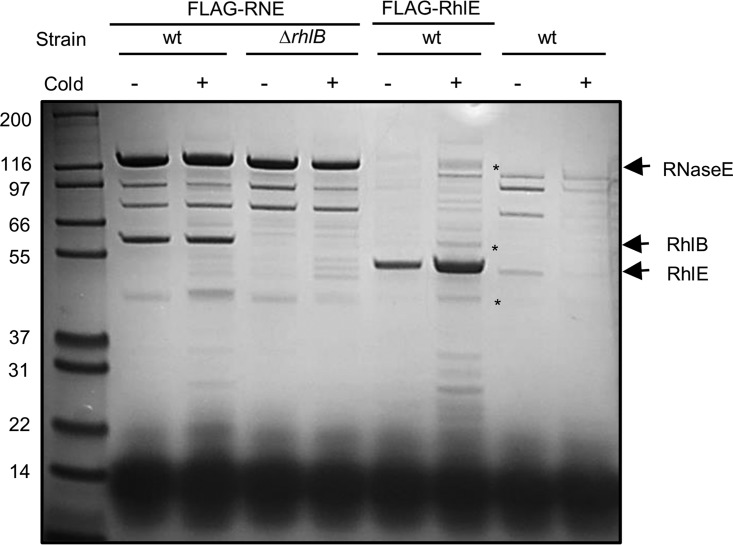
Participation of RhlE in the C. crescentus RNA degradosome. Cultures of C. crescentus were grown at either 30°C (cold−) or 15°C (cold+) up to mid-log phase, and RNA degradosomes were isolated. The strains used were NA1000 (wt) and MM71 (ΔrhlB) containing FLAG-tagged RNase E (FLAG-RNE), MM84 (NA1000 containing FLAG-tagged RhlE), and NA1000 with no tagged proteins as a negative control. Asterisks indicate components of C. crescentus degradosome identified by mass spectrometry that copurified with FLAG-RhlE: RNase E, RhlB, and methionine adenosyltransferase, respectively, from top down.
FIG 6
FIG 6
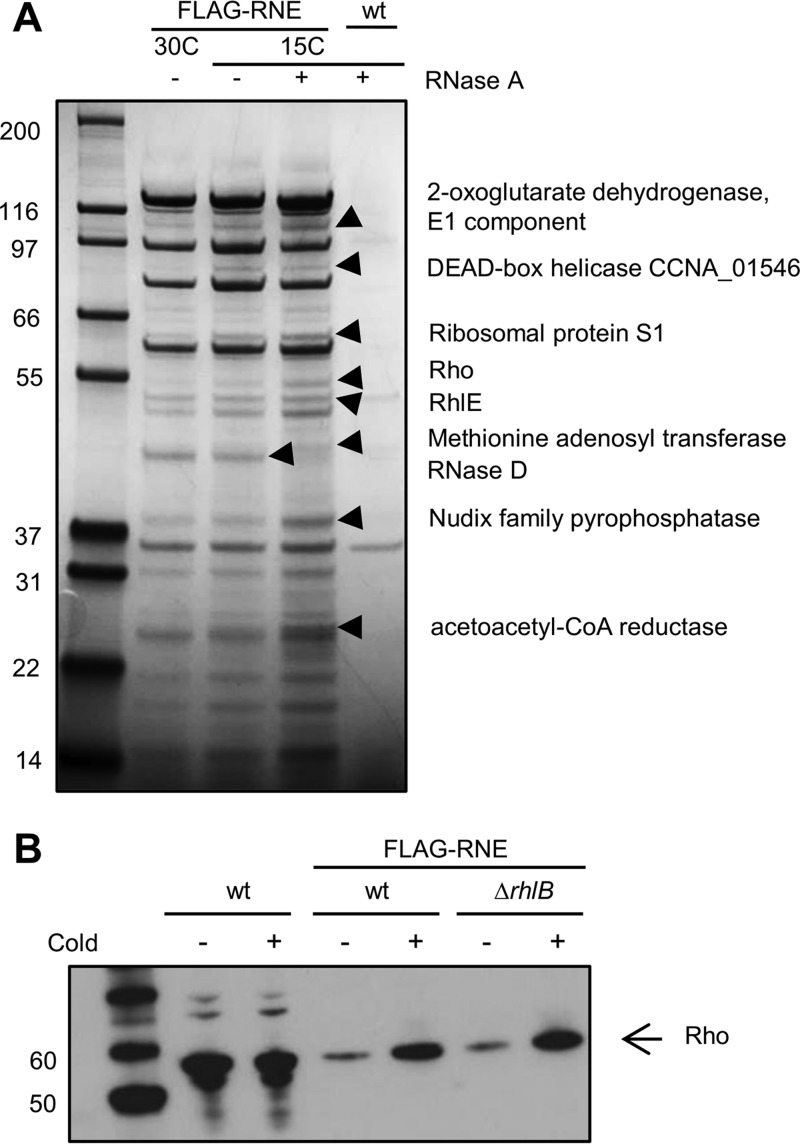
Characterization of proteins associated with the C. crescentus RNA degradosome at low temperature. (A) Cultures of C. crescentus were grown at either 30°C or 15°C up to mid-log phase, and RNA degradosomes were isolated. The strains used were NA1000 containing FLAG-tagged RNase E (FLAG-RNE) and NA1000 with no tagged proteins (wt) as a negative control. The proteins indicated by arrowheads were identified by mass spectrometry. (B) Association of Rho with the C. crescentus RNA degradosome. Cultures of C. crescentus were grown at either 30°C (cold−) or 15°C (cold+) up to mid-log phase, and proteins from total cell extracts or isolated RNA degradosomes were separated by SDS-PAGE. The proteins were transferred to a PVDF membrane, and the Rho protein was identified by immunoblotting with an anti-Rho serum. The samples used were total extract of NA1000 (wt) and isolated RNA degradosomes from NA1000 (wt) or MM71 (ΔrhlB) containing FLAG-tagged RNase E (FLAG-RNE).

References

    1. Phadtare S, Severinov K. 2010. RNA remodeling and gene regulation by cold shock proteins. RNA Biol 7:788–795. doi:10.4161/rna.7.6.13482. - DOI - PMC - PubMed
    1. Barria C, Malecki M, Arraiano CM. 2013. Bacterial adaptation to cold. Microbiology 159:2437–2443. doi:10.1099/mic.0.052209-0. - DOI - PubMed
    1. Kaberdin VR, Bläsi U. 2013. Bacterial helicases in post-transcriptional control. Biochim Biophys Acta 1829:878–883. doi:10.1016/j.bbagrm.2012.12.005. - DOI - PubMed
    1. Khemici V, Linder P. 2016. RNA helicases in bacteria. Curr Opin Microbiol 30:58–66. doi:10.1016/j.mib.2016.01.002. - DOI - PubMed
    1. Gorbalenya AE, Koonin EV. 1993. Helicases: amino acid sequence comparisons and structure-function relationships. Curr Opin Struct Biol 3:419–429. doi:10.1016/S0959-440X(05)80116-2. - DOI

Publication types

MeSH terms