


Eight-minute self-regulation intervention raises educational attainment at scale in individualist but not collectivist cultures
- PMID: 28396404
- PMCID: PMC5410783
- DOI: 10.1073/pnas.1611898114
Eight-minute self-regulation intervention raises educational attainment at scale in individualist but not collectivist cultures
Abstract
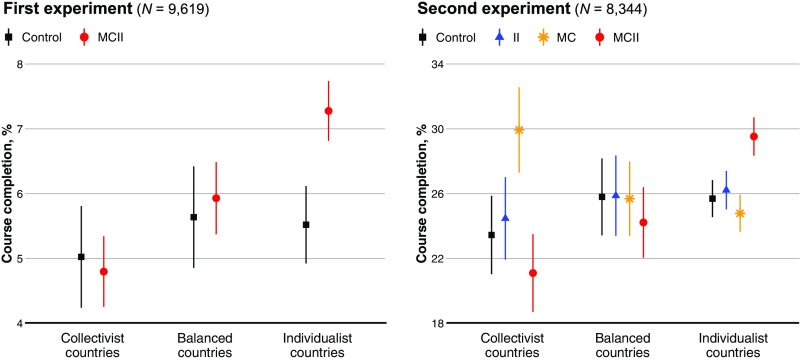
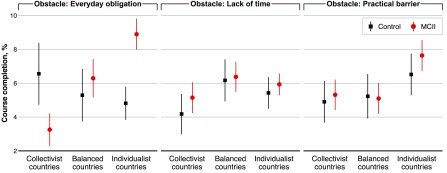
Academic credentials open up a wealth of opportunities. However, many people drop out of educational programs, such as community college and online courses. Prior research found that a brief self-regulation strategy can improve self-discipline and academic outcomes. Could this strategy support learners at large scale? Mental contrasting with implementation intentions (MCII) involves writing about positive outcomes associated with a goal, the obstacles to achieving it, and concrete if-then plans to overcome them. The strategy was developed in Western countries (United States, Germany) and appeals to individualist tendencies, which may reduce its efficacy in collectivist cultures such as India or China. We tested this hypothesis in two randomized controlled experiments in online courses (n = 17,963). Learners in individualist cultures were 32% (first experiment) and 15% (second experiment) more likely to complete the course following the MCII intervention than a control activity. In contrast, learners in collectivist cultures were unaffected by MCII. Natural language processing of written responses revealed that MCII was effective when a learner's primary obstacle was predictable and surmountable, such as everyday work or family obligations but not a practical constraint (e.g., Internet access) or a lack of time. By revealing heterogeneity in MCII's effectiveness, this research advances theory on self-regulation and illuminates how even highly efficacious interventions may be culturally bounded in their effects.
Keywords: culture; education; field experiment; goal pursuit; motivation.
Conflict of interest statement
The authors declare no conflict of interest.
Figures
References
-
- Kena G, et al. 2015. The Condition of Education 2015 (US Department of Education, National Center for Education Statistics, Washington, DC), NCES 2015-144, pp 234–237.
-
- Shah D. 2015 MOOCs in 2015: Breaking down the numbers. EdSurge. Available at https://www.edsurge.com/news/2015-12-28-moocs-in-2015-breaking-down-the-.... Accessed June 1, 2016.
-
- Kizilcec RF, Schneider E. Motivation as a lens to understand online learners: Toward data-driven design with the OLEI scale. ACM Trans Comput Hum Interact. 2015;22(2):6.
-
- Waldrop MM. Online learning: Campus 2.0. Nature. 2013;495(7440):160–163. - PubMed
-
- Kizilcec RF, Piech C, Schneider E. Proceedings of the Third International Conference on Learning Analytics and Knowledge, LAK 2013, Leuven, Belgium. ACM; New York: 2013. Deconstructing disengagement: Analyzing learner subpopulations in massive open online courses; pp. 170–179.
Publication types
MeSH terms
LinkOut - more resources
Full Text Sources
Other Literature Sources
Medical
