


Aortic-Brachial Arterial Stiffness Gradient and Cardiovascular Risk in the Community: The Framingham Heart Study
- PMID: 28396534
- PMCID: PMC5426958
- DOI: 10.1161/HYPERTENSIONAHA.116.08917
Aortic-Brachial Arterial Stiffness Gradient and Cardiovascular Risk in the Community: The Framingham Heart Study
Abstract
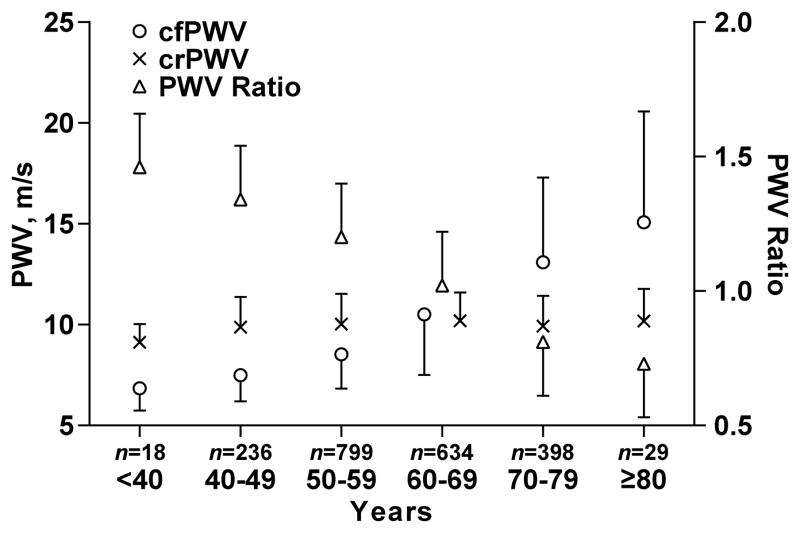
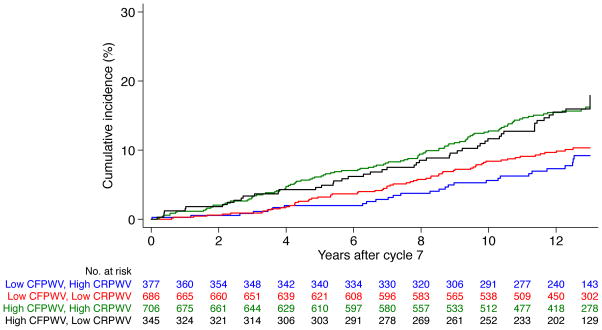
A recent study reported that the aortic-brachial arterial stiffness gradient, defined as carotid-radial/carotid-femoral pulse wave velocity (PWV ratio), predicts all-cause mortality better than carotid-femoral pulse wave velocity (CFPWV) alone in dialysis patients. However, the prognostic significance of PWV ratio for cardiovascular disease (CVD) in the community remains unclear. Accordingly, we assessed the correlates and prognostic value of the PWV ratio in 2114 Framingham Heart Study participants (60±10 years; 56% women) free of overt CVD. Mean PWV ratio decreased from 1.36±0.19 in participants aged <40 years to 0.73±0.21 in those aged ≥80 years. In multivariable linear regression, older age, male sex, higher body mass index, diabetes mellitus, lower high-density lipoprotein cholesterol, higher mean arterial pressure, and higher heart rate were associated with lower PWV ratio (P<0.001 for all). During a median follow-up of 12.6 years, 248 first CVD events occurred. In Cox regression models adjusted for standard CVD risk factors, 1-SD changes in CFPWV (hazard ratio, 1.33; 95% confidence interval, 1.10-1.61) and PWV ratio (hazard ratio, 1.32; 95% confidence interval, 1.09-1.59) were associated with similar CVD risks. Models that included conventional CVD risk factors plus CFPWV or PWV ratio gave the same C statistics (C=0.783). Although PWV ratio has been reported to provide incremental predictive value over CFPWV in dialysis patients, we could not replicate these findings in our community-based sample. Our findings suggest that the prognostic significance of PWV ratio may vary based on baseline CVD risk, and CFPWV should remain the criterion standard for assessing vascular stiffness in the community.
Keywords: blood pressure; cardiovascular diseases; epidemiology; hypertension; risk factors; vascular stiffness.
© 2017 American Heart Association, Inc.
Figures
References
-
- Avolio AP, Chen SG, Wang RP, Zhang CL, Li MF, O’Rourke MF. Effects of aging on changing arterial compliance and left ventricular load in a northern Chinese urban community. Circulation. 1983;68:50–58. - PubMed
-
- Pannier B, Guerin AP, Marchais SJ, Safar ME, London GM. Stiffness of capacitive and conduit arteries: prognostic significance for end-stage renal disease patients. Hypertension. 2005;45:592–596. - PubMed
-
- Mitchell GF, Vita JA, Larson MG, Parise H, Keyes MJ, Warner E, Vasan RS, Levy D, Benjamin EJ. Cross-sectional relations of peripheral microvascular function, cardiovascular disease risk factors, and aortic stiffness: the Framingham Heart Study. Circulation. 2005;112:3722–3728. - PubMed
-
- McEniery CM, McDonnell BJ, So A, Aitken S, Bolton CE, Munnery M, Hickson SS, Yasmin, Maki-Petaja KM, Cockcroft JR, Dixon AK, Wilkinson IB Anglo-Cardiff Collaboration Trial Investigators. Aortic calcification is associated with aortic stiffness and isolated systolic hypertension in healthy individuals. Hypertension. 2009;53:524–531. - PubMed
-
- Kimoto E, Shoji T, Shinohara K, Inaba M, Okuno Y, Miki T, Koyama H, Emoto M, Nishizawa Y. Preferential stiffening of central over peripheral arteries in type 2 diabetes. Diabetes. 2003;52:448–452. - PubMed
Publication types
MeSH terms
Grants and funding
- R01 HL071039/HL/NHLBI NIH HHS/United States
- R01 HL092577/HL/NHLBI NIH HHS/United States
- N01 HC025195/HC/NHLBI NIH HHS/United States
- R01 HL060040/HL/NHLBI NIH HHS/United States
- R01 HL077447/HL/NHLBI NIH HHS/United States
- N01 HC025195/HL/NHLBI NIH HHS/United States
- HHSN268201500001I/HL/NHLBI NIH HHS/United States
- R01 HL080124/HL/NHLBI NIH HHS/United States
- R01 HL070100/HL/NHLBI NIH HHS/United States
- R01 HL126136/HL/NHLBI NIH HHS/United States
- HHSN268201500001C/HL/NHLBI NIH HHS/United States
- R01 HL107385/HL/NHLBI NIH HHS/United States
LinkOut - more resources
Full Text Sources
Other Literature Sources
