Review
. 2017 Oct 1;27(10):684-712.
doi: 10.1089/ars.2017.7083. Epub 2017 Jun 6.

The Reactive Species Interactome: Evolutionary Emergence, Biological Significance, and Opportunities for Redox Metabolomics and Personalized Medicine

Affiliations
Review

The Reactive Species Interactome: Evolutionary Emergence, Biological Significance, and Opportunities for Redox Metabolomics and Personalized Medicine

Miriam M Cortese-Krott et al. Antioxid Redox Signal. .

Abstract

Significance: Oxidative stress is thought to account for aberrant redox homeostasis and contribute to aging and disease. However, more often than not, administration of antioxidants is ineffective, suggesting that our current understanding of the underlying regulatory processes is incomplete. Recent Advances: Similar to reactive oxygen species and reactive nitrogen species, reactive sulfur species are now emerging as important signaling molecules, targeting regulatory cysteine redox switches in proteins, affecting gene regulation, ion transport, intermediary metabolism, and mitochondrial function. To rationalize the complexity of chemical interactions of reactive species with themselves and their targets and help define their role in systemic metabolic control, we here introduce a novel integrative concept defined as the reactive species interactome (RSI). The RSI is a primeval multilevel redox regulatory system whose architecture, together with the physicochemical characteristics of its constituents, allows efficient sensing and rapid adaptation to environmental changes and various other stressors to enhance fitness and resilience at the local and whole-organism level.

Critical issues: To better characterize the RSI-related processes that determine fluxes through specific pathways and enable integration, it is necessary to disentangle the chemical biology and activity of reactive species (including precursors and reaction products), their targets, communication systems, and effects on cellular, organ, and whole-organism bioenergetics using system-level/network analyses.

Future directions: Understanding the mechanisms through which the RSI operates will enable a better appreciation of the possibilities to modulate the entire biological system; moreover, unveiling molecular signatures that characterize specific environmental challenges or other forms of stress will provide new prevention/intervention opportunities for personalized medicine. Antioxid. Redox Signal. 00, 000-000.

Keywords: hydrogen sulfide; microbiome; network medicine; nitric oxide; polysulfides; systems biology.


Conflict of interest statement

M.F. is a member of the Scientific Advisory Board of AOBiome, LLC, a company commercializing the use of ammonia-oxidizing bacteria for the treatment of inflammatory skin diseases and hypertension. None of the other authors have any conflict of interests to declare.

Figures
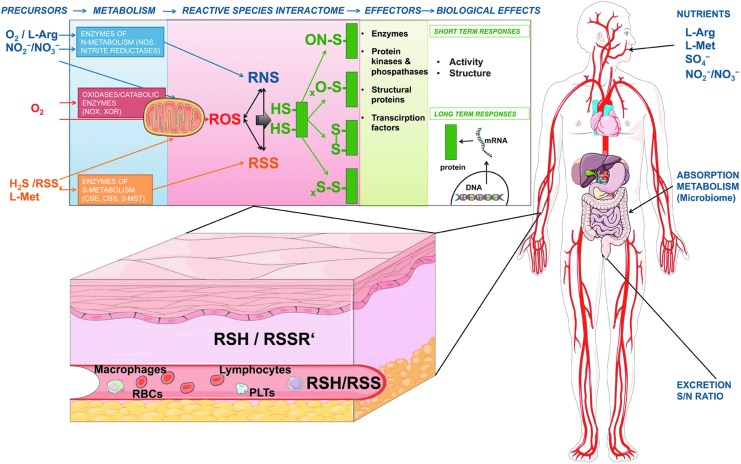
<b>FIG. 1.</b>
FIG. 1.
Intracellular, extracellular, and interorgan/systemic role of the RSI. Precursors of the RSI are organic and inorganic substrates and cofactors, including amino acids (e.g., arginine, methionine), vitamins (B6, B12, C), and xanthine, as well as oxygen, nitrite, polysulfides, thiosulfate, and sulfate, which are transformed by mitochondrial or cytoplasmic enzymes into ROS, RNS, and RSS. The chemical interactions among ROS, RNS, and RSS lead to formation of a number of products with different reactivities, stabilities, half-lives, and therefore different lifetimes defined by their physicochemical properties, covering a wide range of maximal travel distances. A common target of the RSI are cysteine thiols in proteins, acting as redox switches, able to fine-tune activity of signaling molecules, and leading to short-term responses (e.g., protein kinases and phosphatases inducing changes in signaling and glucose metabolism) or long-term adaptation (by modifying redox switches responsible for gene expression regulation, such as the HIF, NFkB, and Keap1/Nrf2 pathways). The RSI serves also as a local and systemic heterocellular communication system mediated by actions of longer-lasting products of the RSI (e.g., nitrite, polysulfides) and circulating thiols. The nutritional and physiological status of the organism affects the RSI by reciprocally regulating precursor availability, metabolism, signaling, and mitochondrial function. RNS, reactive nitrogen species; ROS, reactive oxygen species; RSS, reactive sulfur species.
<b>FIG. 2.</b>
FIG. 2.
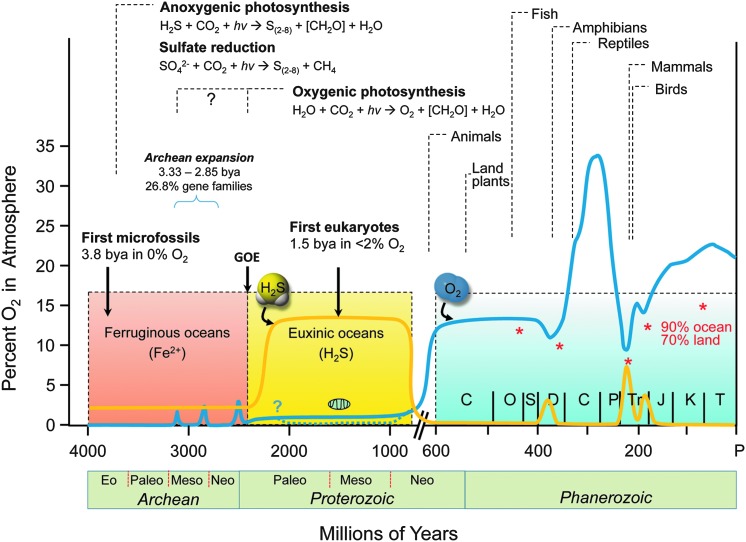
Evolution of sulfur and oxygen metabolism. The lines indicate fluctuations in concentration of atmospheric oxygen (blue) and oceanic sulfide (orange) over evolutionary times. Atmospheric O2 was essentially absent from the environment at the onset of life ∼3.8 bya. After the great oxidation event (GOE), the concentration of O2 in the atmosphere increased, which was accompanied by a substantial increase in H2S. The first eukaryotes appeared in oceans and developed in anoxic and sulfidic (euxinic) conditions for hundreds of millions of years using sulfur as their energy source, producing RSS. During this time, defense mechanisms against RSS evolved, improving cell survival and minimizing the need for repair of damaged cell constituents. Appearance of oxygenic cyanobacteria and plants led to increases in O2 levels and oxidation of H2S and Fe2+ ∼0.6 bya. Those changes were accompanied by a significant decrease in dissolved H2S and a repurposing of enzymatic systems that originally evolved to protect organisms against RSS to serve additional antioxidative protective functions. Mass extinctions (*, percentage of marine and land life) were often associated with a fall in ambient O2 and increases in H2S, perhaps providing a biological filter for descendants that retained some degree of tolerance to hypoxia and sulfide. Modified with permission from Olson and Straub (139). bya, billion years ago; H2S, hydrogen sulfide.
<b>FIG. 3.</b>
FIG. 3.
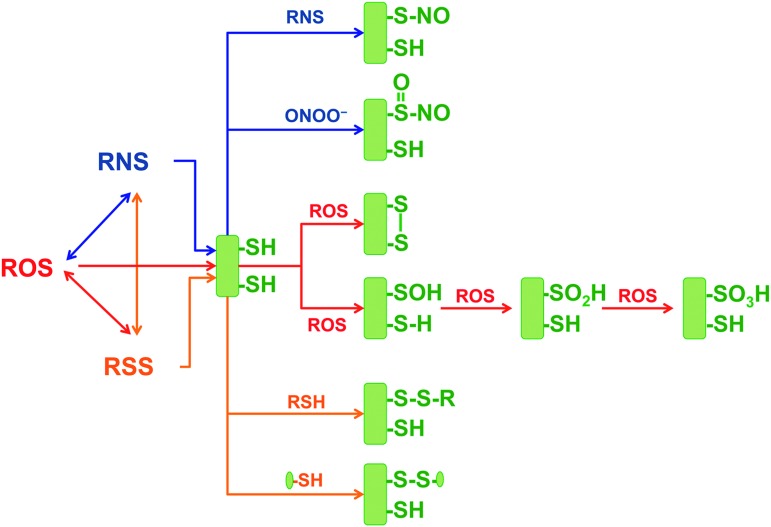
Cysteine modifications induced by interaction with ROS, RNS, and RSS. The reactive species interactome consists of the interaction of reactive species (ROS, RNS, and RSS) with one another and with cysteine thiols as redox switches (reactions with other functional groups omitted here for the sake of simplicity). The outcome of these interactions depends on the chemical characteristics of the species inducing the modification (e.g., O2•−, H2O2, NO, ONOO) and their fluxes and the environmental conditions (e.g., pO2, pH), as well as on the reactivity and localization of the targeted cysteines. The lines indicate the outcome of protein cysteine modifications induced by RNS (blue), ROS (red), or RSS (orange).
<b>FIG. 4.</b>
FIG. 4.
Metabolic pathways fueling the RSI. In mammals, L-arginine is formed from citrulline, derived either from dietary glutamine or proline via ornithine and carbamoylphosphate in the mitochondria or from bicarbonate (HCO3) and ammonia (NH3) via the hepatic urea cycle. Citrulline is then transported via the blood to the kidney where it is converted into arginine. Arginine used for protein formation and (O2-dependent) NO synthesis can be recycled via the arginine/citrulline cycle. NOS activity is inhibited by different methylated arginine residues released by proteolysis (e.g., ADMA). A key interaction between nitrogen and sulfur metabolism is the methylation of arginine using SAM-dependent methyltransferases. SAM is a cofactor produced from methionine and used for methylation of a large number of biomolecules; in the methionine recycling pathway, the removal of one methyl group (-CH3) results in the formation of homocysteine. Depending on the availability of methionine, homocysteine is either recycled to methionine with the help of vitamin B12 and folic acid or is degraded to cystathionine and cysteine. While the latter also serves as precursor of cellular glutathione production, both compounds can generate H2S in the transsulfuration pathway. Not shown here is the formation of ROS via NADPH oxidases, the mitochondrial respiratory chain, and other sources. See Supplementary Figure S1 for more details. ADMA, asymmetric dimethylarginine; NOS, nitric oxide synthases; SAH, S-adenosyl-homocysteine; SAM, S-adenosyl-methionine.
<b>FIG. 5.</b>
FIG. 5.
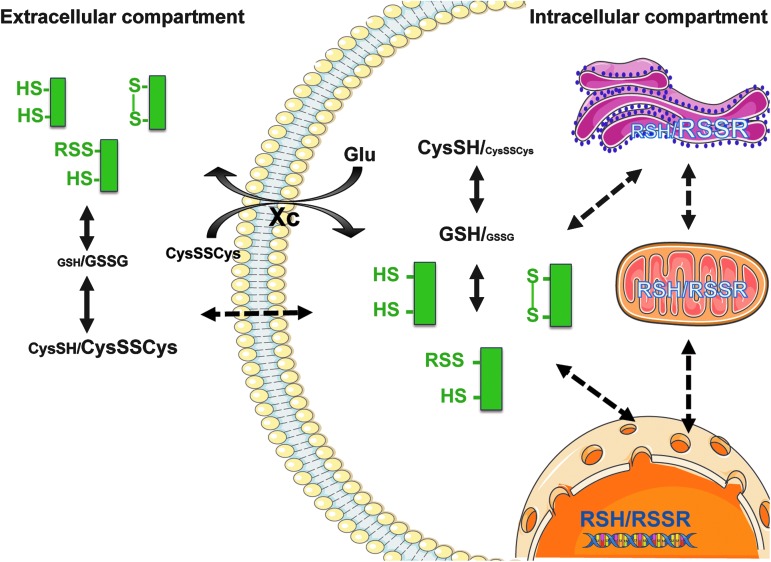
Thiol transport between cell organelles and exchange between the intra- and extracellular compartments. In human plasma, aminothiols such as cysteine, homocysteine, and glutathione exist in free (reduced and oxidized) and protein-bound form, but little is known about the dynamics of their regulation and relationship with each other. As documented for cysteine and glutathione, aminothiols are transported across cell membranes and exchanged between cell organelles, with specific transporters such as the cystine (CysSSCys)/glutamate (Glu) antiporter (Xc), which plays an important role in the regulation of cell surface redox. Continuous arrows indicate known relationships, interrupted arrows represent unknown relationships. In both the intracellular and extracellular compartments, protein thiols represent the main pool of sulfhydryl (-SH) groups. (Note that different font sizes in the figure denote relative concentrations and that mixed disulfides of low-molecular-weight thiols and post-translational thiol modifications are omitted here for the sake of simplicity.) The cytosol is considerably more reduced compared with the extracellular space or the endoplasmic reticulum (where proper protein folding requires more oxidizing conditions). The redox couples, cysteine/cystine, GSH/GSSG, and protein-bound thiols, are not in equilibrium with each other, which suggests the involvement of specific enzyme systems that determine the steady-state levels of these species. Maintaining disequilibria requires energy, and energy tends to be allocated according to criteria that confer robustness of organisms along the evolutionary selection process. First steps into the direction of decoding what determines ATP utilization hierarchies at a systems level are being taken, but the mechanisms of regulation of systemic thiol/disulfide status remain largely obscure. Considering the inverse association of free thiols with risk of death, a further assessment of these relationships and their significance for the cellular stress responses, DNA repair processes, and other hard clinical endpoints seems to be justified. However, no number of observational studies will ever be able to establish causality; this will require prospective and interventional studies.
<b>FIG. 6.</b>
FIG. 6.
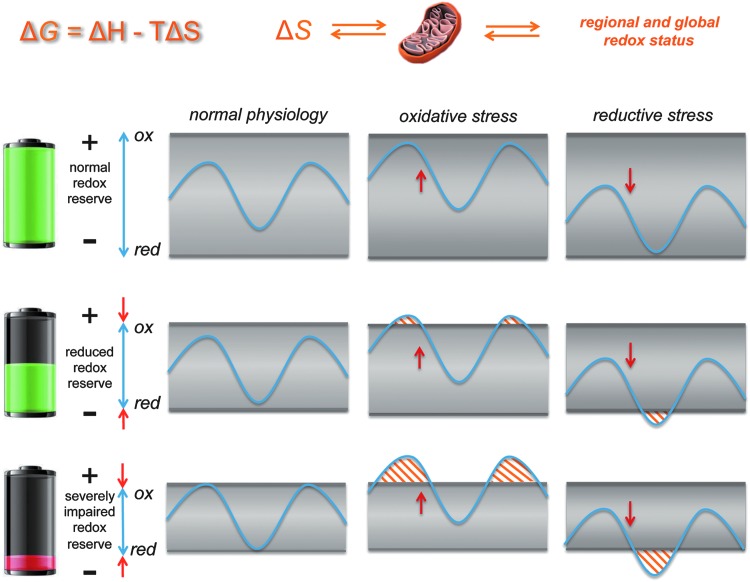
Simplified scheme visualizing the consequences of a reduced redox buffering capacity (redox reserve) due to bioenergetic limitations. Under normal physiological conditions, extracellular redox poise is subject to diurnal variations, fluctuating between more reducing (−) and more oxidizing (+) conditions (12). The capacity of a cell/organism to deal with changes in reductive and oxidative load is intimately linked to mitochondrial function. Enhanced mitochondrial activity is associated with higher oxidative stress, which affects the redox status of the local tissue microenvironment, while the activity of the mitochondrial respiratory chain itself and mitochondrial intermediary metabolism are modulated by the local and global redox status (upper cartoon). An adequate bioenergetic reserve capacity allows redox stresses (oxidative stress induced by, for example, strenuous physical activity or reductive stress due to chronic overfeeding) into either direction to be comfortably accommodated without incurring damage to cellular constituents (upper panels); physiological redox fluctuations experienced in daily life situations are well within the normal buffering capacity. Mitochondrial dysfunction leads to impaired cellular bioenergetics, resulting in narrowing of a cell's or an organism's ability to buffer redox stresses, inflicting damage and/or compromising adaptive capacities (middle panels), which can result in severe impairment of redox regulatory events upon further bioenergetic challenge (lower panels). Under these conditions, significant damage may be inflicted (shaded areas), demanding the allocation of additional energy to cellular repair processes. According to these relationships, chronic stress triggers a vicious cycle that can lead to a condition associated with severely limited redox reserve capacity, compromising cellular surveillance and repair mechanisms and inviting cascading network failures. This notion is consistent with the links of AMP-activated protein kinase and aberrant mitochondrial gene expression with cellular stress, aging/degenerative processes and immune processes (186), molecular system energetics (159, 160) in general, and the emerging concept of bioenergetic health, where redox biology controls the interface between bioenergetics, autophagy, and circadian control of metabolism (29, 209). See also Box 7.

References

    1. Aragones J, Fraisl P, Baes M, and Carmeliet P. Oxygen sensors at the crossroad of metabolism. Cell Metab 9: 11–22, 2009 - PubMed
    1. Bailey TS, Henthorn HA, and Pluth MD. The intersection of NO and H2S: persulfides generate NO from nitrite through polysulfide formation. Inorg Chem 55: 12618–12625, 2016 - PubMed
    1. Banne AF, Amiri A, and Pero RW. Reduced level of serum thiols in patients with a diagnosis of active disease. J Anti Aging Med 6: 327–334, 2003 - PubMed
    1. Bao XR, Ong S-E, Goldberger O, Peng J, Sharma R, Thompson DA, Vafai SB, Cox AG, Marutani E, and Ichinose F. Mitochondrial dysfunction remodels one-carbon metabolism in human cells. Elife 5: e10575, 2016 - PMC - PubMed
    1. Basudhar D, Ridnour LA, Cheng R, Kesarwala AH, Heinecke J, and Wink DA. Biological signaling by small inorganic molecules. Coord Chem Rev 306: 708–723, 2016 - PMC - PubMed