


Therapeutic Potential of Targeting the Ghrelin Pathway
- PMID: 28398233
- PMCID: PMC5412382
- DOI: 10.3390/ijms18040798
Therapeutic Potential of Targeting the Ghrelin Pathway
Abstract
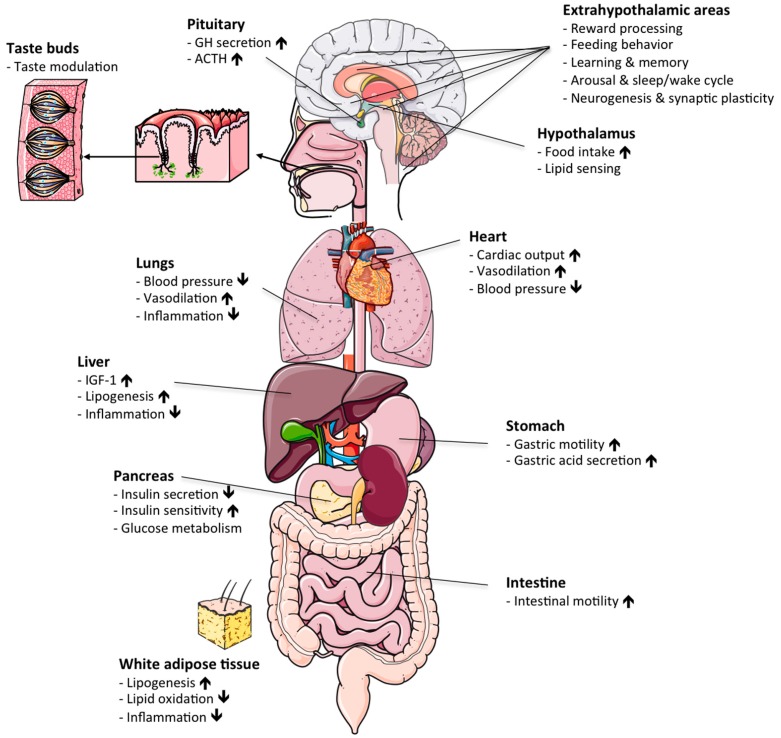
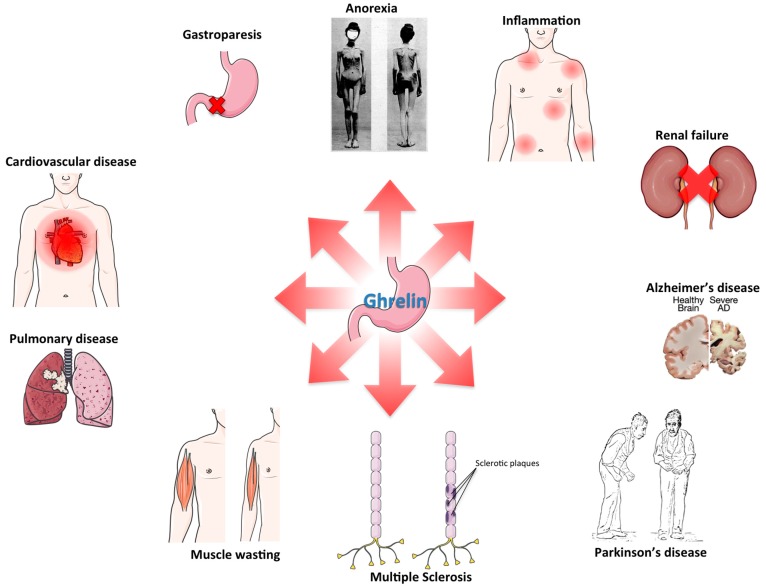
Ghrelin was discovered in 1999 as the endogenous ligand of the growth-hormone secretagogue receptor 1a (GHSR1a). Since then, ghrelin has been found to exert a plethora of physiological effects that go far beyond its initial characterization as a growth hormone (GH) secretagogue. Among the numerous well-established effects of ghrelin are the stimulation of appetite and lipid accumulation, the modulation of immunity and inflammation, the stimulation of gastric motility, the improvement of cardiac performance, the modulation of stress, anxiety, taste sensation and reward-seeking behavior, as well as the regulation of glucose metabolism and thermogenesis. Due to a variety of beneficial effects on systems' metabolism, pharmacological targeting of the endogenous ghrelin system is widely considered a valuable approach to treat metabolic complications, such as chronic inflammation, gastroparesis or cancer-associated anorexia and cachexia. The aim of this review is to discuss and highlight the broad pharmacological potential of ghrelin pathway modulation for the treatment of anorexia, cachexia, sarcopenia, cardiopathy, neurodegenerative disorders, renal and pulmonary disease, gastrointestinal (GI) disorders, inflammatory disorders and metabolic syndrome.
Keywords: anorexia; ghrelin; inflammation; pathology; therapy.
Conflict of interest statement
The authors declare no conflict of interest.
Figures
References
-
- Blake A.D., Smith R.G. Desensitization studies using perifused rat pituitary cells show that growth hormone-releasing hormone and His-d-Trp-Ala-Trp-d-Phe-Lys-NH2 stimulate growth hormone release through distinct receptor sites. J. Endocrinol. 1991;129:11–19. doi: 10.1677/joe.0.1290011. - DOI - PubMed
Publication types
MeSH terms
Substances
LinkOut - more resources
Full Text Sources
Other Literature Sources
Medical
