


The development of a prediction tool to identify cancer patients at high risk for chemotherapy-induced nausea and vomiting
- PMID: 28398530
- PMCID: PMC5452068
- DOI: 10.1093/annonc/mdx100
The development of a prediction tool to identify cancer patients at high risk for chemotherapy-induced nausea and vomiting
Abstract
Background: Despite the availability of effective antiemetics and evidence-based guidelines, up to 40% of cancer patients receiving chemotherapy fail to achieve complete nausea and vomiting control. In addition to type of chemotherapy, several patient-related risk factors for chemotherapy-induced nausea and vomiting (CINV) have been identified. To incorporate these factors into the optimal selection of prophylactic antiemetics, a repeated measures cycle-based model to predict the risk of ≥ grade 2 CINV (≥2 vomiting episodes or a decrease in oral intake due to nausea) from days 0 to 5 post-chemotherapy was developed.
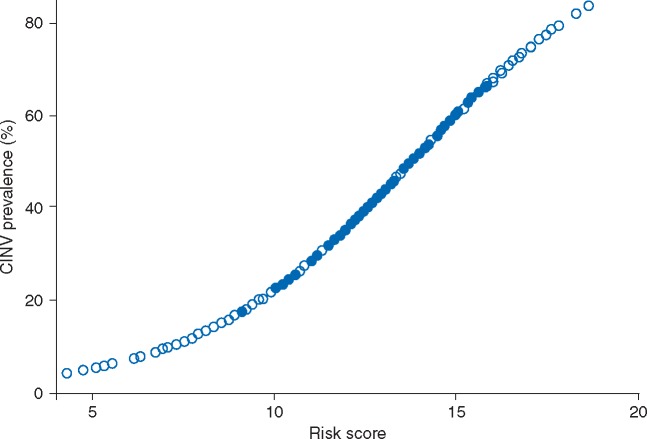
Patients and methods: Data from 1198 patients enrolled in one of the five non-interventional CINV prospective studies were pooled. Generalized estimating equations were used in a backwards elimination process with the P-value set at <0.05 to identify the relevant predictive factors. A risk scoring algorithm (range 0-32) was then derived from the final model coefficients. Finally, a receiver-operating characteristic curve (ROCC) analysis was done to measure the predictive accuracy of the scoring algorithm.
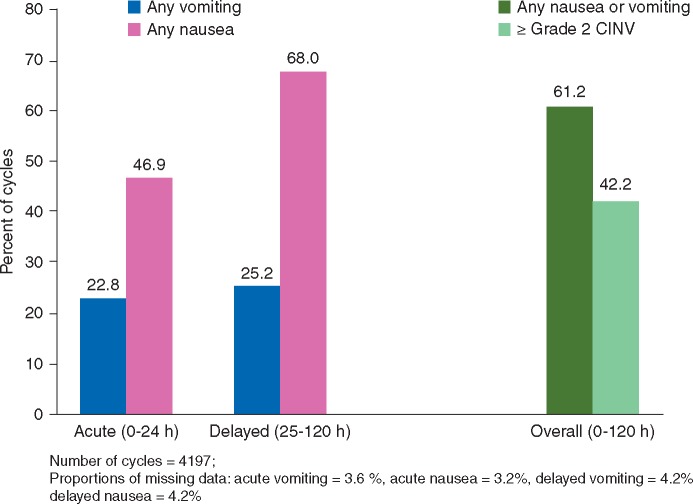
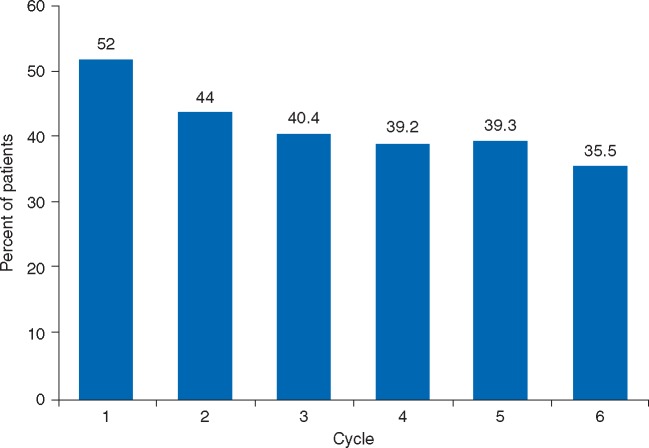
Results: Over 4197 chemotherapy cycles, 42.2% of patients experienced ≥grade 2 CINV. Eight risk factors were identified: patient age <60 years, the first two cycles of chemotherapy, anticipatory nausea and vomiting, history of morning sickness, hours of sleep the night before chemotherapy, CINV in the prior cycle, patient self-medication with non-prescribed treatments, and the use of platinum or anthracycline-based regimens. The ROC analysis indicated good predictive accuracy with an area-under-the-curve of 0.69 (95% CI: 0.67-0.70). Before to each cycle of therapy, patients with risk scores ≥16 units would be considered at high risk for developing ≥grade 2 CINV.
Conclusions: The clinical application of this prediction tool will be an important source of individual patient risk information for the oncology clinician and may enhance patient care by optimizing the use of the antiemetics in a proactive manner.
Keywords: CINV; cancer; emesis; nausea; prediction; risk.
© The Author 2017. Published by Oxford University Press on behalf of the European Society for Medical Oncology.
Figures
Comment in
-
Identifying predictive factors of chemotherapy-induced nausea and vomiting (CINV): a novel approach.Ann Oncol. 2017 Jun 1;28(6):1165-1167. doi: 10.1093/annonc/mdx120. Ann Oncol. 2017. PMID: 28398565 No abstract available.
References
-
- Kuchuk I, Bouganim N, Beusterien K. et al. Preference weights for chemotherapy side effects from the perspective of women with breast cancer. Breast Cancer Res Treat 2013; 142: 101–107. - PubMed
-
- Sun CC, Bodurka DC, Weaver CB. et al. Rankings and symptom assessments of side effects from chemotherapy: insights from experienced patients with ovarian cancer. Support Care Cancer 2005; 13: 219–227. - PubMed
-
- Lee J, Dibble SL, Pickett M, Luce J.. Chemotherapy-induced nausea/vomiting and functional status in women treated for breast cancer. Cancer Nurs 2005; 28: 249–255. - PubMed
-
- Rusthoven JJ, Osoba D, Butts CA. et al. The impact of postchemotherapy nausea and vomiting on quality of life after moderately emetogenic chemotherapy. Support Care Cancer 1998; 6: 389–395. - PubMed
-
- Hernandez Torres C, Mazzarello S, Ng T. et al. Defining optimal control of chemotherapy-induced nausea and vomiting-based on patients' experience. Support Care Cancer 2015; 23: 3341–3359. - PubMed
MeSH terms
Substances
Grants and funding
LinkOut - more resources
Full Text Sources
Other Literature Sources
Medical
