. 2017 Apr 1;68(9):2299-2308.
doi: 10.1093/jxb/erx113.

The 2-oxoglutarate-dependent dioxygenase superfamily participates in tanshinone production in Salvia miltiorrhiza

Affiliations

The 2-oxoglutarate-dependent dioxygenase superfamily participates in tanshinone production in Salvia miltiorrhiza

Zhichao Xu et al. J Exp Bot. .

Abstract

Highly oxidized tanshinones are pharmacological ingredients extracted from the medicinal model plant Salvia miltiorrhiza and are mainly used to treat cardiovascular diseases. Previous studies have confirmed that cytochrome P450 mono-oxygenases (CYP450s) have a key function in the biosynthesis of tanshinones; however, no solid evidence links oxidation to the 2-oxoglutarate-dependent dioxygenase (2OGD) superfamily. Here, we identified 132 members of the DOXB and DOXC subfamilies of 2OGD by scanning the 2OG-FeII Oxy domain using a genome-wide strategy in S. miltiorrhiza. The DOXC class was phylogenetically divided into twelve clades. Combining phylogenetic relationships, differential expression and co-expression from various organs and tissues revealed that two 2OGDs were directly related to flavonoid metabolism, and that 13 2OGDs from different clades were predicted to be involved in tanshinone biosynthesis. Based on this insight into tanshinone production, we experimentally detected significant decreases in miltirone, cryptotanshinone, and tanshinone IIA (0.16-, 0.56-, and 0.56-fold, respectively) in 2OGD5 RNAi transgenic lines relative to the control lines using a metabonomics analysis. 2OGD5 was found to play a crucial role in the downstream biosynthesis of tanshinones following the hydroxylation of CYPs. Our results highlight the evolution and diversification of 2OGD superfamily members and suggest that they contribute to the complexity of tanshinone metabolites.

Keywords: 2-oxoglutarate-dependent dioxygenase; 2OGD5 RNAi.; Hydroxylation; Salvia miltiorrhiza; danshen; miltirone; tanshinone biosynthesis.


Figures

Fig. 1.
Fig. 1.
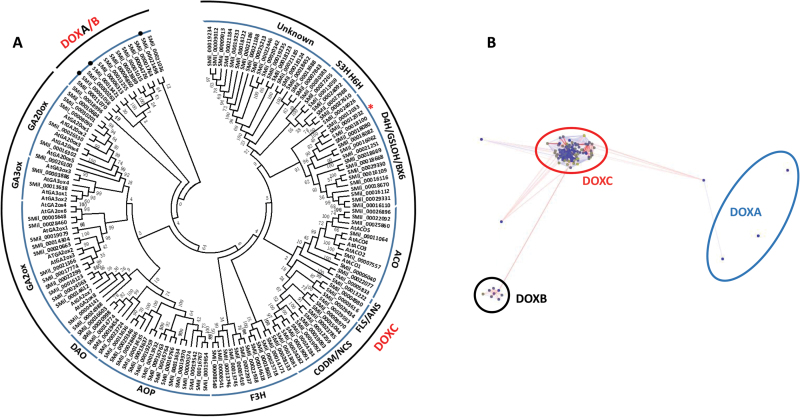
(A) Analysis of the phylogenetic relationships of 2OGD gene members in S. miltiorrhiza. A total of 132 2OGD proteins from S. miltiorrhiza were used to construct a neighbor-joining tree. Bootstrap values are presented for all branches. The 132 2OGDs were clustered into two classes, and then the DOXC class was divided into 11 clades. These clades were named according to their known functions in other species. The asterisk (*) indicates 2OGD5, on which functional analysis was performed. (B) The CLANS analysis clustered the 2OGDs into three classes (DOXA, DOXB, and DOXC). Three 2OGD members were classified into the DOXA class, which differed from the phylogenetic tree. Connected dots indicate significant similarity (P<10–4) based on the BLASTP search. The other three dots outside of the DOXA–C clusters were clustered in the unclassified group.
Fig. 2.
Fig. 2.
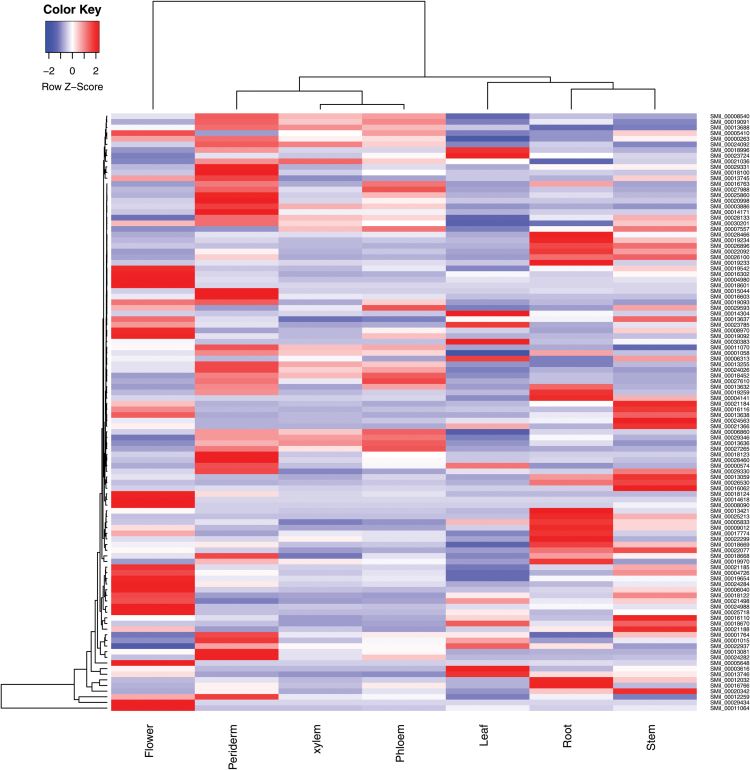
Heat map depicting 2OGD gene expression patterns in different organs and root tissues. The colors represent decreasing log10(RPKM) values as indicated in the key.
Fig. 3.
Fig. 3.
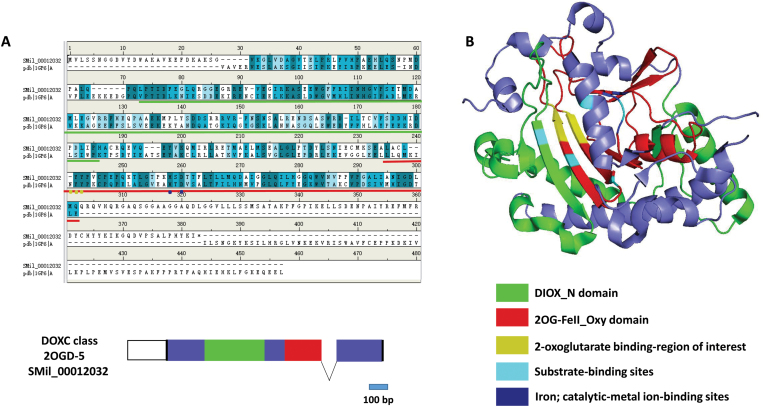
The gene structure and homology modeling of 2OGD5 from S. miltiorrhiza. (A) 2OGD5 was aligned to the anthocyanidin synthase sequence of A. thaliana (AtLDOX). (B) The predicted homology modeling was derived from the PDB database (PDBID:1GP6). The different colors represent the different domains and binding sites, as indicated in the key.
Fig. 4.
Fig. 4.
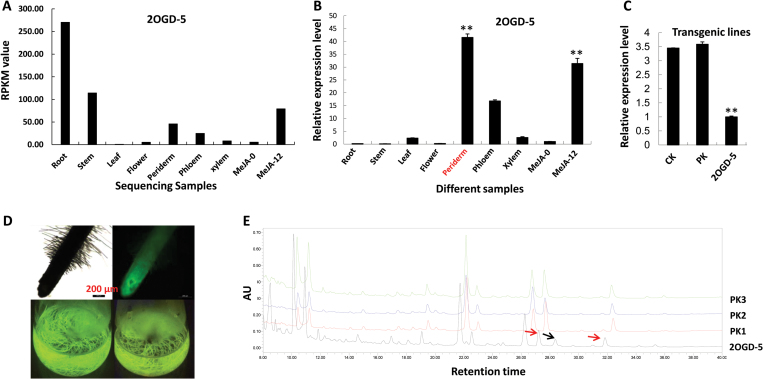
Biochemical identification of 2OGD5 in S. miltiorrhiza. (A) The gene expression of 2OGD5 based on the RNA-seq data in different organs, root tissues, and following MeJA treatment. MeJA-12 indicates that the leaves were sprayed with 200 μM MeJA for 12 h. (B) The 2OGD5 gene expression based on qPCR analysis in different organs, root tissues, and following MeJA treatment. (C) The expression levels of 2OGD5 in control and RNAi hairy roots. ‘CK’ is the hairy roots following infection with ACCC10060; ‘PK’ is the hairy roots following infection with ACCC10060 carried in the PK7GWIWG2D(II) vector. ‘2OGD5’ is the hairy roots following infection with ACCC10060 carried in the PK7GWIWG2D(II)-2OGD5 vector. (D) Positive green-fluorescent transgenic hairy roots expressing GFP. (E) Tanshinone variation determined using UPLC detection in the different hairy roots; AU, arbitrary units. The red arrows highlight where there is a decrease in the content of the compound relative to the control lines, and the black arrow highlights where there is an increase. In (B, C) the asterisks represent significant differences (**P<0.01) using one-way ANOVA analysis.
Fig. 5.
Fig. 5.
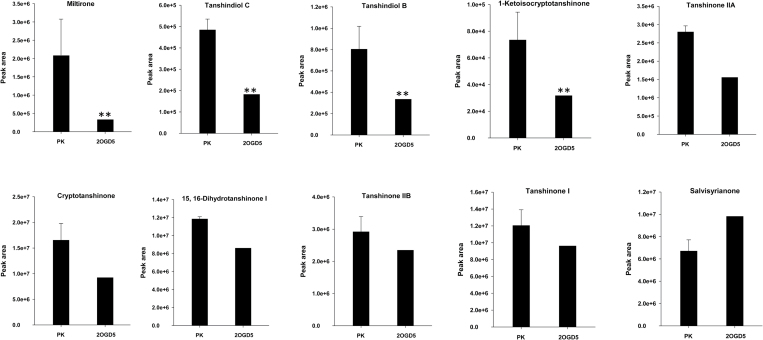
The relative quantification of tanshinones in different hairy roots based on the LC-MS/MS analysis. The error bars show the standard deviation from three independent RNAi hairy roots. Asterisks (**) represent a significant difference (more than 2-fold, P<0.05) using Student’s t-test.

References

    1. Boutanaev AM, Moses T, Zi J, Nelson DR, Mugford ST, Peters RJ, Osbourn A. 2015. Investigation of terpene diversification across multiple sequenced plant genomes. Proceedings of the National Academy of Sciences, USA 112, E81–E88. - PMC - PubMed
    1. Caputi L, Malnoy M, Goremykin V, Nikiforova S, Martens S. 2012. A genome-wide phylogenetic reconstruction of family 1 UDP-glycosyltransferases revealed the expansion of the family during the adaptation of plants to life on land. The Plant Journal 69, 1030–1042. - PubMed
    1. Chen S, Song J, Sun C, Xu J, Zhu Y, Verpoorte R, Fan T. 2015. Herbal genomics: Examining the biology of traditional medicines. Science 347, S27–S28.
    1. Cui G, Duan L, Jin B, et al. 2015. Functional divergence of diterpene syntheses in the medicinal plant Salvia miltiorrhiza. Plant Physiology 169, 1607–1618. - PMC - PubMed
    1. Falnes PØ, Johansen RF, Seeberg E. 2002. AlkB-mediated oxidative demethylation reverses DNA damage in Escherichia coli. Nature 419, 178–182. - PubMed