. 2017 May 15;215(10):1546-1550.
doi: 10.1093/infdis/jix182.

Continued Transmission of Zika Virus in Humans in West Africa, 1992-2016

Affiliations

Continued Transmission of Zika Virus in Humans in West Africa, 1992-2016

Bobby Brooke Herrera et al. J Infect Dis. .

Abstract

First identified in 1947 in Uganda, Zika virus (ZIKV) has remained largely unstudied until the recent outbreak in Latin America. This study aimed to measure the prevalence of ZIKV in febrile patients in Senegal and Nigeria in samples collected from 1992 to 2016. The seroprevalence of ZIKV was 6.2% based on ZIKV immunoglobulin M and negative for dengue reactivity. ZIKV envelope was amplified from 4 samples. Phylogenetic analysis showed that the ZIKVs belonged to the African lineage, grouping with either the Nigerian or MR766 sublineages. This study provides evidence that ZIKV has been silently circulating in West Africa for 2 decades.

Keywords: Africa.; HIV; Malaria; Nigeria; Senegal; Seroprevalence; Zika virus.


Figures

Figure 1.
Figure 1.
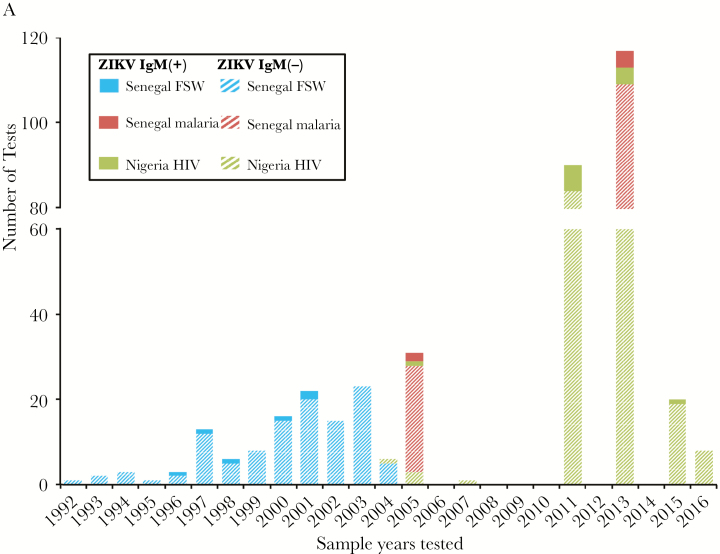
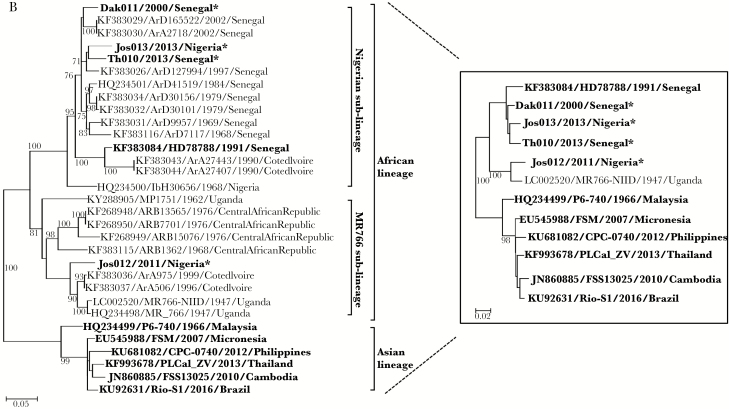
A, Frequency of Zika virus (ZIKV) results between 1992 and 2016. Blue, Senegalese female sex worker (FSW) cohort; red, Senegalese malaria cohort; green, Nigerian human immunodeficiency virus (HIV) cohort. The solid bars represent the number of immunoglobulin M (IgM)–positive samples and the hashed bars represent the number of negative samples. B, Phylogenetic analysis of ZIKV E genes of 4 ZIKVs from Senegal and Nigeria using reference ZIKV sequences isolated from humans, monkeys, and mosquitoes. The evolutionary history was inferred by using the maximum-likelihood method based on the Tamura-Nei model with 1000 boot resampling. Spondweni virus was used to root the tree. The boxed maximum-likelihood tree was produced as above using ZIKVs isolated from only humans and the MR766 monkey ZIKV. The 4 ZIKVs identified in this study are indicated with an asterisk (*).
Figure 1.
Figure 1.
A, Frequency of Zika virus (ZIKV) results between 1992 and 2016. Blue, Senegalese female sex worker (FSW) cohort; red, Senegalese malaria cohort; green, Nigerian human immunodeficiency virus (HIV) cohort. The solid bars represent the number of immunoglobulin M (IgM)–positive samples and the hashed bars represent the number of negative samples. B, Phylogenetic analysis of ZIKV E genes of 4 ZIKVs from Senegal and Nigeria using reference ZIKV sequences isolated from humans, monkeys, and mosquitoes. The evolutionary history was inferred by using the maximum-likelihood method based on the Tamura-Nei model with 1000 boot resampling. Spondweni virus was used to root the tree. The boxed maximum-likelihood tree was produced as above using ZIKVs isolated from only humans and the MR766 monkey ZIKV. The 4 ZIKVs identified in this study are indicated with an asterisk (*).

References

    1. Simpson DI. Zika virus infection in man. Trans R Soc Trop Med Hyg 1964; 58:335–8. - PubMed
    1. Weaver SC, Costa F, Garcia-Blanco MA, et al. Zika virus: history, emergence, biology, and prospects for control. Antiviral Res 2016; 130:69–80. - PMC - PubMed
    1. Macnamara FN. Zika virus: a report on three cases of human infection during an epidemic of jaundice in Nigeria. Trans R Soc Trop Med Hyg 1954; 48:139–45. - PubMed
    1. Faye O, Freire CC, Iamarino A, et al. Molecular evolution of Zika virus during its emergence in the 20(th) century. PLoS Negl Trop Dis 2014; 8:e2636. - PMC - PubMed
    1. World Health Organization. The history of Zika virus. Available at: http://www.who.int/emergencies/zika-virus/history/en/ Accessed 2 February 2017.

Publication types

MeSH terms