Sustained Reduction in HIV Diagnoses in Massachusetts, 2000-2014
- PMID: 28398778
- PMCID: PMC5388961
- DOI: 10.2105/AJPH.2017.303697
Sustained Reduction in HIV Diagnoses in Massachusetts, 2000-2014
Abstract
Objectives: To describe secular trends in reported HIV diagnoses in Massachusetts concurrent with treatment access expansion.
Methods: We characterized cases of HIV infection reported to the Massachusetts HIV/AIDS Surveillance Program between 2000 and 2014 by sex, age, race/ethnicity, and exposure mode. We used Poisson regression to test the statistical significance of trends in diagnoses.
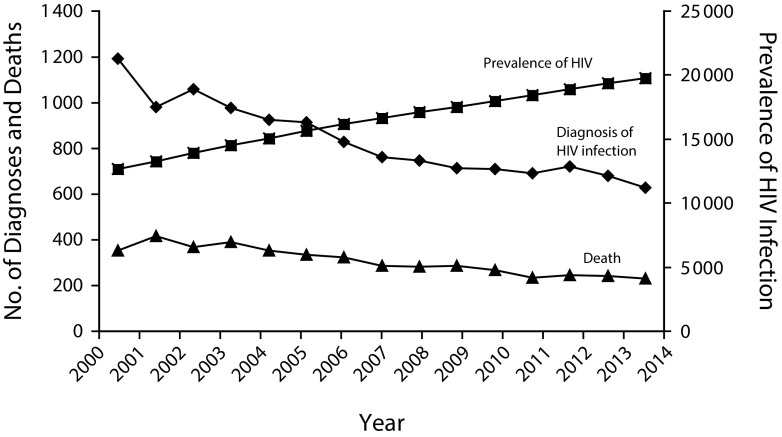
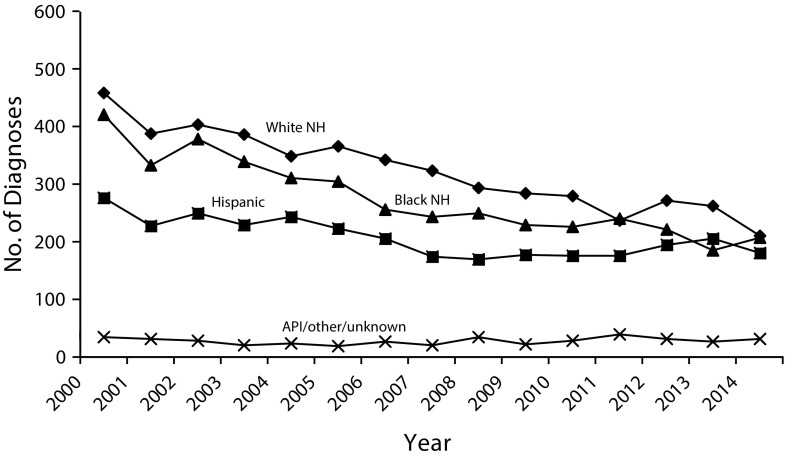
Results: Between 2000 and 2014, annual new HIV infections diagnosed in Massachusetts decreased by 47% (P < .001 for trend). We observed significant reductions in diagnoses among women (58% when comparing 2000 with 2014), men (42%), Whites (54%), Blacks (51%), and Hispanics (35%; P < .001 for trend). New diagnoses decreased significantly among men who have sex with men (19%), persons who inject drugs (91%), and heterosexuals (86%; P < .001 for trend). We saw statistically significant downward trends among all men by race/ethnicity, but the trend among Black men who have sex with men was nonsignificant.
Conclusions: Sustained reduction in new HIV diagnoses was concurrent with Massachusetts's Medicaid expansion, state health care reform, and public health strategies to improve care access. A contributory effect of expanded HIV treatment and population-level viral suppression is hypothesized for future research.
Figures
References
-
- Frieden TR, Foti K, Mermin J. Applying public health principles to the HIV epidemic—how are we doing? N Engl J Med. 2015;373(23):2281–2287. - PubMed
-
- The White House Office of National AIDS Policy. National HIV/AIDS Strategy for the United States. 2010. Available at: https://www.aids.gov/federal-resources/national-hiv-aids-strategy/nhas.pdf. Accessed March 17, 2017.
Publication types
MeSH terms
LinkOut - more resources
Full Text Sources
Other Literature Sources
Medical