


Comment
doi: 10.1016/j.devcel.2017.03.020.
Hematopoiesis Lineage Tree Uprooted: Every Cell Is a Rainbow
Affiliations
- PMID: 28399402
- PMCID: PMC6183053
- DOI: 10.1016/j.devcel.2017.03.020
Item in Clipboard
Comment
Hematopoiesis Lineage Tree Uprooted: Every Cell Is a Rainbow
Dev Cell.
.
Abstract
Differentiation of hematopoietic stem cells into distinct cell types was thought to occur through a series of discrete, stable progenitor states. Work from Velten et al. (2017) now shows that hematopoietic cells differentiate via a mechanism of continuous lineage priming and thus represent a CLOUD-HSPC.
Copyright © 2017 Elsevier Inc. All rights reserved.
Figures
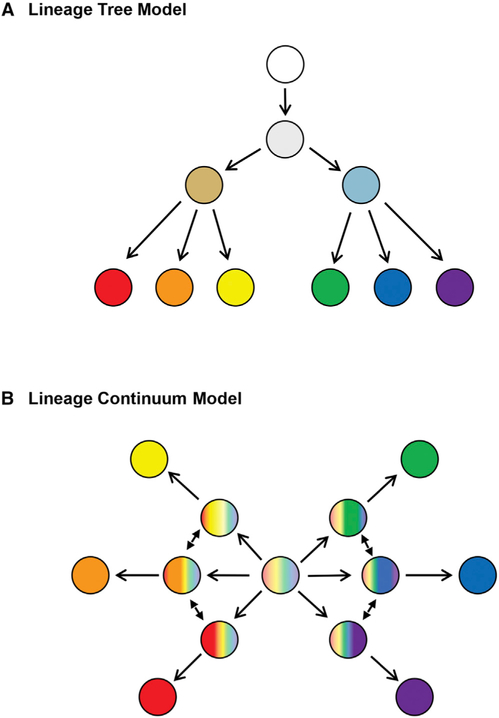
(A) Lineage tree model: The most oligo-potent cell is depicted in white, and transitions via binary fate decisions to ultimately generate distinct cell lineages are depicted in vibrant, distinct colors. (B) Lineage continuum model: All oligo-potent cells are highly transcriptionally diverse and undergo direct lineage commitment to generate distinct cell types, as opposed to transitioning through a series of discrete and stable progenitors.
Comment on
-
Human haematopoietic stem cell lineage commitment is a continuous process.Nat Cell Biol. 2017 Apr;19(4):271-281. doi: 10.1038/ncb3493. Epub 2017 Mar 20. Nat Cell Biol. 2017. PMID: 28319093 Free PMC article.
References
Publication types
MeSH terms
Grants and funding
LinkOut - more resources
Full Text Sources
Other Literature Sources
