Review
. 2017 Aug:47:72-82.
doi: 10.1016/j.ceb.2017.02.004. Epub 2017 Apr 8.

The emerging role of retromer in neuroprotection

Affiliations
Review

The emerging role of retromer in neuroprotection

Kirsty J McMillan et al. Curr Opin Cell Biol. 2017 Aug.

Abstract

Efficient sorting and transportation of integral membrane proteins, such as ion channels, nutrient transporters, signalling receptors, cell-cell and cell-matrix adhesion molecules is essential for the function of cellular organelles and hence organism development and physiology. Retromer is a master controller of integral membrane protein sorting and transport through one of the major sorting station within eukaryotic cells, the endosomal network. Subtle de-regulation of retromer is an emerging theme in the pathoetiology of Parkinson's disease. Here we summarise recent advances in defining the neuroprotective role of retromer and how its de-regulation may contribute to Parkinson's disease by interfering with: lysosomal health and protein degradation, association with accessory proteins including the WASH complex and mitochondrial health.


Figures

Figure 1
Figure 1
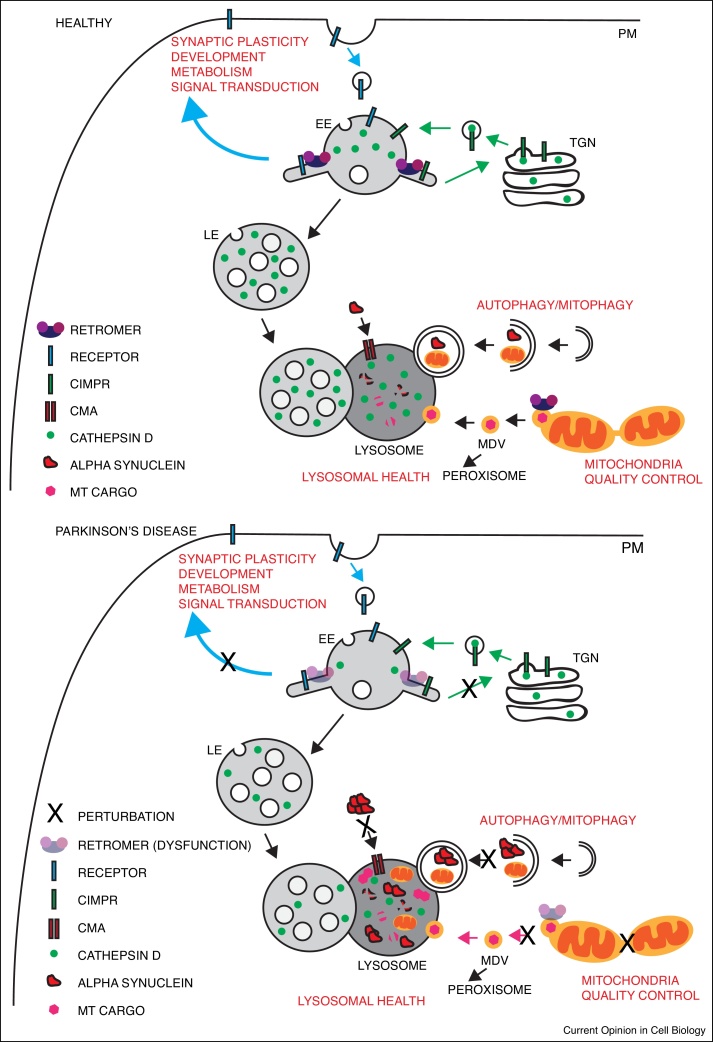
Retromer and Parkinson’s disease. Retromer has been shown to play an important role in the pathology of Parkinson’s disease (PD). The different pathways shown to be affected by retromer dysfunction are illustrated and include changes in lysosomal health and protein degradation, association with accessory proteins including the WASH complex and mitochondrial health. MDV, mitochondria derived vesicles, CMA, chaperone mediated autophagy.
Figure 2
Figure 2
Overview of the endosomal pathways implicated in Parkinson’s disease. In physiological conditions cargo proteins enter the endosomal network where they are either retrieved and recycled (to the plasma membrane (PM), trans-golgi network (TGN) or to specialised organelles) or sorted for degradation within the lysosome. Retromer is involved in the retrieval and recycling of cargo away from the degradative pathway. Retromer dysfunction has been implicated in Parkinson’s disease (PD). Several mechanisms are proposed including perturbations in lysosomal health, autophagy flux, mitochondria quality control and the cell surface proteome. Impairment of retromer affects sorting of integral cell surface proteins, which can affect many aspects of plasma membrane function. Furthermore, retromer dysfunction affects trafficking of hydrolases from the TGN to the lysosome (via CI-MPR) affecting the health of the lysosome and resulting in reduced protein degradation. Retromer is also involved in the trafficking of proteins needed in autophagasome formation, chaperone mediated autophagy (CMA) and mitochondria derived vesicles (MDV) all of which are involved in maintaining proteostasis. Impairment of these different pathways are thought to lead to increases in alpha synuclein, the key protein present in Lewy bodies in Parkinson’s disease, as well as other proteins and damaged organelles potentially leading to cell death. In addition, retromer dysfunction has been shown to affect mitochondrial health due to changes in the expression of fission and fusion proteins which may also play a role in the pathology of Parkinson’s disease. EE, early endosome; LE, late endosome, MT, mitochondria.
Figure 3
Figure 3
Retromer and mitochondrial fusion and fission. Retromer dysfunction is thought to prevent the degradation of mitochondrial cargo as well as disrupt the balance of mitochondrial fusion/fission leading to neurodegeneration. Retromer has been shown to interact with the mitochondrial E3 ubiquitin protein ligase 1 (MUL1). MUL1 is enriched in mitochondria-derived vesicles and is also involved in mitochondrial fusion through it regulation of the mitochondrial protein mitofusin 2 (MFN2). Retromer suppression causes an increase in MUL1 expression, leading to the increased degradation of MFN2 and mitochondrial fragmentation and dysfunction. In contrast, retromer has also been shown to interact with the mitochondrial fission protein: dynamin-like protein (DLP1). Overexpression of retromer or expression of the VPS35(p.D620N) mutation enhances the interaction of retromer with DLP1. This results in the removal of the DLP-1 complex by mitochondria-derived vesicles for degradation by the lysosome/peroxisome resulting in excessive fission.

References

    1. Huotari J., Helenius A. Endosome maturation. EMBO J. 2011;30:3481–3500. - PMC - PubMed
    1. Burd C., Cullen P.J. Retromer: a master conductor of endosome sorting. Cold Spring Harb. Perspect. Biol. 2014;6 - PMC - PubMed
    1. Wang S., Bellen H.J. The retromer complex in development and disease. Development. 2015;142:2392–2396. - PMC - PubMed
    1. Henne W.M., Stenmark H., Emr S.D. Molecular mechanisms of the membrane sculpting ESCRT pathway. Cold Spring Harb. Perspect. Biol. 2013;5 - PMC - PubMed
    1. Hsu V.W., Bai M., Li J. Getting active: protein sorting in endocytic recycling. Nat. Rev. Mol. Cell Biol. 2012;13:323–328. - PubMed

Substances

LinkOut - more resources