. 2017 Apr 11;15(1):28.
doi: 10.1186/s12951-017-0261-x.

Chitosan nanoparticle-mediated co-delivery of shAtg-5 and gefitinib synergistically promoted the efficacy of chemotherapeutics through the modulation of autophagy

Affiliations

Chitosan nanoparticle-mediated co-delivery of shAtg-5 and gefitinib synergistically promoted the efficacy of chemotherapeutics through the modulation of autophagy

Yan Zheng et al. J Nanobiotechnology. .

Abstract

Background: Autophagy reportedly plays vital and complex roles in many diseases. During times of starvation or energy deficiency, autophagy will occur at higher levels to provide cells with the nutrients or energy necessary to survive in stressful conditions. Some anti-cancer drugs induce protective autophagy and reduce cell apoptosis. Autophagy can adversely affect apoptosis, and blocking autophagy will increase the sensitivity of cells to apoptosis signals.

Methods: We designed chitosan nanoparticles (NPs) to promote the co-delivery of gefitinib (an anti-cancer drug) and shRNA-expressing plasmid DNA that targets the Atg-5 gene (shAtg-5) as an autophagy inhibitor to improve anti-cancer effects and autophagy mediation.

Results: The results showed that when compared to treatment with a single drug, chitosan NPs were able to facilitate the intracellular distribution of NPs, and they improved the transfection efficiency of gene in vitro. The co-delivery of gefitinib and shAtg-5 increased cytotoxicity, induced significant apoptosis through the prohibition of autophagy, and markedly inhibited tumor growth in vivo.

Conclusions: The co-delivery of gefitinib/shAtg-5 in chitosan NPs produced superior anti-cancer efficacy via the internalization effect of NPs, while blocking autophagy with shAtg-5 enhanced the synergistic antitumor efficacy of gefitinib.

Keywords: Apoptosis; Autophagy; Gefitinib; Nanoparticles; shAtg-5.


Figures
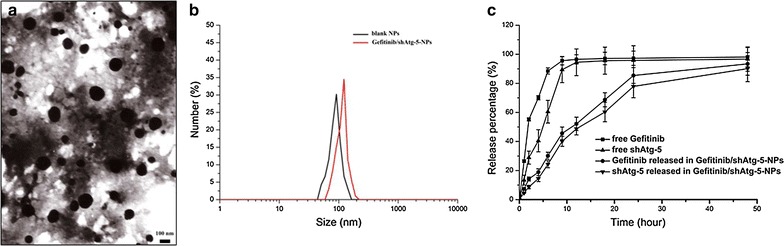
Fig. 1
Fig. 1
Characterization of gefitinib/shAtg-5 NPs. TEM images of gefitinib/shAtg-5 NPs (a), DLS analysis of the obtained gefitinib/shAtg-5 NPs (b), and the in vitro release profile of gefitinib/shAtg-5 NPs in phosphate buffered saline (pH 7.4 at 37 °C) for 48 h (c). The results were expressed as mean ± SD (n = 3)
Fig. 2
Fig. 2
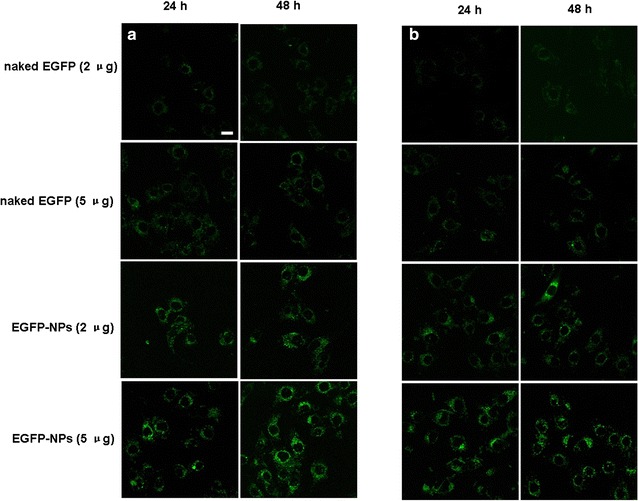
The in vitro transfection efficiency of EGFP-loaded NPs was investigated by observing the microscopic images of A549 cells and PLC cells following incubation with free EGFP and EGFP-loaded NPs for 48 h (a A549 cells; b PLC cells). Scale bar 50 μm
Fig. 3
Fig. 3
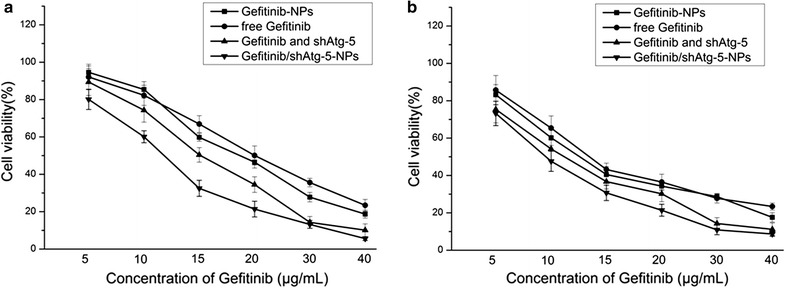
The in vitro viability of A549 cells (a) and PLC cells (b) treated with various gefitinib formulations. The results were expressed as mean ± SD (n = 3)
Fig. 4
Fig. 4
The uptake of NPs in PLC cells and A549 cells. Fluorescence microscopy analysis of the uptake of Rhodamine B-labeled NPs in PLC cells (a) and A549 cells (b). Scale bar was 50 μm. Fluorescence spectrum analysis of the uptake of FITC-labeled NPs in PLC cells (c) and A549 cells (d). The results were expressed as mean ± SD (n = 3). ***p < 0.001 versus the NP-treated cells within 3 h
Fig. 5
Fig. 5
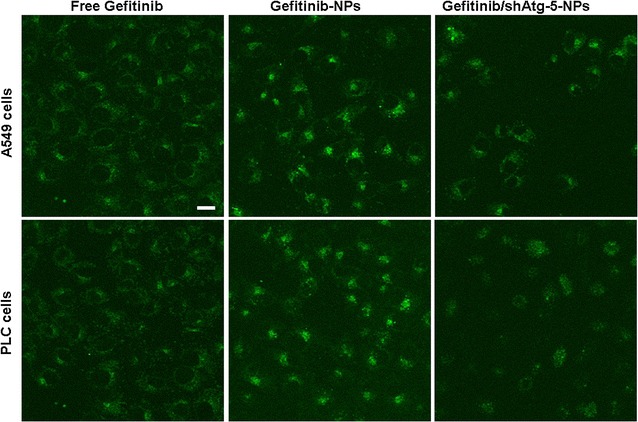
Confocal microscope images of GFP-LC3-transfected A549 cells and PLC cells treated with free gefitinib and gefitinib-loaded NPs. Scale bar 100 μm
Fig. 6
Fig. 6
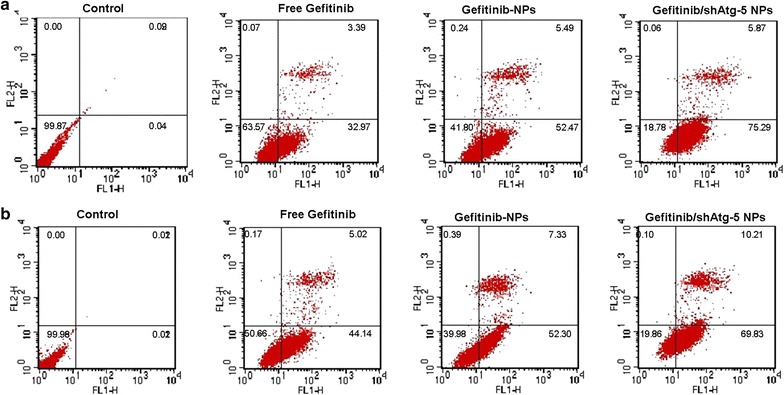
The early apoptosis of A549 cells (a) and PLC cells (b) treated with free gefitinib, gefitinib NPs, and gefitinib/shAtg-5 NPs
Fig. 7
Fig. 7
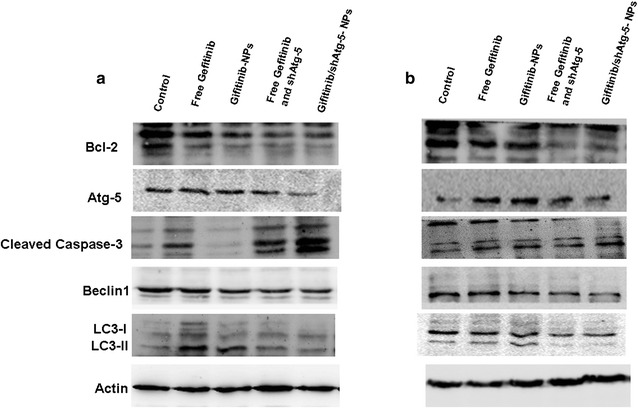
Apoptotic effects of various gefitinib formulations on A549 cells (a) and PLC cells (b). Western blot analyses of the expression levels of cleaved caspase-3, Bcl-2, Beclin1, Atg-5, and LC3 proteins in A549 cells and PLC cells following treatment
Fig. 8
Fig. 8
Tumor growth inhibition and histological examination of tumor sections in nude mice bearing PLC tumors following treatment with different formulations. a Images of a xenograft tumor model in vivo following treatment with PBS, free gefitinib, free gefitinib and shAtg-5, gefitinib NPs, and gefitinib/shAtg-5 NPs for 3 weeks. b Tumor volume curves after the animals were treated by different preparations. The results were expressed as mean ± SD (n = 5). c Histological examination of tumor sections (20 days after the first treatment). Nuclei were stained blue, while the extracellular matrix and cytoplasm were stained red via H&E staining. For the immunohistochemistry staining, blue stains showed the nuclei, and brown stains in the cytoplasm indicated protein expression in tumor cells. Scale bar for H&E staining: 40 μm; scale bar for immunohistochemistry staining: 20 μm

References

    1. Sotiropoulou PA, Christodoulou MS, Silvani A, et al. Chemical approaches to targeting drug resistance in cancer stem cells. Drug Discov Today. 2014;19(10):1547–1562. doi: 10.1016/j.drudis.2014.05.002. - DOI - PubMed
    1. Kathawala RJ, Gupta P, Ashby CR, Jr, Chen ZS. The modulation of ABC transporter-mediated multidrug resistance in cancer: a review of the past decade. Drug Resist Updat. 2015;18:1–17. doi: 10.1016/j.drup.2014.11.002. - DOI - PubMed
    1. Kibria G, Hatakeyama H, Harashima H. Cancer multidrug resistance: mechanisms involved and strategies for circumvention using a drug delivery system. Arch Pharm Res. 2014;37(1):4–15. doi: 10.1007/s12272-013-0276-2. - DOI - PubMed
    1. Chen N, Debnath J. Autophagy and tumorigenesis. FEBS Lett. 2010;584(7):1427–1435. doi: 10.1016/j.febslet.2009.12.034. - DOI - PMC - PubMed
    1. Rao S, Yang H, Penninger JM, Kroemer G. Autophagy in non-small cell lung carcinogenesis: a positive regulator of antitumor immunosurveillance. Autophagy. 2014;10(3):529–531. doi: 10.4161/auto.27643. - DOI - PMC - PubMed

MeSH terms

LinkOut - more resources