


Health Literacy and Awareness of Atrial Fibrillation
- PMID: 28400367
- PMCID: PMC5533014
- DOI: 10.1161/JAHA.116.005128
Health Literacy and Awareness of Atrial Fibrillation
Abstract
Background: Atrial fibrillation (AF) is the most common clinically significant arrhythmia in adults and a major risk factor for ischemic stroke. Nonetheless, previous research suggests that many individuals diagnosed with AF lack awareness about their diagnosis and inadequate health literacy may be an important contributing factor to this finding.
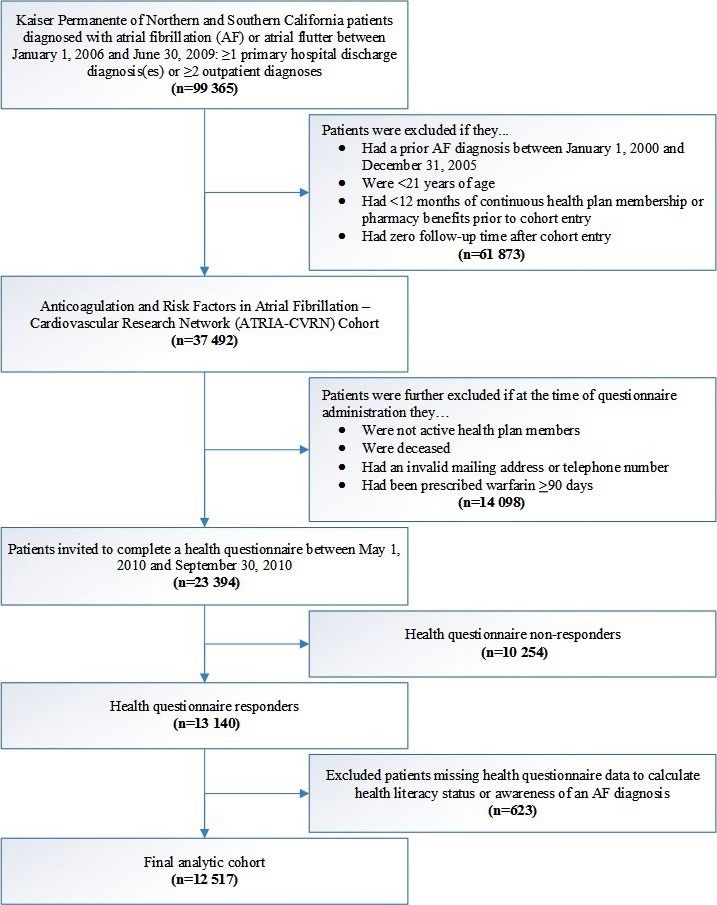
Methods and results: We examined the association between health literacy and awareness of an AF diagnosis in a large, ethnically diverse cohort of Kaiser Permanente Northern and Southern California adults diagnosed with AF between January 1, 2006 and June 30, 2009. Using self-reported questionnaire data completed between May 1, 2010 and September 30, 2010, awareness of an AF diagnosis was evaluated using the question "Have you ever been told by a doctor or other health professional that you have a heart rhythm problem called atrial fibrillation or atrial flutter?" and health literacy was assessed using a validated 3-item instrument examining problems because of reading, understanding, and filling out medical forms. Of the 12 517 patients diagnosed with AF, 14.5% were not aware of their AF diagnosis and 20.4% had inadequate health literacy. Patients with inadequate health literacy were less likely to be aware of their AF diagnosis compared with patients with adequate health literacy (prevalence ratio=0.96; 95% CI [0.94, 0.98]), adjusting for sociodemographics, health behaviors, and clinical characteristics.
Conclusions: Lower health literacy is independently associated with less awareness of AF diagnosis. Strategies designed to increase patient awareness of AF and its complications are warranted among individuals with limited health literacy.
Keywords: arrhythmia; atrial fibrillation; awareness; health literacy.
© 2017 The Authors. Published on behalf of the American Heart Association, Inc., by Wiley.
Figures
References
-
- Go AS, Hylek EM, Phillips KA, Chang Y, Henault LE, Selby JV, Singer DE. Prevalence of diagnosed atrial fibrillation in adults: national implications for rhythm management and stroke prevention: the anticoagulation and risk factors in atrial fibrillation (ATRIA) study. JAMA. 2001;285:2370–2375. - PubMed
-
- Chugh SS, Havmoeller R, Narayanan K, Singh D, Rienstra M, Benjamin EJ, Gillum RF, Kim YH, McAnulty JH Jr, Zheng ZJ, Forouzanfar MH, Naghavi M, Mensah GA, Ezzati M, Murray CJ. Worldwide epidemiology of atrial fibrillation: a Global Burden of Disease 2010 Study. Circulation. 2014;129:837–847. - PMC - PubMed
-
- Mozaffarian D, Benjamin EJ, Go AS, Arnett DK, Blaha MJ, Cushman M, Das SR, de Ferranti S, Despres JP, Fullerton HJ, Howard VJ, Huffman MD, Isasi CR, Jimenez MC, Judd SE, Kissela BM, Lichtman JH, Lisabeth LD, Liu S, Mackey RH, Magid DJ, McGuire DK, Mohler ER III, Moy CS, Muntner P, Mussolino ME, Nasir K, Neumar RW, Nichol G, Palaniappan L, Pandey DK, Reeves MJ, Rodriguez CJ, Rosamond W, Sorlie PD, Stein J, Towfighi A, Turan TN, Virani SS, Woo D, Yeh RW, Turner MB; American Heart Association Statistics C, Stroke Statistics S . Heart disease and stroke statistics—2016 update: a report from the American Heart Association. Circulation. 2016;133:e38–e360. - PubMed
-
- Colilla S, Crow A, Petkun W, Singer DE, Simon T, Liu X. Estimates of current and future incidence and prevalence of atrial fibrillation in the U.S. adult population. Am J Cardiol. 2013;112:1142–1147. - PubMed
-
- Lip GY, Kamath S, Jafri M, Mohammed A, Bareford D. Ethnic differences in patient perceptions of atrial fibrillation and anticoagulation therapy: the West Birmingham Atrial Fibrillation Project. Stroke. 2002;33:238–242. - PubMed
Publication types
MeSH terms
LinkOut - more resources
Full Text Sources
Other Literature Sources
Medical
