


Modulatory effects of acupuncture on brain networks in mild cognitive impairment patients
- PMID: 28400807
- PMCID: PMC5361509
- DOI: 10.4103/1673-5374.200808
Modulatory effects of acupuncture on brain networks in mild cognitive impairment patients
Abstract
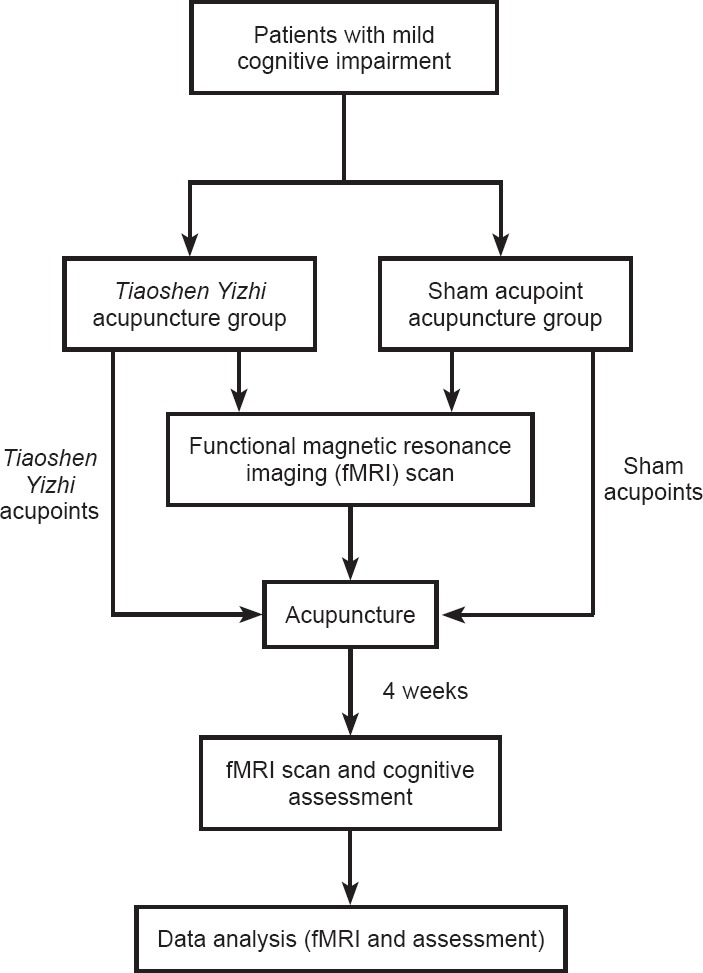
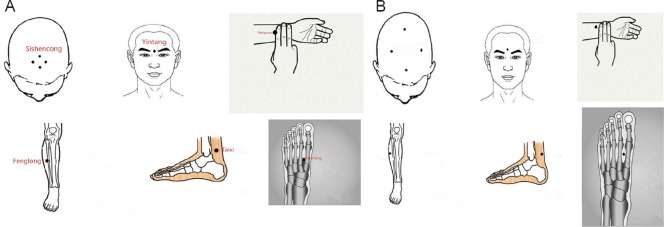
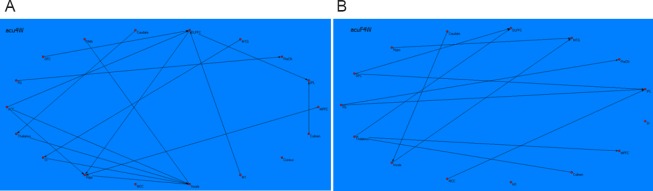
Functional magnetic resonance imaging has been widely used to investigate the effects of acupuncture on neural activity. However, most functional magnetic resonance imaging studies have focused on acute changes in brain activation induced by acupuncture. Thus, the time course of the therapeutic effects of acupuncture remains unclear. In this study, 32 patients with amnestic mild cognitive impairment were randomly divided into two groups, where they received either Tiaoshen Yizhi acupuncture or sham acupoint acupuncture. The needles were either twirled at Tiaoshen Yizhi acupoints, including Sishencong (EX-HN1), Yintang (EX-HN3), Neiguan (PC6), Taixi (KI3), Fenglong (ST40), and Taichong (LR3), or at related sham acupoints at a depth of approximately 15 mm, an angle of ± 60°, and a rate of approximately 120 times per minute. Acupuncture was conducted for 4 consecutive weeks, five times per week, on weekdays. Resting-state functional magnetic resonance imaging indicated that connections between cognition-related regions such as the insula, dorsolateral prefrontal cortex, hippocampus, thalamus, inferior parietal lobule, and anterior cingulate cortex increased after acupuncture at Tiaoshen Yizhi acupoints. The insula, dorsolateral prefrontal cortex, and hippocampus acted as central brain hubs. Patients in the Tiaoshen Yizhi group exhibited improved cognitive performance after acupuncture. In the sham acupoint acupuncture group, connections between brain regions were dispersed, and we found no differences in cognitive function following the treatment. These results indicate that acupuncture at Tiaoshen Yizhi acupoints can regulate brain networks by increasing connectivity between cognition-related regions, thereby improving cognitive function in patients with mild cognitive impairment.
Keywords: Alzheimer's disease; Tiaoshen Yizhi; acupuncture; brain network; mild cognitive impairment; nerve regeneration; neural regeneration; neuroimaging; resting-state functional magnetic resonance imaging.
Conflict of interest statement
Conflicts of interest: None declared.
Figures
References
-
- Bai F, Zhang Z, Watson DR, Yu H, Shi Y, Yuan Y, Zang Y, Zhu C, Qian Y. Abnormal functional connectivity of hippocampus during episodic memory retrieval processing network in amnestic mild cognitive impairment. Biol Psychiatry. 2009a;65:951–958. - PubMed
-
- Bai L, Qin W, Tian J, Dong M, Pan X, Chen P, Dai J, Yang W, Liu Y. Acupuncture modulates spontaneous activities in the anticorrelated resting brain networks. Brain Res. 2009b;1279:37–49. - PubMed
-
- Bai L, Yan H, Li L, Qin W, Chen P, Liu P, Gong Q, Liu Y, Tian J. Neural specificity of acupuncture stimulation at pericardium 6: evidence from an FMRI study. J Magn Reson Imaging. 2010;31:71–77. - PubMed
LinkOut - more resources
Full Text Sources
Other Literature Sources
Medical
