


How a CT-Direct Protocol at an American Comprehensive Stroke Center Led to Door-to-Needle Times Less Than 30 Minutes
- PMID: 28400899
- PMCID: PMC5382655
- DOI: 10.1177/1941874416672783
How a CT-Direct Protocol at an American Comprehensive Stroke Center Led to Door-to-Needle Times Less Than 30 Minutes
Abstract
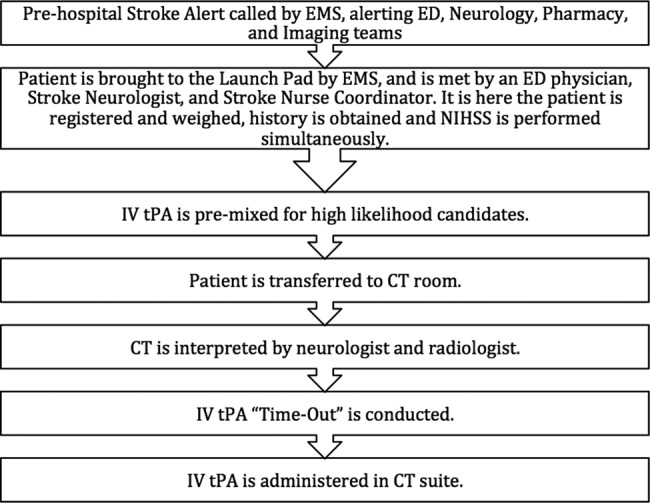
Background and purpose: The safety and efficacy of intravenous tissue plasminogen activator (IV tPA) following acute ischemic stroke (AIS) is dependent on its timely administration. In 2014, our Comprehensive Stroke Center designed and implemented a computed tomography-Direct protocol to streamline the evaluation process of suspected patients with AIS, with the aim of reducing door-to-needle (DTN) times. The objectives of our study were to describe the protocol development and implementation process, and to compare DTN times and symptomatic intracranial hemorrhage (sICH) rates before and after protocol implementation.
Methods: Data were prospectively collected for patients with AIS receiving IV tPA between January 1, 2010, and May 31, 2015. The DTN times, examined as median times and time treatment windows, and sICH rates were compared pre- and postimplementation.
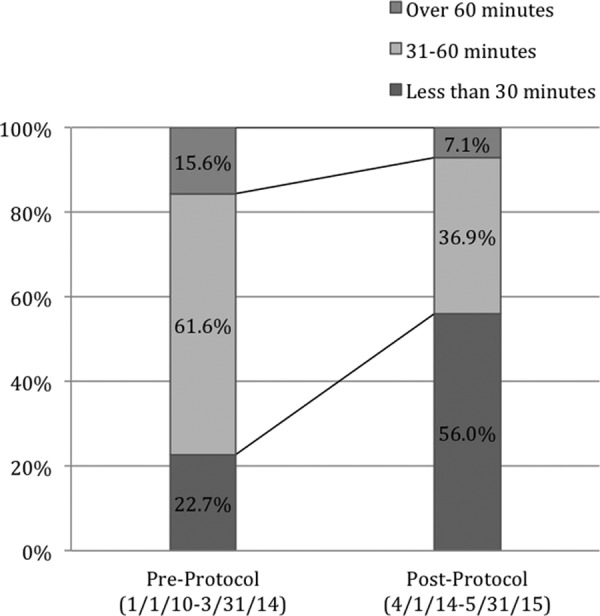
Results: Two hundred ninety-five patients were included in the study. After protocol implementation, median DTN times were significantly reduced (38 vs 28 minutes; P < .001). The distribution of patients treated in the three time treatment windows described below changed significantly, with an increase in patients with DTN times of 30 minutes or less, and a decrease in patients with DTN times 31 to 60 minutes and over 60 minutes (P < .001). There were two cases of sICH prior to implementation and one sICH case postimplementation.
Conclusions: The implementation of a protocol that streamlined the processing of suspected patients with AIS significantly reduced DTN time without negatively impacting patient safety.
Keywords: acute stroke; door-to-needle time; evidence-based medicine; ischemic stroke; tissue-type plasminogen activator.
Conflict of interest statement
Declaration of Conflicting Interests: The authors declared no potential conflicts of interest with respect to the research, authorship, and/or publication of this article.
Figures
References
-
- Saver JL. Time is brain—quantified. Stroke. 2006;37(1):263–266. - PubMed
-
- Marler JR, Tilley BC, Lu M, et al. Early stroke treatment associated with better outcome: the NINDS rt-PA stroke study. Neurology. 2000;55(11):1649–1655. - PubMed
-
- Jauch EC, Saver JL, Adams HP, et al. Guidelines for the early management of patients with acute ischemic stroke a guideline for healthcare professionals from the American Heart Association/American Stroke Association. Stroke. 2013;44(3):870–947. - PubMed
-
- Fonarow GC, Smith EE, Saver JL, et al. Timeliness of tissue-type plasminogen activator therapy in acute ischemic stroke patient characteristics, hospital factors, and outcomes associated with door-to-needle times within 60 minutes. Circulation. 2011;123(7):750–758. - PubMed
-
- Meretoja A, Strbian D, Mustanoja S, Tatlisumak T, Lindsberg PJ, Kaste M. Reducing in-hospital delay to 20 minutes in stroke thrombolysis. Neurology. 2012;79(4):306–313. - PubMed
LinkOut - more resources
Full Text Sources
Other Literature Sources