


Comprehensive survey of household radon gas levels and risk factors in southern Alberta
- PMID: 28401142
- PMCID: PMC5378506
- DOI: 10.9778/cmajo.20160142
Comprehensive survey of household radon gas levels and risk factors in southern Alberta
Abstract
Background: The inhalation of naturally occurring radon (222Rn) gas from indoor air exposes lung tissue to α-particle bombardment, a highly mutagenic form of ionizing radiation that damages DNA and increases the lifetime risk of lung cancer. We analyzed household radon concentrations and risk factors in southern Alberta, including Calgary, the third-largest Canadian metropolis.
Methods: A total of 2382 residential homes (2018 in Calgary and 364 in surrounding townships) from an area encompassing 82% of the southern Alberta population were tested for radon, per Health Canada guidelines, for at least 90 days (median 103 d) between 2013 and 2016. Participants also provided home metrics (construction year, build type, foundation type, and floor and room of deployment of the radon detector) via an online survey. Homes that were subsequently remediated were retested to determine the efficacy of radon reduction techniques in the region.
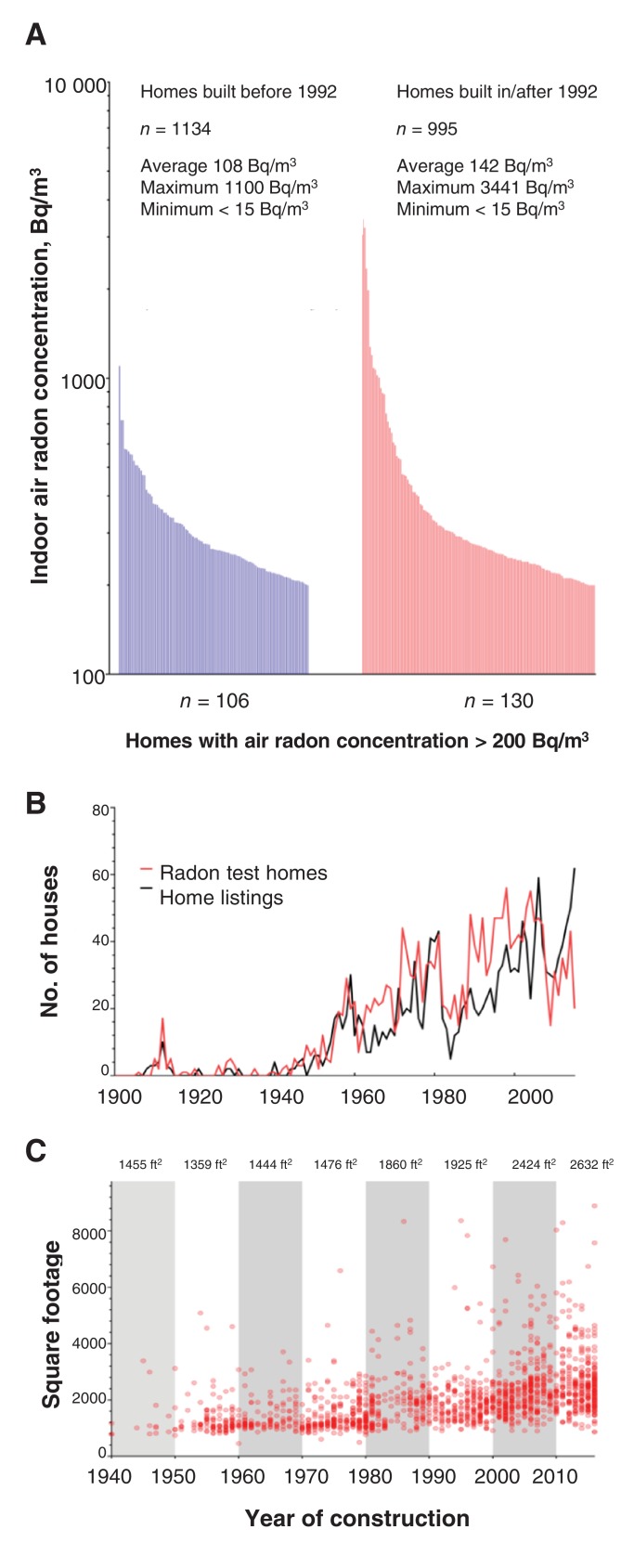
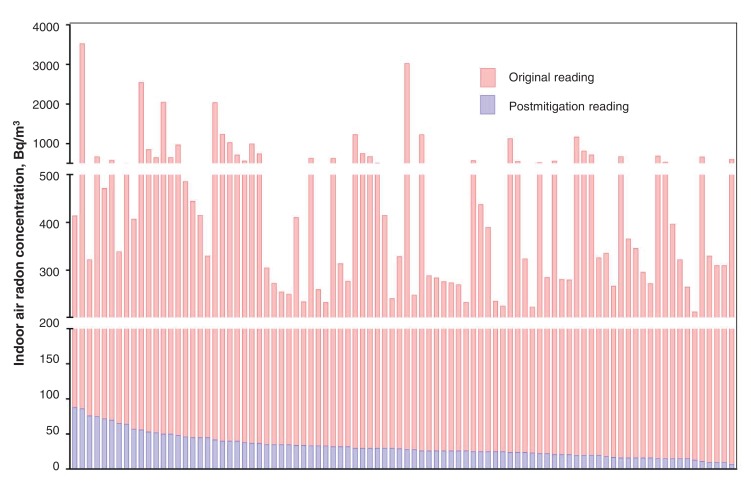
Results: The average indoor air radon level was 126 Bq/m3, which equates to an effective absorbed radiation dose of 3.2 mSv/yr. A total of 1135 homes (47.6%) had levels of 100 Bq/m3 or higher, and 295 homes (12.4%) had levels of 200 Bq/m3 or higher; the range was less than 15 Bq/m3 to 3441 Bq/m3. Homes built in 1992 or later had radon levels 31.5% higher, on average, than older homes (mean 142 Bq/m3 v. 108 Bq/m3). For 90 homes with an average radon level of 575 Bq/m3 before mitigation, radon suppression successfully reduced levels to an average of 32.5 Bq/m3.
Interpretation: Our findings show that radon exposure is a genuine public health concern in southern Alberta, suggest that modern building practices are associated with increased indoor air radon accumulation, legitimatize efforts to understand the consequences of radon exposure to the public, and suggest that radon testing and mitigation are likely to be impactful cancer prevention strategies.
Conflict of interest statement
Competing interests: None declared.
Figures
References
-
- Schauer DA, Linton OW. NCRP Report no. 160, Ionizing radiation exposure of the population of the United States, medical exposure - Are we doing less with more, and is there a role for health physicists? Health Phys. 2009;97:1–5. - PubMed
-
- Henshaw DL, Eatough JP, Richardson RB. Radon as a causative factor in induction of myeloid leukaemia and other cancers. Lancet. 1990;335:1008–12. - PubMed
-
- Marsh JW, Bailey MR. A review of lung-to-blood absorption rates for radon progeny. Radiat Prot Dosimetry. 2013;157:499–514. - PubMed
-
- Teras LR, Diver WR, Turner MC, et al. Residential radon exposure and risk of incident hematologic malignancies in the Cancer Prevention Study-II Nutrition Cohort. Environ Res. 2016;148:46–54. - PubMed
LinkOut - more resources
Full Text Sources
Other Literature Sources
