Review
. 2017 Aug;134(2):187-205.
doi: 10.1007/s00401-017-1709-7. Epub 2017 Apr 11.

Interactions of pathological proteins in neurodegenerative diseases

Affiliations
Review

Interactions of pathological proteins in neurodegenerative diseases

Tara L Spires-Jones et al. Acta Neuropathol. 2017 Aug.

Abstract

Neurodegenerative diseases such as Alzheimer's disease (AD), frontotemporal lobar degeneration (FTD), Lewy body disease (LBD), Parkinson's disease (PD), and amyotrophic lateral sclerosis (ALS) have in common that protein aggregates represent pathological hallmark lesions. Amyloid β-protein, τ-protein, α-synuclein, and TDP-43 are the most frequently aggregated proteins in these disorders. Although they are assumed to form disease-characteristic aggregates, such as amyloid plaques and neurofibrillary tangles in AD or Lewy bodies in LBD/PD, they are not restricted to these clinical presentations. They also occur in non-diseased individuals and can co-exist in the same brain without or with a clinical picture of a distinct dementing or movement disorder. In this review, we discuss the co-existence of these pathologies and potential additive effects in the human brain as well as related functional findings on cross-seeding and molecular interactions between these aggregates/proteins. We conclude that there is evidence for interactions at the molecular level as well as for additive effects on brain damage by multiple pathologies occurring in different functionally important neurons. Based upon this information, we hypothesize a cascade of events that may explain general mechanisms in the development of neurodegenerative disorders: (1) distinct lesions are a prerequisite for the development of a distinct disease (e.g., primary age-related tauopathy for AD), (2) disease-specific pathogenic events further trigger the development of a specific disease (e.g., Aβ aggregation in AD that exaggerate further Aβ and AD-related τ pathology), (3) the symptomatic disease manifests, and (4) neurodegenerative co-pathologies may be either purely coincidental or (more likely) have influence on the disease development and/or its clinical presentation.

Keywords: Alzheimer’s disease; Amyloid beta; Amyotrophic lateral sclerosis; Frontotemporal lobar degeneration; Lewy body; Synuclein; TDP-43; Tau.


Conflict of interest statement

DRT received consultancies from Covance Laboratories (UK) and GE-Healthcare (UK), received a speaker honorarium from GE-Healthcare (UK), and collaborated with Novartis Pharma Basel (Switzerland). TS-J collaborates with Cognition Therapeutics (USA).

Figures
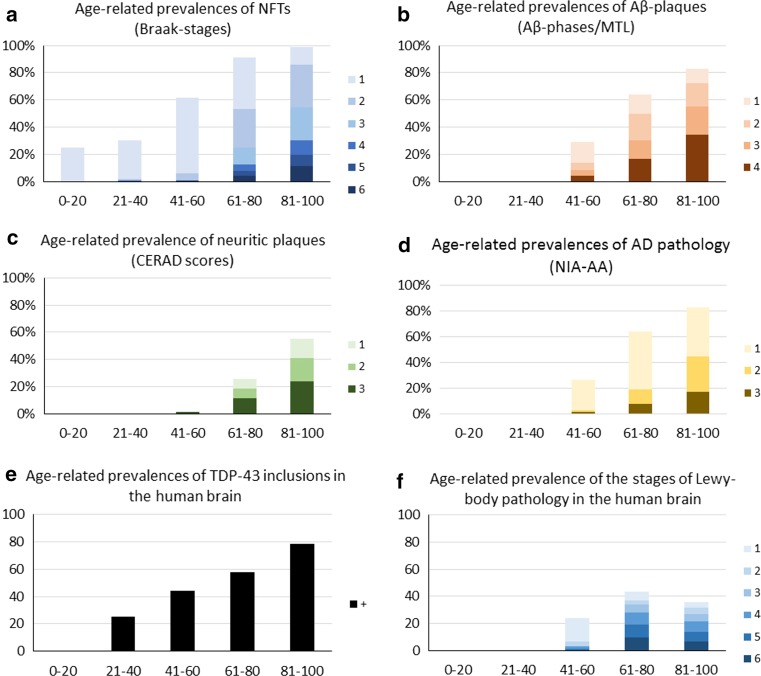
Fig. 1
Fig. 1
Pathological proteins accumulate with increasing age as measured in large post-mortem studies. Age-related prevalence of NFTs (a, n = 1310), Aβ plaques (b, n = 849), neuritic plaques (c, n = 662), AD pathology as defined by NIA-AA (d, n = 662), TDP-43 pathology (e, n = 147), and Lewy body pathology (f, n = 582) (reevaluation of previously published cases by the authors (JA, DRT) [95, 139, 146, 147]). The prevalence for NFTs is provided separately for each Braak-NFT stage (I–VI) [12] (a) and that for Aβ plaques separately for each phase of Aβ-plaque deposition as determined in medial temporal lobe sections (14) [144] corresponding with the plaques extension all over the entire brain [143]. The frequency of neuritic plaques (c) is shown separately for each CERAD score (13) [98]. The neuritic plaques were detected in these cases by Gallyas silver staining or immunohistochemistry against abnormal phosphorylated τ-protein (AT-8) [142, 146]. The degree of AD pathology has been assessed in accordance with the current neuropathological criteria for the description of AD pathology as published by the National Institute of Aging and the Alzheimer Association [low (1)—high (3)] [60] (d). The prevalence of TDP-43 aggregates was assessed dichotomously on the basis of an immunostaining with an antibody against phosphorylated TDP-43 (presence = 1) (e). The prevalence of LB pathology was assessed by classifying the LB pathology according to Braak et al. (16) [14]. Prevalences were provided separately for each stage (f). In contrast, to τ, Aβ, and TDP-43 pathology, the prevalence of LB pathology decreases after a peek in the age group 61–80 years probably indicating a life expectancy limiting effect of LB pathology
Fig. 2
Fig. 2
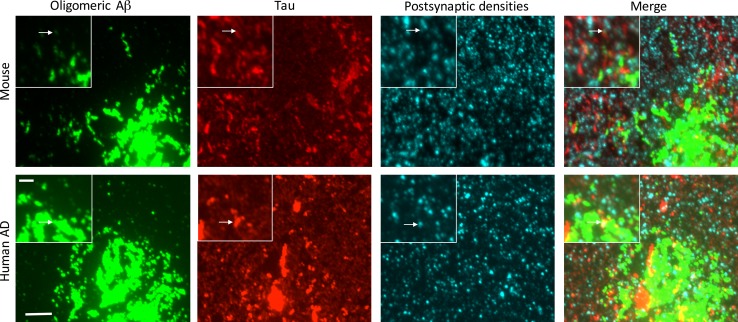
Co-aggregation of pathological proteins in synapses may contribute to neurodegeneration. Synaptic toxicity of pathological proteins is thought to be one of the driving forces in several neurodegenerative diseases. In both a mouse model expressing fAD mutations in APP and PS1 and human wild-type τ ([65], top) and human AD brain (bottom), we observe colocalization of Aβ and τ at some synapses using the array tomography technique (arrows). Scale bars represent 5 µm in large panel and 2 µm in inset
Fig. 3
Fig. 3
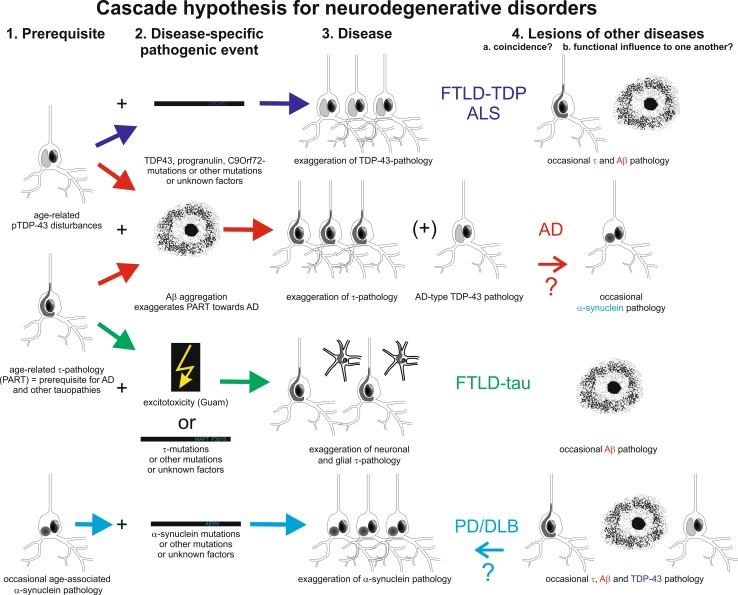
Cascade hypothesis for neurodegenerative disorders: Pathological protein interactions contribute to neurodegeneration. Schematic representation of the interplay between the different neurodegenerative protein aggregates and their related diseases. As a result of the current knowledge about disease progression and experimental evidence about protein-aggregate interactions in vivo an in vitro, we hypothesize that abnormal τ-protein accumulation is an event that happens during aging in the brain stem of nearly everyone above 40 years of age [15] (1 prerequisite for disease). AD appears to develop when Aβ aggregates occur and initiate more pathological accumulation of τ and its spread through the brain (2 disease-specific pathogenic event and 3 disease). Maturation of plaque-associated and soluble/dispersible Aβ-aggregates thereby appear to be a critical event in the progression of the disease. Abnormal τ-protein aggregates, TDP-43 aggregates, and α-syn aggregates occur in smaller subset of individuals during age as shown in Fig. 1 (it is not clear whether it is a result of aging or the early stages of neurodegeneration). Once Aβ aggregates prevail in a certain amount or biochemical maturation stage, it is tempting to speculate that these Aβ aggregates may also exaggerate/catalyze TDP-43 or possibly also α-syn pathology in pattern similar to that seen in AD or AD-LBD (4 α-syn pathology is typical for PD/DLB and can be interpreted as pure coincidence or as influenced by/influencing AD pathology or its clinical picture). In the absence of Aβ and/or after exposure to other triggers (e.g., disease-specific mutations, excitotoxicity in Guam disease [35]) τ, α-syn, and TDP-43 aggregates develop other neurodegenerative disorders such as FTLD-tau, FTLD-TDP, ALS, or PD/DLB. AD Alzheimer’s disease, FTLD frontotemporal lobar degeneration, ALS amyotrophic lateral sclerosis (synonymous with MND—motor neuron disease), LBD Lewy body disease [including Parkinson’s disease (PD) and DLB]

References

    1. Abramowski D, Rabe S, Rijal Upadhaya A, Reichwald J, Danner S, Staab D, Capetillo-Zarate E, Yamaguchi H, Saido TC, Wiederhold KH, et al. Transgenic expression of intraneuronal Abeta42 but not Abeta40 leads to cellular Abeta lesions, degeneration and functional impairment without typical Alzheimer’s disease pathology. J Neurosci. 2012;32:1273–1283. doi: 10.1523/JNEUROSCI.4586-11.2012. - DOI - PMC - PubMed
    1. Alafuzoff I, Arzberger T, Al-Sarraj S, Bodi I, Bogdanovic N, Braak H, Bugiani O, Del Tredici K, Ferrer I, Gelpi E, et al. Staging of neurofibrillary pathology in Alzheimer’s disease. A study of the BrainNet Europe Consortium. Brain Pathol. 2008;18:484–496. - PMC - PubMed
    1. Alzheimer’s Association 2016 Alzheimer’s disease facts and figures. Alzheimers Dement. 2016;12:459–509. doi: 10.1016/j.jalz.2016.03.001. - DOI - PubMed
    1. Amador-Ortiz C, Lin WL, Ahmed Z, Personett D, Davies P, Duara R, Graff-Radford NR, Hutton ML, Dickson DW. TDP-43 immunoreactivity in hippocampal sclerosis and Alzheimer’s disease. Ann Neurol. 2007;61:435–445. doi: 10.1002/ana.21154. - DOI - PMC - PubMed
    1. Arima K, Mizutani T, Alim MA, Tonozuka-Uehara H, Izumiyama Y, Hirai S, Ueda K. NACP/alpha-synuclein and tau constitute two distinctive subsets of filaments in the same neuronal inclusions in brains from a family of parkinsonism and dementia with Lewy bodies: double-immunolabeling fluorescence and electron microscopic studies. Acta Neuropathol. 2000;100:115–121. doi: 10.1007/s004010050002. - DOI - PubMed

MeSH terms