


Informal care: choice or constraint?
- PMID: 28401583
- PMCID: PMC5873411
- DOI: 10.1111/scs.12441
Informal care: choice or constraint?
Abstract
Background: 'Choice' is increasingly pursued as a goal of social policy. However, the degree to which choice is exercised when entering an informal caring role is open to debate.
Aim: In this study, we examined the degree of choice and constraint in entering a caring role, and the relationship between choice and carers' well-being.
Methods: Data were derived from 1100 responses to a postal survey conducted in a British city. Statistical tests of association and multivariable regression modelling were applied to study the factors associated with choice in entering a caring role and the association that choice in entering a caring role had with carers' well-being.
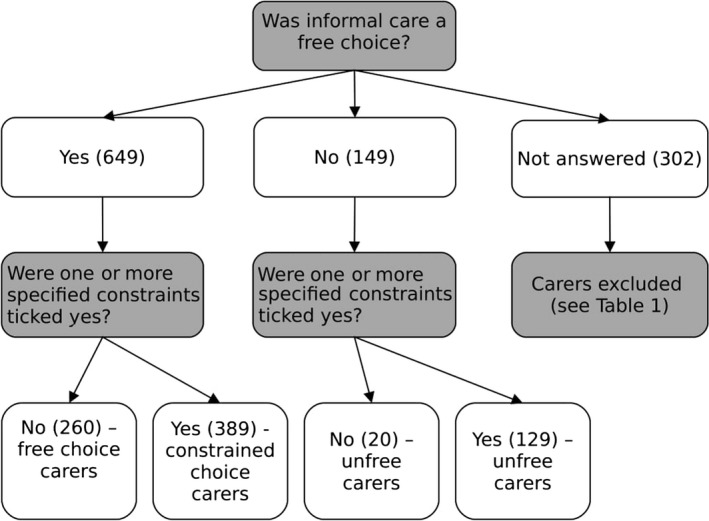
Results: We found that informal care was generally perceived to be a free choice, albeit in most cases, a choice was also constrained by duty, financial or social resources. Having a sense of free choice in entering care was strongly and positively associated with the carer's well-being.
Conclusion: The study findings are consistent with a view that enabling individuals to have more choice in their caring roles may be beneficial.
Keywords: choice; informal care; motivation; quality of life; survey; well-being.
© 2017 The Authors. Scandinavian Journal of Caring Sciences published by John Wiley & Sons Ltd on behalf of Nordic College of Caring Science.
Figures
References
-
- HM Government . Recognised, valued and supported: next steps for the carers strategy. 2011.
-
- Pickard L, Wittenberg R, Comas‐Herrera A, King D, Malley J. Care by spouses, care by children: projections of informal care for older people in England to 2031. Soc Policy Soc 2007; 6: 353–66.
-
- ONS . 2011 Census Analysis: Unpaid care in England and Wales, 2011 and comparison with 2001. 2013.
-
- Pinquart M, Sorensen S. Differences between caregivers and noncaregivers in psychological health and physical health: a meta‐analysis. Psychol Aging 2003; 18: 250–67. - PubMed
-
- Carmichael F, Charles S. The opportunity costs of informal care: does gender matter? J Health Econ 2003; 22: 781–803. - PubMed
MeSH terms
Grants and funding
LinkOut - more resources
Full Text Sources
Other Literature Sources
Medical
