. 2017 Nov;42(12):2285-2291.
doi: 10.1038/npp.2017.72. Epub 2017 Apr 2.

Menthol Enhances Nicotine Reward-Related Behavior by Potentiating Nicotine-Induced Changes in nAChR Function, nAChR Upregulation, and DA Neuron Excitability

Affiliations

Menthol Enhances Nicotine Reward-Related Behavior by Potentiating Nicotine-Induced Changes in nAChR Function, nAChR Upregulation, and DA Neuron Excitability

Brandon J Henderson et al. Neuropsychopharmacology. 2017 Nov.

Abstract

Understanding why the quit rate among smokers of menthol cigarettes is lower than non-menthol smokers requires identifying the neurons that are altered by nicotine, menthol, and acetylcholine. Dopaminergic (DA) neurons in the ventral tegmental area (VTA) mediate the positive reinforcing effects of nicotine. Using mouse models, we show that menthol enhances nicotine-induced changes in nicotinic acetylcholine receptors (nAChRs) expressed on midbrain DA neurons. Menthol plus nicotine upregulates nAChR number and function on midbrain DA neurons more than nicotine alone. Menthol also enhances nicotine-induced changes in DA neuron excitability. In a conditioned place preference (CPP) assay, we observed that menthol plus nicotine produces greater reward-related behavior than nicotine alone. Our results connect changes in midbrain DA neurons to menthol-induced enhancements of nicotine reward-related behavior and may help explain how smokers of menthol cigarettes exhibit reduced cessation rates.


Figures
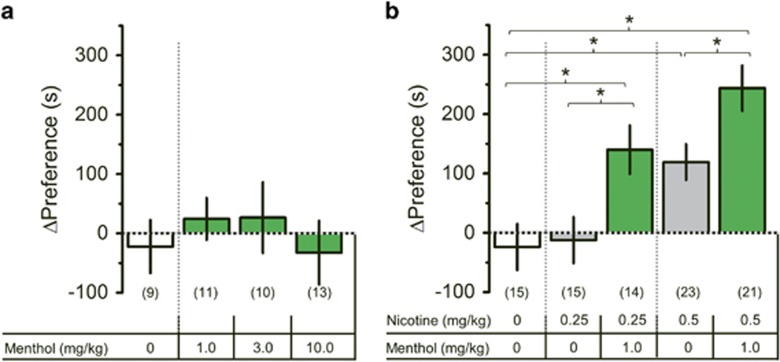
Figure 1
Figure 1
Menthol alone is not rewarding but enhances nicotine reward-related behavior. (a and b) Mice were administered saline, menthol, nicotine, or menthol plus nicotine at doses indicated. The data are mean±SEM. *p<0.05, one-way ANOVA, post hoc Tukey. Numbers in parentheses represent number of mice per group.
Figure 2
Figure 2
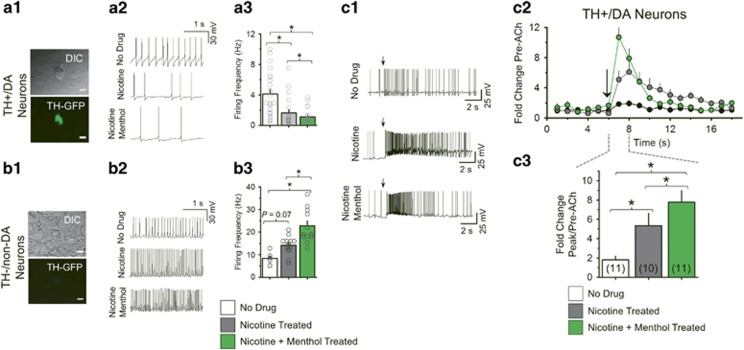
Menthol enhances nicotine-induced changes midbrain neuron firing frequency. (a1, b1) Neurons were identified as TH+/DA or TH-/non-DA using TH-eGFP fluorescence. Bars, 20 μm. (a2–3, b2–3, c1–3) Neurons were treated 10 days with control, 200 nM nicotine, or 500 nM menthol plus 200 nM nicotine and firing frequencies were recorded in current clamp mode. (a3, b3) Mean firing frequency of neurons (n=20–22 for TH+/DA neurons and 9–13 for TH−/non-DA neurons). (c1) Current-clamp recordings of TH+/DA neurons before and after ACh puff (100 ms, 300 μM at arrows). (c2) Mean firing frequency over time before and after ACh application. (c3) Mean ‘peak’ firing frequency during 2 s post-ACh puff. For (c1–3), number of neurons recorded is indicated in parenthesis of (c3). The data are mean±SEM: *, p<0.05, one-way ANOVA, post hoc Tukey.
Figure 3
Figure 3
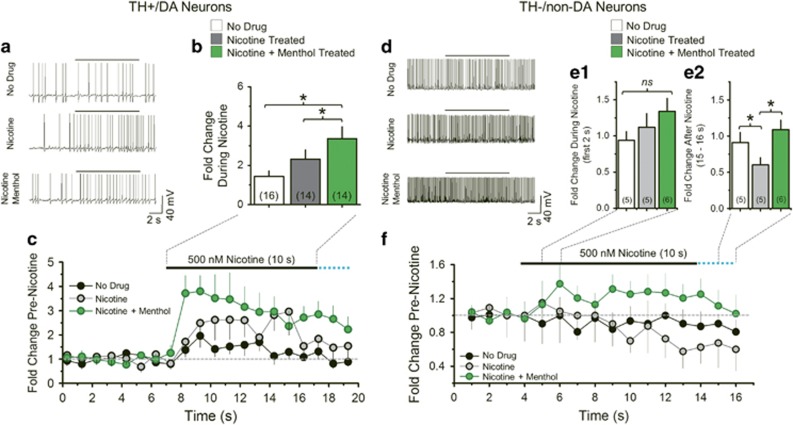
Menthol plus nicotine alters neuron excitability during acute exposure to smoking-relevant nicotine concentrations. Neurons were treated 10 days with control, nicotine, or menthol plus nicotine. (a and d) Representative current-clamp traces from TH+/DA and TH−/non-DA neurons puffed with nicotine. (b) Mean change in TH+/DA neuron firing frequency during 10 s nicotine applications. (c) and (f), mean firing frequency over time for TH+/DA and TH−/non-DA neurons, respectively. (e1–2) Mean fold-change in TH−/non-DA firing frequency following the first 2 s of nicotine puff (e1) and 2 s following end of nicotine puff (e2). For (c) and (b), number of individual neurons recorded is indicated in parenthesis in (b). For (f) and (e1–2), number of individual neurons recorded is indicated in parenthesis in (e1-2). The data are mean±SEM. *, p<0.05, one-way ANOVA, post hoc Tukey. Bars indicate 10 s, 500 nM nicotine application and (c, f) dotted blue lines indicate nicotine remains briefly after the end of puff due to perfusion rate.
Figure 4
Figure 4
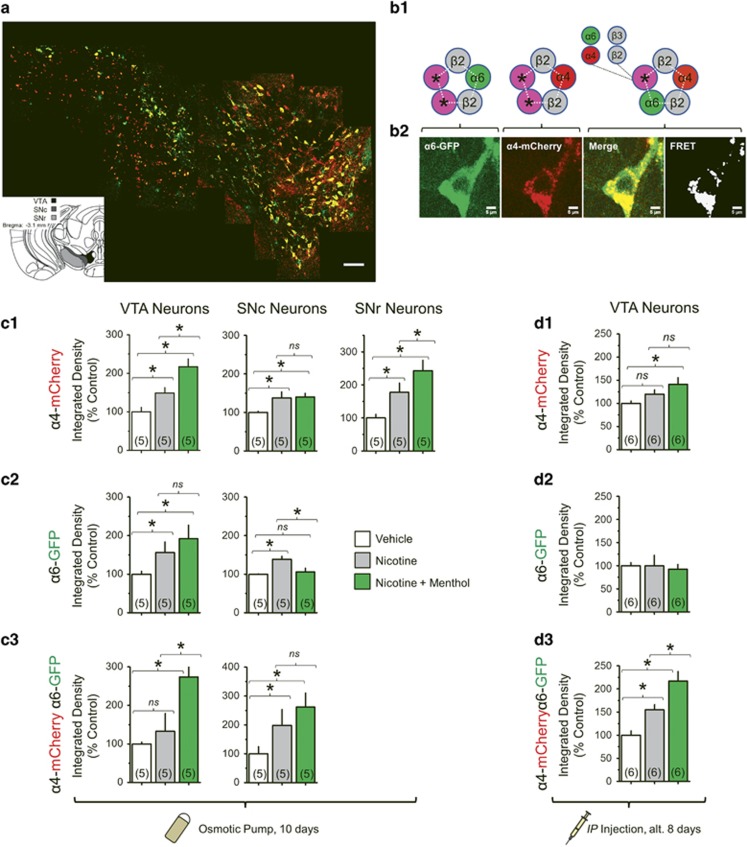
Menthol enhances nicotine-induced upregulation. (a) Representative coronal slice (bregma −3.1) with α4-mCherryα6-GFP-labeled neurons in the VTA, SNc, and SNr. Bar, 100 μm. (b1) Potential assemblies of midbrain nAChRs revealed by GFP and mCherry fluorescence. The subunits indicated by * are uncertain (α4, α6, β2, or β3). (b2) Representative α4-mCherryα6-GFP* neurons. (c1–3) α4-mCherry*, α6-GFP*, or α4α6* nAChR-integrated density. The data are mean±SEM, normalized to vehicle. (c1–3) Chronic treatments were 10 days: vehicle, 2 mg/kg/h nicotine, or 2 mg/kg/h nicotine with 2 mg/kg/h menthol. (d1–3) Mice were given drug dosing identical to CPP assays. Number of mice for each treatment is indicated in parenthesis. *p<0.05, one-way ANOVA, post hoc Tukey.
Figure 5
Figure 5
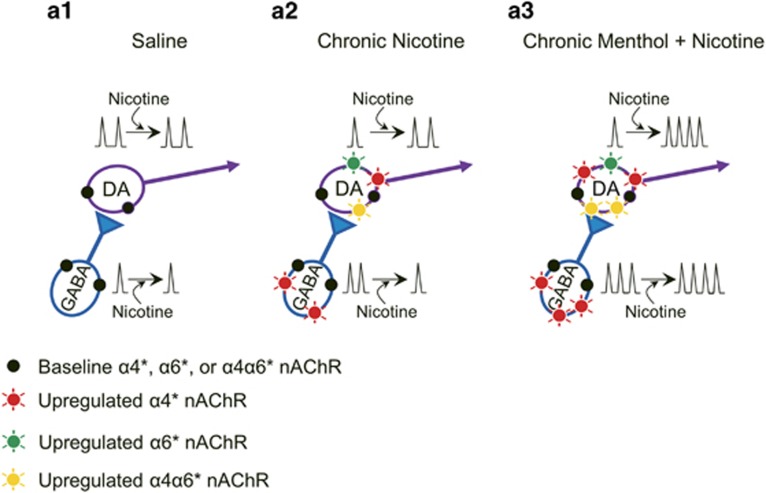
Summary. Simplified circuit diagram showing GABAergic neurons (blue) projecting to VTA DA neurons (purple). Arrows indicate acute applications of nicotine and its effect on firing frequency. See discussion for complete description.

References

    1. Ahijevych K, Garrett BE (2010). The role of menthol in cigarettes as a reinforcer of smoking behavior. Nicotine Tob Res 12(Suppl 2): S110–S116. - PMC - PubMed
    1. Ai J, Taylor KM, Lisko JG, Tran H, Watson CH, Holman MR (2015). Menthol content in US marketed cigarettes. Nicotine Tob Res 18: 1575–1580. - PMC - PubMed
    1. Alsharari SD, King JR, Nordman JC, Muldoon PP, Jackson A, Zhu AZX et al (2015). Effects of menthol on nicotine pharmacokinetic, pharmacology and dependence in mice. PloS ONE 10: e0137070. - PMC - PubMed
    1. Biswas L, Harrison E, Gong Y, Avusula R, Lee J, Zhang M et al (2016). Enhancing effect of menthol on nicotine self-administration in rats. Psychopharmacology 233: 3417–3427. - PMC - PubMed
    1. Brody A, Mukhin A, La Charite J, Ta K, Farahi J, Sugar C et al (2013). Up-regulation of nicotinic acetylcholine receptors in menthol cigarette smokers. Int J Neuropsychopharmacol 16: 957–966. - PMC - PubMed

MeSH terms