


Elephants know when their bodies are obstacles to success in a novel transfer task
- PMID: 28402335
- PMCID: PMC5389349
- DOI: 10.1038/srep46309
Elephants know when their bodies are obstacles to success in a novel transfer task
Abstract
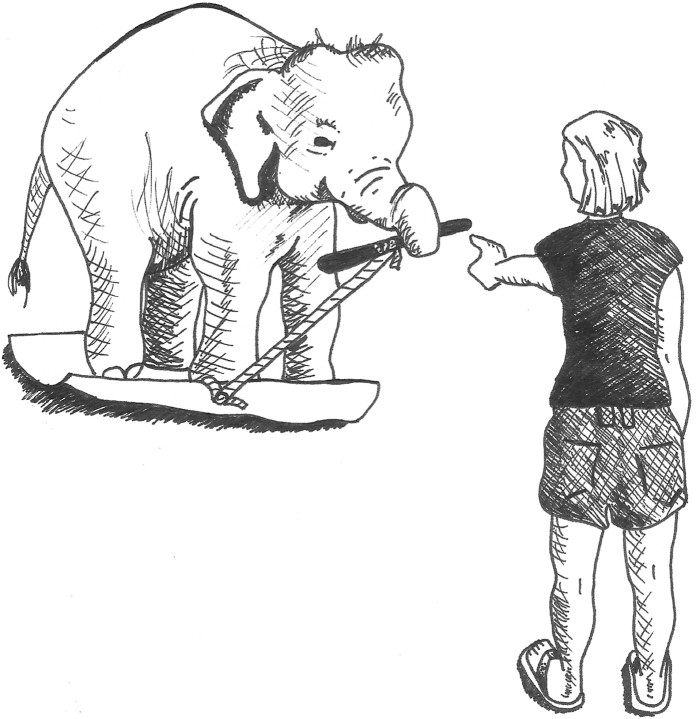
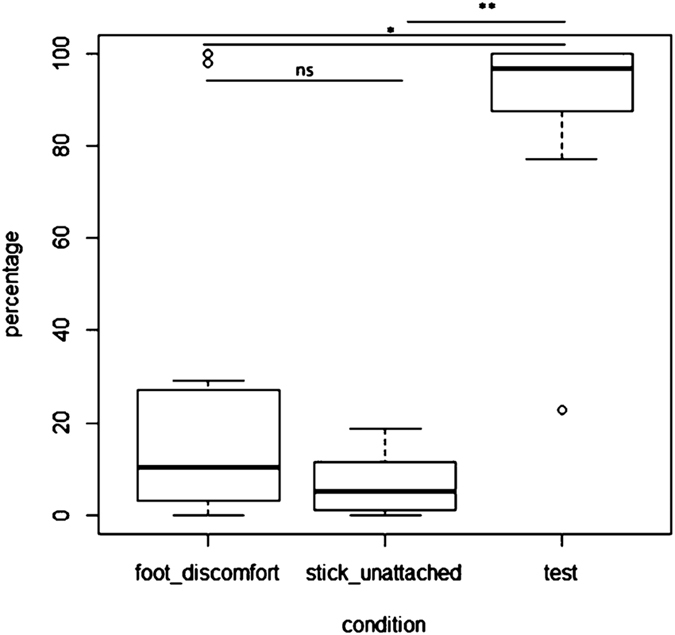
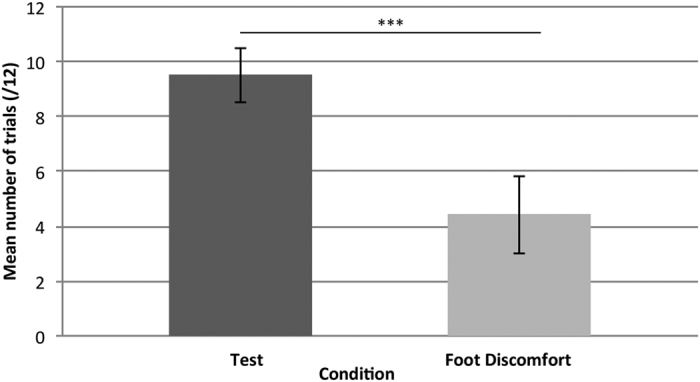
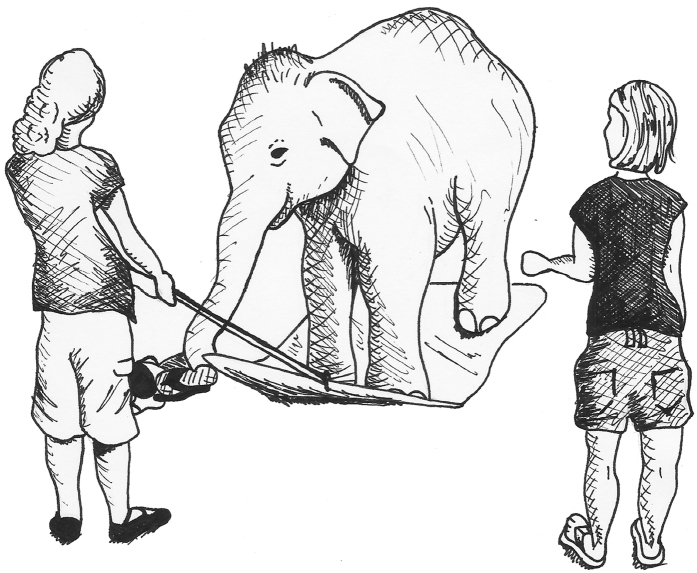
The capacity to recognise oneself as separate from other individuals and objects is difficult to investigate in non-human animals. The hallmark empirical assessment, the mirror self-recognition test, focuses on an animal's ability to recognise itself in a mirror and success has thus far been demonstrated in only a small number of species with a keen interest in their own visual reflection. Adapting a recent study done with children, we designed a new body-awareness paradigm for testing an animal's understanding of its place in its environment. In this task, Asian elephants (Elephas maximus) were required to step onto a mat and pick up a stick attached to it by rope, and then pass the stick forward to an experimenter. In order to do the latter, the elephants had to see their body as an obstacle to success and first remove their weight from the mat before attempting to transfer the stick. The elephants got off the mat in the test significantly more often than in controls, where getting off the mat was unnecessary. This task helps level the playing field for non-visual species tested on cognition tasks and may help better define the continuum on which body- and self-awareness lie.
Conflict of interest statement
J.P. is the founder and executive director of Think Elephants International, a US public charity that provided partial funding support for this research project. The authors declare no other competing financial interests.
Figures
References
-
- Gallup G. Self-awareness and the emergence of mind in primates. Am. J. Primatol. 2, 237–248 (1982). - PubMed
-
- Plotnik J. M., de Waal F. B. M., Moore D. & Reiss D. Self-recognition in the Asian elephant and future directions for cognitive research with elephants in zoological settings. Zoo Biol. 29, 179–91 (2010). - PubMed
-
- Bekoff M. Considering animals—not ‘ higher primates ’ consciousness and self in animals: some reflections. Zygon 38, 229–245 (2003).
-
- Herman L. M. Body and self in dolphins. Conscious. Cogn. 21, 526–45 (2012). - PubMed
-
- de Waal F. B. M. Good Natured. The origins of right and wrong in humans and other animals (Harvard University Press, 1996).
Publication types
MeSH terms
LinkOut - more resources
Full Text Sources
Other Literature Sources
