. 2017 Jun 20;45(11):6837-6847.
doi: 10.1093/nar/gkx254.

Stepwise assembly of the earliest precursors of large ribosomal subunits in yeast

Affiliations

Stepwise assembly of the earliest precursors of large ribosomal subunits in yeast

Wu Chen et al. Nucleic Acids Res. .

Abstract

Small ribosomal subunits are co-transcriptionally assembled on the nascent precursor rRNA in Saccharomyces cerevisiae. It is unknown how the highly intertwined structure of 60S large ribosomal subunits is initially formed. Here, we affinity purified and analyzed a series of pre-60S particles assembled in vivo on plasmid-encoded pre-rRNA fragments of increasing lengths, revealing a spatiotemporal assembly map for 34 trans-acting assembly factors (AFs), 30 ribosomal proteins and 5S rRNA. The gradual association of AFs and ribosomal proteins with the pre-rRNA fragments strongly supports that the pre-60S is co-transcriptionally, rather than post-transcriptionally, assembled. The internal and external transcribed spacers ITS1, ITS2 and 3΄ ETS in pre-rRNA must be processed in pre-60S. We show that the processing machineries for ITS1 and ITS2 are primarily recruited by the 5΄ and 3΄ halves of pre-27S RNA, respectively. Nevertheless, processing of both ITS1 and ITS2 requires a complete 25S region. The 3΄ ETS plays a minor role in ribosome assembly, but is important for efficient rRNA processing and ribosome maturation. We also identified a distinct pre-60S state occurring before ITS2 processing. Our data reveal the elusive co-transcriptional assembly pathway of large ribosomal subunit.


Figures

Figure 1.
Figure 1.
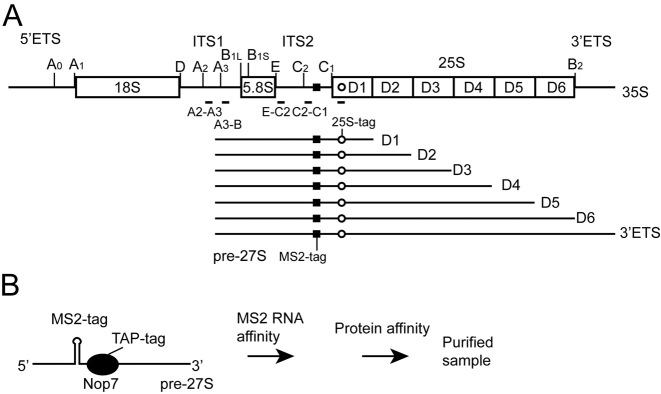
Purification of plasmid-derived pre-60S particles. (A) Construction of pre-27S RNA fragments. The structural diagram and processing sites of 35S pre-rRNA are shown on the top. Seven pre-27S RNA fragments terminate after one of six domains I–VI (D1–D6) of 25S rRNA or the 3΄ ETS and contain an MS2-tag (square) in ITS2 and a plasmid-specific sequence (circle, 25S-tag) in domain I. These RNAs are transcribed under a GAL-promoter in multiple-copy 2μ plasmids. Locations of hybridization probes are indicated. (B) Plasmid-derived pre-60S particles were affinity purified via an MS2-tag in pre-rRNA and then via TAP-tagged Nop7.
Figure 2.
Figure 2.
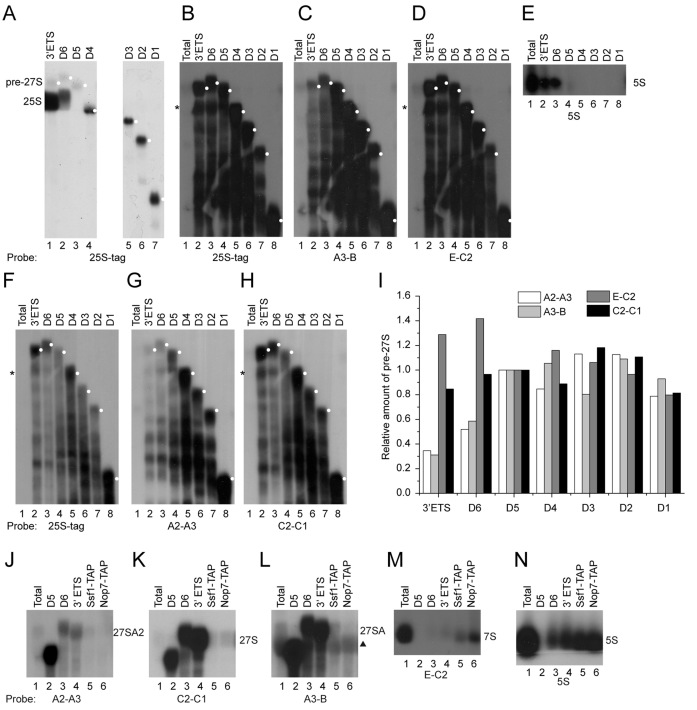
Processing of plasmid-derived pre-27S RNAs. (A) Total RNAs from Nop7-TAP strains that expressed an indicated pre-27S RNA fragment were separated on agarose-formaldehyde gels and blotted with 32P-labeled oligonucleotides that hybridize to the plasmid-specific 25S-tag in the D1 domain. The longest pre-27S RNAs in each lane are labeled with white circles. (B–H) Northern blot analysis of RNAs in purified pre-60S particles. Total RNA (15 μg) in the first lane was from the BY4741 strain. RNAs were separated on two gels (B–E and F–H) and hybridized to probes 25S-tag (B and F), A3-B(C), E-C1(D), 5S (E), A2-A3(G) and C1-C2 (H). The binding sites of probes are indicated in Figure 1A. The top bands labeled with white circles represent species containing an intact ITS2. Asterisk indicates a degradation product that had a similar size as 25S rRNA and hybridized to the ITS2-targeting probes. (I) Quantification of the top RNA species detected by different probes in B–D and F–H. The volume of the top band in each lane detected by a probe was divided by the volume detected by 25S-tag. The resultant ratios were further normalized to that of D5 RNA. (J–N) Northern blot analysis of RNA in the D5, D6 and 3΄ ETS particles and the chromosomal Ssf1-TAP and Nop7-TAP particles. Triangles indicate cross-hybridization signals of 25S rRNA.
Figure 3.
Figure 3.
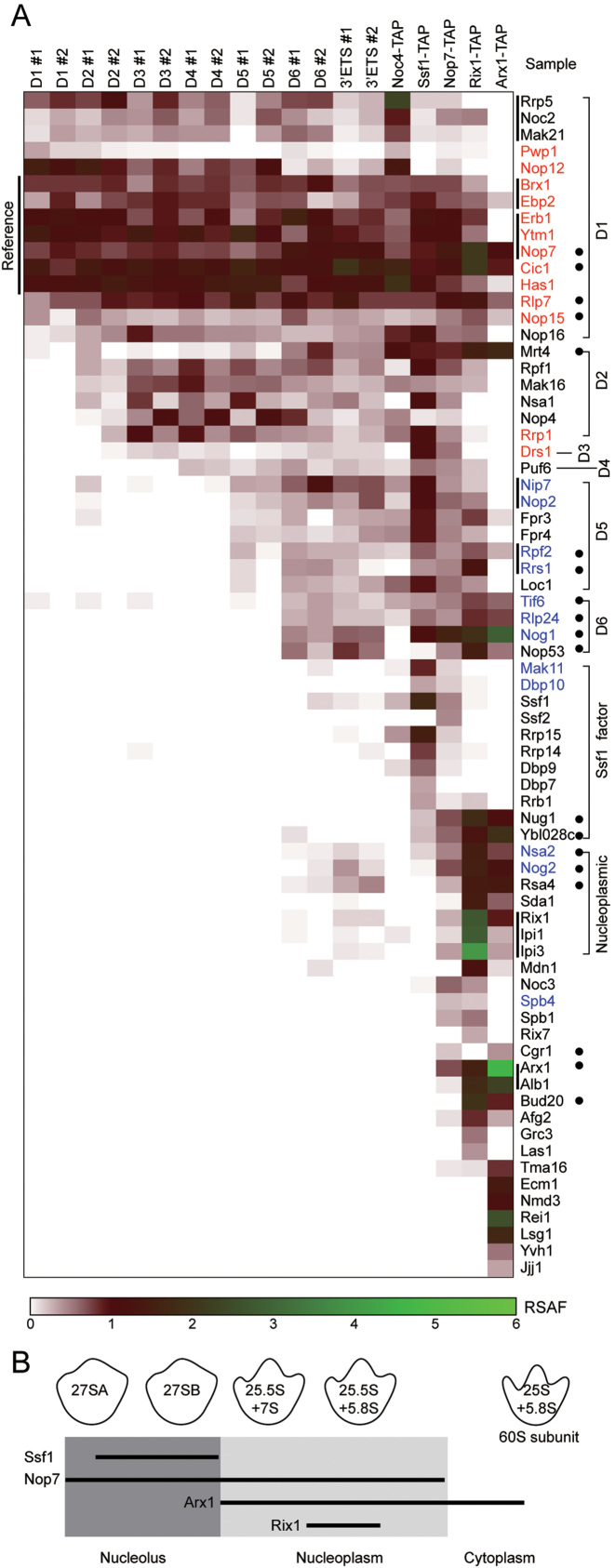
Assembly order of AFs to pre-60S. (A) Heatmap of AFs associated with progressively elongated pre-27S RNAs and chromosomal pre-60S particles. The proteins are color-coded according to their RSAF values normalized against the reference proteins Brx1, Ebp2, Erb1, Ytm1, Nop7, Cic1 and Has1 by default. The Arx1-TAP particle is normalized against Nop7 and Cic1 because the other reference proteins were of very low abundance or absent. The plasmid-derived particles were purified and analyzed in duplicate. Noc4-TAP, Ssf1-TAP, Rix1-TAP and Arx1-TAP are chromosomal particles. A3-factors and B-factors are colored red and blue, respectively. Solid circles mark 19 AFs found in the structure of an early nucleoplasmic pre-60S (11,12). (B) Association duration of the indicated AFs with evolving pre-60S particles. Pre-rRNA species in different pre-60S particles are shown.
Figure 4.
Figure 4.
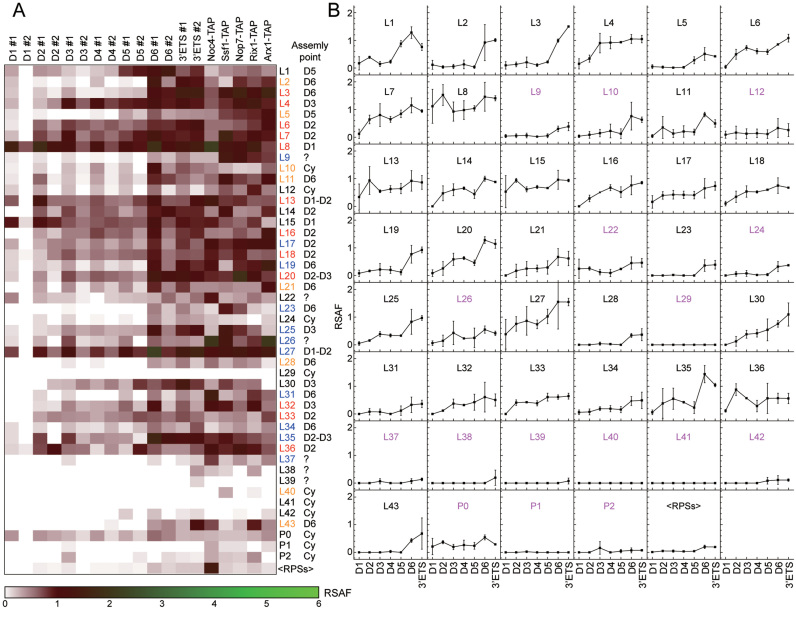
Assembly order of PRLs. (A) Heatmap of RPLs in pre-60S particles. The proteins are color-coded according to their RSAF values normalized against Brx1, Ebp2, Erb1, Ytm1, Nop7, Cic1 and Has1 for plasmid-derived particles. The total RSAF value of RPLs of chromosomal particles is further normalized against that of the 3΄ ETS #1 particle. The last row shows average RSAFs for RPSs. The early, middle, late and other unclassified RPLs are colored red, blue, orange and black, respectively. The deduced assembly points or ranges are displayed on the right. Cy indicates cytoplasmic assembly, and question mark denotes ‘not assigned’. (B) The average RSAF values of two samples are plotted as a function of pre-27S RNAs for each RPL. Error bars are standard deviations. RPLs that are assembled at the cytoplasm or unassigned are colored magenta.
Figure 5.
Figure 5.
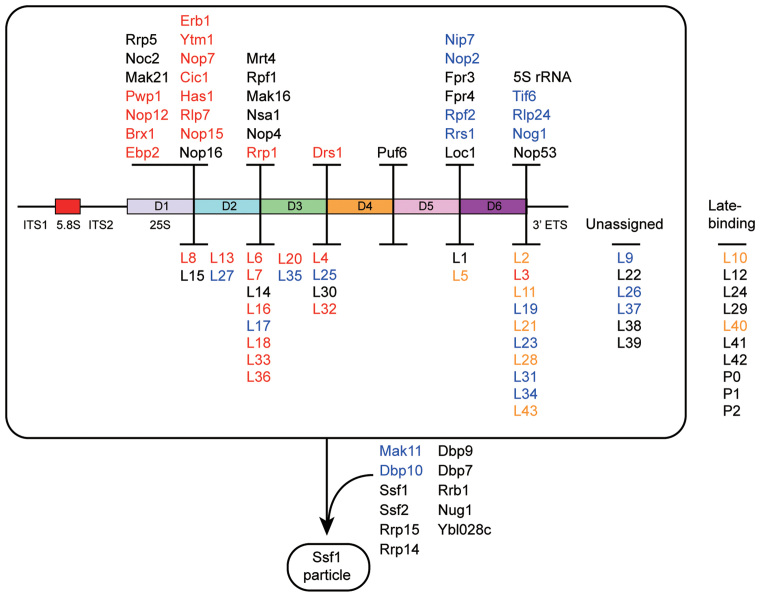
Assembly map of early pre-60S. The AFs and RPLs are placed at their deduced assembly points. A3-factors and B-factors are colored red and blue, respectively. The early, middle, late and other unclassified RPLs are colored red, blue, orange and black, respectively. The rectangular box refers to a pre-60S state before ITS2 processing, which develops into the Ssf1 particle with association of additional AFs.

References

    1. Woolford J.L. Jr, Baserga S.J.. Ribosome biogenesis in the yeast Saccharomyces cerevisiae. Genetics. 2013; 195:643–681. - PMC - PubMed
    1. de la Cruz J., Karbstein K., Woolford J.L. Jr. Functions of ribosomal proteins in assembly of eukaryotic ribosomes in vivo. Annu. Rev. Biochem. 2015; 84:93–129. - PMC - PubMed
    1. Grandi P., Rybin V., Bassler J., Petfalski E., Strauss D., Marzioch M., Schafer T., Kuster B., Tschochner H., Tollervey D. et al. 90S pre-ribosomes include the 35S pre-rRNA, the U3 snoRNP, and 40S subunit processing factors but predominantly lack 60S synthesis factors. Mol. Cell. 2002; 10:105–115. - PubMed
    1. Dragon F., Gallagher J.E., Compagnone-Post P.A., Mitchell B.M., Porwancher K.A., Wehner K.A., Wormsley S., Settlage R.E., Shabanowitz J., Osheim Y. et al. A large nucleolar U3 ribonucleoprotein required for 18S ribosomal RNA biogenesis. Nature. 2002; 417:967–970. - PMC - PubMed
    1. Osheim Y.N., French S.L., Keck K.M., Champion E.A., Spasov K., Dragon F., Baserga S.J., Beyer A.L.. Pre-18S ribosomal RNA is structurally compacted into the SSU processome prior to being cleaved from nascent transcripts in Saccharomyces cerevisiae. Mol. Cell. 2004; 16:943–954. - PubMed

MeSH terms

LinkOut - more resources