


Biotin-thiamine responsive basal ganglia disease: Identification of a pyruvate peak on brain spectroscopy, novel mutation in SLC19A3, and calculation of prevalence based on allele frequencies from aggregated next-generation sequencing data
- PMID: 28402605
- PMCID: PMC10506158
- DOI: 10.1002/ajmg.a.38189
Biotin-thiamine responsive basal ganglia disease: Identification of a pyruvate peak on brain spectroscopy, novel mutation in SLC19A3, and calculation of prevalence based on allele frequencies from aggregated next-generation sequencing data
Abstract
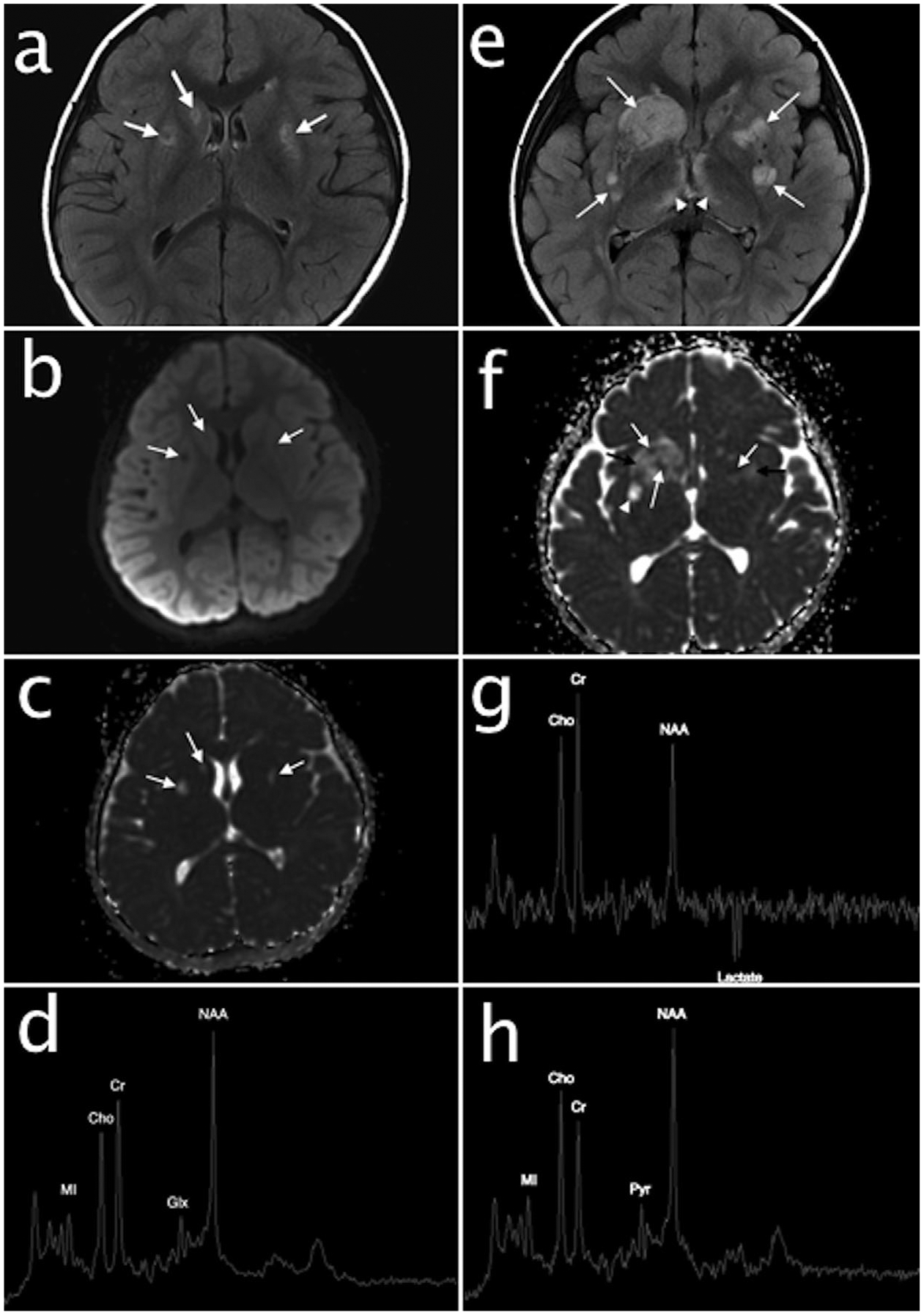
Biotin-thiamine responsive basal ganglia disease is an inborn error of metabolism caused by mutations in SLC19A3, encoding a transporter of thiamine across the plasma membrane. We report a novel mutation identified in the homozygous state in a patient with typical brain MRI changes. In addition, this patient had markedly elevated CSF pyruvate, a low lactate-to-pyruvate molar ratio, and an abnormal pyruvate peak at 2.4 ppm on brain magnetic resonance spectroscopy. Using aggregated exome sequencing data, we calculate the carrier frequency of mutations in SLC19A3 as 1 in 232 individuals in the general population, for an estimated prevalence of the disease of approximately 1 in 215,000 individuals. The disease is thus more frequent than previously recognized, and the presence of a pyruvate peak on spectroscopy could serve as an important diagnostic clue.
Keywords: SLC19A3; biotin-thiamine responsive basal ganglia disease; magnetic resonance spectroscopy; pyruvate; thiamine metabolism dysfunction syndrome 2; thiamine transporter-2 deficiency.
© 2017 Wiley Periodicals, Inc.
Conflict of interest statement
CONFLICTS OF INTEREST
The authors report no conflict of interest.
Figures
References
-
- Alfadhel M, Almuntashri M, Jadah RH, Bashiri FA, Rifai MT, Al Shalaan H, & Al-Twaijri W (2013). Biotin-responsive basal ganglia disease should be renamed biotin-thiamine-responsive basal ganglia disease: A retrospective review of the clinical, radiological and molecular findings of 18 new cases. Orphanet Journal of Rare Diseases, 8, 83. - PMC - PubMed
-
- Chawla S, Kumar S, & Gupta RK (2004). Marker of parasitic cysts on in vivo proton magnetic resonance spectroscopy: Is it succinate or pyruvate? Journal of Magnetic Resonance Imaging, 20, 1052–1053. - PubMed
-
- Debs R, Depienne C, Rastetter A, Bellanger A, Degos B, Galanaud D, … Sedel F (2010). Biotin-responsive basal ganglia disease in ethnic Europeans with novel SLC19A3 mutations. Archives of Neurology, 67, 126–130. - PubMed
Publication types
MeSH terms
Substances
Supplementary concepts
Grants and funding
LinkOut - more resources
Full Text Sources
Other Literature Sources
