


Malignant Melanoma in African-Americans: A Population-Based Clinical Outcomes Study Involving 1106 African-American Patients from the Surveillance, Epidemiology, and End Result (SEER) Database (1988-2011)
- PMID: 28403068
- PMCID: PMC5403065
- DOI: 10.1097/MD.0000000000006258
Malignant Melanoma in African-Americans: A Population-Based Clinical Outcomes Study Involving 1106 African-American Patients from the Surveillance, Epidemiology, and End Result (SEER) Database (1988-2011)
Abstract
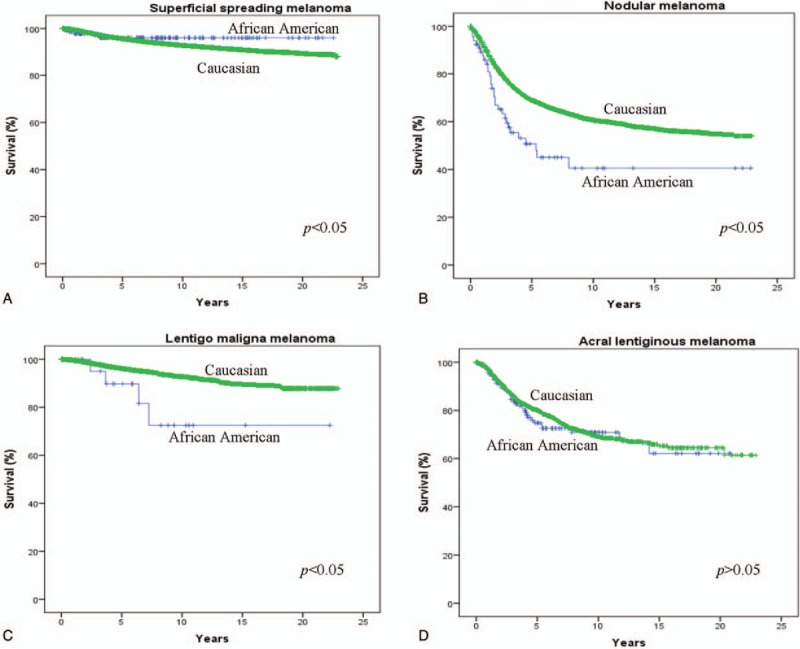
Malignant melanoma accounts for 75% of all skin cancer deaths and is potentially curable if identified early. Although melanoma is rare in African-Americans (AA), it is associated with a worse prognosis than in Caucasians. This study examines the demographic, pathologic, and clinical factors impacting AA melanoma outcomes.Data for 1106 AA and 212,721 Caucasian cutaneous melanoma patients were abstracted from the Surveillance, Epidemiology, and End Result (SEER) database (1988-2011). Data were grouped on the basis of histological subtypes: "Superficial Spreading" (SS), "Nodular" (NM), "Lentigo Maligna" (LM), "Acral Lentiginous" (AL), and "Not otherwise specified" (NOS).Cutaneous malignant melanoma occurs most commonly in the sixth and seventh decade of life. Caucasian patients presented most commonly with trunk melanomas (34.5%), while lower extremity melanomas were more common in AAs (56.1%), P < 0.001. AAs presented with deeper tumors, more advanced stage of disease, and higher rates of ulceration and lymph node positivity than Caucasians. Cancer-specific mortality was significantly higher, while 5-year cancer-specific survival was significantly lower among AAs for NM and AL subtypes. Multivariate analysis identified male gender, regional and distant stage, NM and AL subtypes as independently associated with increased mortality among both ethnic groups.AAs present most often with AL melanoma on the lower extremities, and with deeper and more advanced stage lesions. AAs have higher cancer-specific mortality for NM and LM than Caucasians. Melanoma education for AA patients and health care providers is needed to increase disease awareness, facilitate early detection, and promote access to effective treatment.
Conflict of interest statement
The authors report no conflicts of interest.
Figures
References
-
- National Cancer Institute. SEER Stat Facts Sheet: Melanoma of the Skin. Accessed August 23, 2016.
-
- Longstreth J. Cutaneous malignant melanoma and ultraviolet radiation: a review. Cancer Metastasis Rev 1988;7:321–33. - PubMed
-
- Magnus K. Incidence of malignant melanoma of the skin in Norway, 1955-1970. Variations in time and space and solar radiation. Cancer 1973;32:1275–86. - PubMed
-
- Cormier JN, Xing Y, Ding M, et al. Ethnic differences among patients with cutaneous melanoma. Arch Intern Med 2006;166:1907–14. - PubMed
MeSH terms
LinkOut - more resources
Full Text Sources
Other Literature Sources
Medical
