


Weight change during chemotherapy in breast cancer patients: a meta-analysis
- PMID: 28403873
- PMCID: PMC5389147
- DOI: 10.1186/s12885-017-3242-4
Weight change during chemotherapy in breast cancer patients: a meta-analysis
Abstract
Background: Weight gain during chemotherapy in women with breast cancer is commonly reported. However, there are important differences between studies that examined weight change during chemotherapy; e.g. type of chemotherapy, menopausal status, time between body weight measurements and sample size. The purpose of this meta-analysis was to quantify changes in body weight during chemotherapy for women with breast cancer, taking these differences into account.
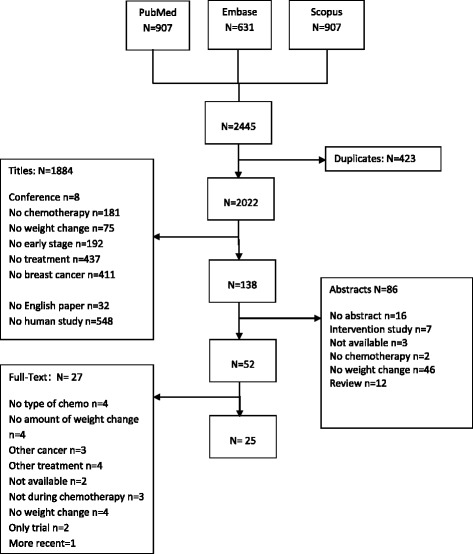
Methods: We identified relevant studies using PubMed, Scopus and Embase databases. The search was limited to human studies published in English up to and including December 2015. Only studies among women with early stage breast cancer treated with chemotherapy, with reported body weight before and after chemotherapy and type of chemotherapy were included. Random-effect models were used, and heterogeneity between studies was explored through stratified analyses and meta-regression. Sensitivity analyses were done to explore whether a specific study markedly affected the results.
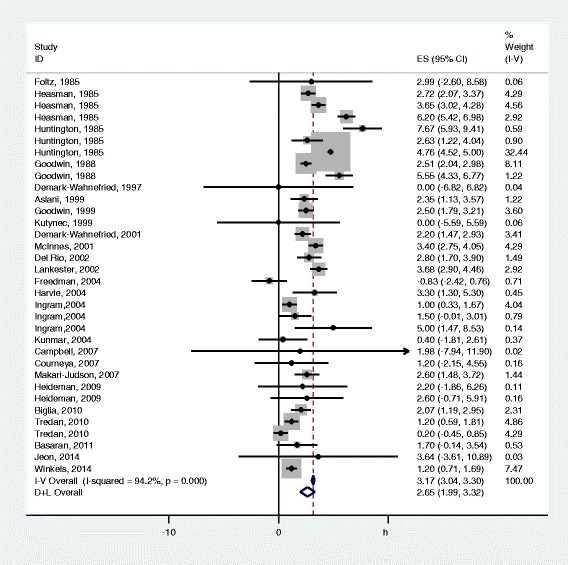
Results: In total 25 papers were found, including data from 2620 women. Overall, body weight increased during chemotherapy: 2.7 kg (95% CI 2.0, 7.5) with a high degree of heterogeneity (I2 = 94.2%). Stratified analyses showed weight gain in all strata, but did not substantially reduce heterogeneity. Univariate meta-regression showed less weight gain in prospective studies compared to chart review studies (-2.0, 95% CI: -3.1, -0.8). Studies including cyclophosphamide, methotrexate and 5-fluorouracil (CMF) regimes showed a greater weight gain compared to those that did not (2.2, 95% CI: 1.1, 3.3); and papers published until the year 2000 showed a greater weight gain compared to those published after 2000 (1.9, 95% CI:-0.8, 3.1). In the multivariate models only studies including CMF regimes and studies published until 2000 were associated with significant weight gain of respectively 1.3 and 1.4 kg.
Conclusion: Despite the high heterogeneity, this meta-analysis shows significant weight gain during chemotherapy for women with breast cancer. Weight gain was more pronounced in papers published until 2000 and women receiving CMF as chemotherapy regime. Although weight gain after chemotherapy has decreased over the course of time, weight gain is still substantial and deserves clinical attention.
Keywords: Breast cancer; Chemotherapy; Meta-analysis; Weight change.
Figures
References
-
- McInnes JA, Knobf MT. Weight gain and quality of life in women treated with adjuvant chemotherapy for early-stage breast cancer. Oncol Nurs Forum. 2001;28:675–684. - PubMed
-
- Cheney CL, Mahloch J, Freeny P. Computerized tomography assessment of women with weight changes associated with adjuvant treatment for breast cancer. Am J Clin Nutr. 1997;66:141–146. - PubMed
-
- Goodwin PJ. Obesity and insulin resistance in breast cancer: Are clinical trials needed? Breast Dis. 2012;23:310–13. ISSN: 1043-321X.
Publication types
MeSH terms
Substances
LinkOut - more resources
Full Text Sources
Other Literature Sources
Medical
