


Spatial clustering and risk factors of malaria infections in Bata district, Equatorial Guinea
- PMID: 28403879
- PMCID: PMC5389164
- DOI: 10.1186/s12936-017-1794-z
Spatial clustering and risk factors of malaria infections in Bata district, Equatorial Guinea
Abstract
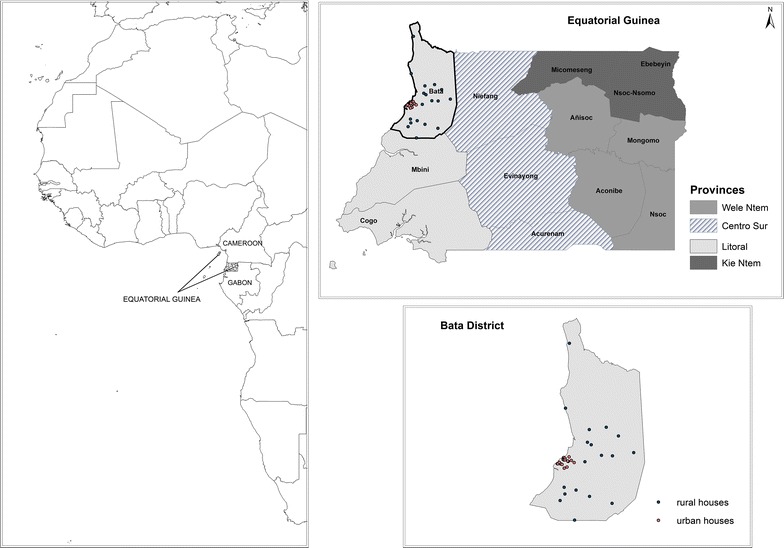
Background: The transmission of malaria is intense in the majority of the countries of sub-Saharan Africa, particularly in those that are located along the Equatorial strip. The present study aimed to describe the current distribution of malaria prevalence among children and its environment-related factors as well as to detect malaria spatial clusters in the district of Bata, in Equatorial Guinea.
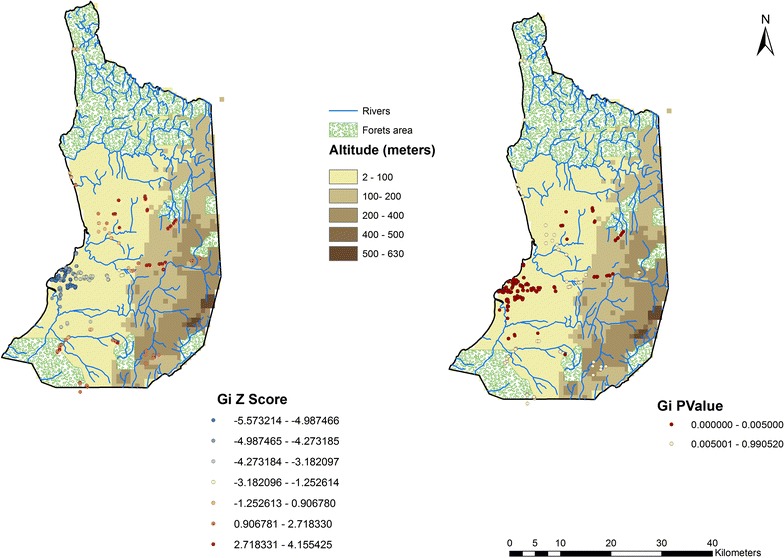
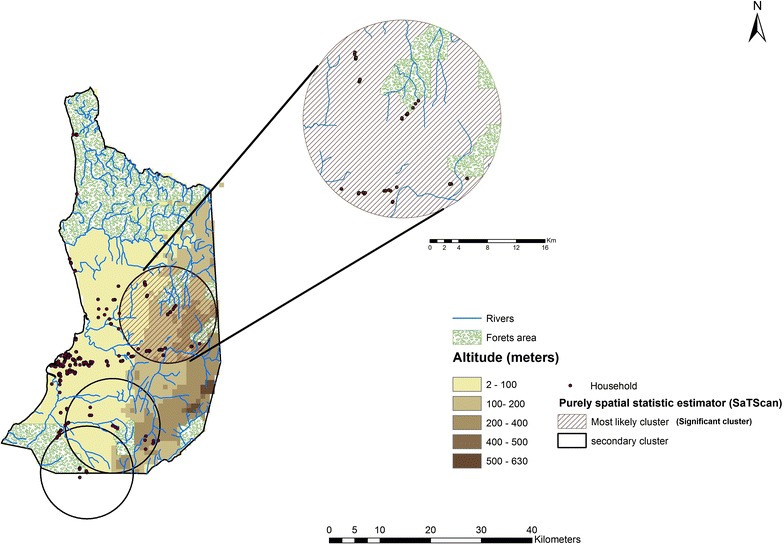
Methods: From June to August 2013 a representative cross-sectional survey using a multistage, stratified, cluster-selected sample was carried out of children in urban and rural areas of Bata District. All children were tested for malaria using rapid diagnostic tests (RDTs). Results were linked to each household by global position system data. Two cluster analysis methods were used: hot spot analysis using the Getis-Ord Gi statistic, and the SaTScan™ spatial statistic estimates, based on the assumption of a Poisson distribution to detect spatial clusters. In addition, univariate associations and Poisson regression model were used to explore the association between malaria prevalence at household level with different environmental factors.
Results: A total of 1416 children aged 2 months to 15 years living in 417 households were included in this study. Malaria prevalence by RDTs was 47.53%, being highest in the age group 6-15 years (63.24%, p < 0.001). Those children living in rural areas were there malaria risk is greater (65.81%) (p < 0.001). Malaria prevalence was higher in those houses located <1 km from a river and <3 km to a forest (IRR: 1.31; 95% CI 1.13-1.51 and IRR: 1.44; 95% CI 1.25-1.66, respectively). Poisson regression analysis also showed a decrease in malaria prevalence with altitude (IRR: 0.73; 95% CI 0.62-0.86). A significant cluster inland of the district, in rural areas has been found.
Conclusions: This study reveals a high prevalence of RDT-based malaria among children in Bata district. Those households situated in inland rural areas, near to a river, a green area and/or at low altitude were a risk factor for malaria. Spatial tools can help policy makers to promote new recommendations for malaria control.
Keywords: Children; Equatorial Guinea; Malaria; Rapid diagnostic tests; Spatial.
Figures
References
-
- WHO. World Malaria Report 2016. Geneva: World Health Organization; 2016. http://www.who.int/malaria/publications/world-malaria-report-2016/report.... Accessed 24 Mar 2017.
MeSH terms
LinkOut - more resources
Full Text Sources
Other Literature Sources
Medical
