


Burden of asymptomatic malaria among a tribal population in a forested village of central India: a hidden challenge for malaria control in India
- PMID: 28404504
- PMCID: PMC5457477
- DOI: 10.1016/j.puhe.2017.02.010
Burden of asymptomatic malaria among a tribal population in a forested village of central India: a hidden challenge for malaria control in India
Abstract
Objective: Chhattisgarh in India is a malaria-endemic state with seven southern districts that contributes approximately 50-60% of the reported malaria cases in the state every year. The problem is further complicated due to asymptomatic malaria cases which are largely responsible for persistent transmission. This study was undertaken in one of the forested villages of the Keshkal subdistrict in Kondagaon district to ascertain the proportion of the population harbouring subclinical malarial infections.
Study design: Community-based cross-sectional study.
Methods: Mass blood surveys were undertaken of the entire population of the village in the post-monsoon seasons of 2013 and 2014. Fingerprick blood smears were prepared from individuals of all ages to detect malaria infections in their blood. Individuals with fever at the time of the survey were tested with rapid diagnostic tests, and parasitaemia in thick blood smears was confirmed by microscopy. Malaria-positive cases were treated with anti-malarials in accordance with the national drug policy.
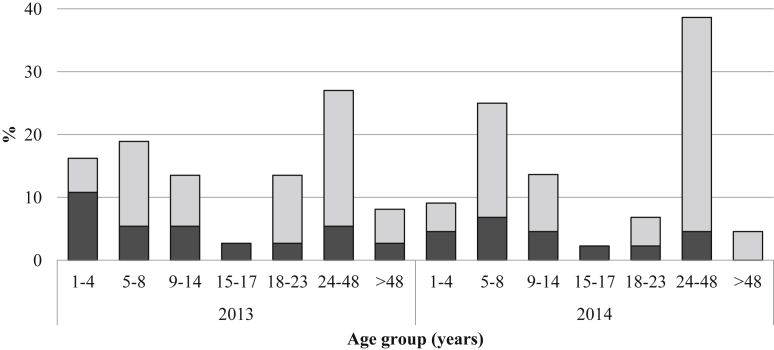
Results: Peripheral blood smears of 134 and 159 individuals, including children, were screened for malaria infection in 2013 and 2014, respectively. Overall, the malaria slide positivity rates were 27.6% and 27.7% in 2013 and 2014, respectively, and the prevalence rates of asymptomatic malaria were 20% and 22.8%. This study showed that, for two consecutive years, the prevalence of asymptomatic malaria infection was significantly higher among children aged ≤14 years (34.4% and 34.1% for 2013 and 2014, respectively) compared with adults (15.2% and 18.2% for 2013 and 2014, respectively; P = 0.023 and 0.04, respectively).
Conclusion: The number of asymptomatic malaria cases, especially Plasmodium falciparum, is significant, reinforcing the underlying challenge facing the malaria elimination programme in India.
Keywords: Asymptomatic malaria; Chhattisgarh; India; Parasitaemia.
Copyright © 2017 The Authors. Published by Elsevier Ltd.. All rights reserved.
Figures
References
-
- National Vector Borne Disease Control Program . Ministry of Health and Family Welfare, Government of India; New Delhi: 2015. Current malaria situation in India.http://nvbdcp.gov.in/Doc/mal_situation_Mar2015.pdf Available at: (last accessed 20 April 2015)
-
- Sabat R.N., Gitte S. Govt of India, MoHFW, Raipur; Raipur: 2012. Assessment of post distribution of LLIN and concurrent supervision of IRS.http://rltrird.cg.gov.in/pdf/ROHFW/Field%20survey/Assessment%20of%20post... Available at: (last accessed 15 December 2015)
-
- Bousema T., Okell L., Felger I., Drakeley C. Asymptomatic malaria infections: detectability, transmissibility and public health relevance. Nat Rev Microbiol. 2014;12:833–840. - PubMed
MeSH terms
Grants and funding
LinkOut - more resources
Full Text Sources
Other Literature Sources
Medical
