. 2017 Mar 15;31(6):617-627.
doi: 10.1101/gad.292409.116.

Transcriptional integration of paternal and maternal factors in the Arabidopsis zygote

Affiliations

Transcriptional integration of paternal and maternal factors in the Arabidopsis zygote

Minako Ueda et al. Genes Dev. .

Abstract

In many plants, the asymmetric division of the zygote sets up the apical-basal axis of the embryo. Unlike animals, plant zygotes are transcriptionally active, implying that plants have evolved specific mechanisms to control transcriptional activation of patterning genes in the zygote. In Arabidopsis, two pathways have been found to regulate zygote asymmetry: YODA (YDA) mitogen-activated protein kinase (MAPK) signaling, which is potentiated by sperm-delivered mRNA of the SHORT SUSPENSOR (SSP) membrane protein, and up-regulation of the patterning gene WOX8 by the WRKY2 transcription factor. How SSP/YDA signaling is transduced into the nucleus and how these pathways are integrated have remained elusive. Here we show that paternal SSP/YDA signaling directly phosphorylates WRKY2, which in turn leads to the up-regulation of WOX8 transcription in the zygote. We further discovered the transcription factors HOMEODOMAIN GLABROUS11/12 (HDG11/12) as maternal regulators of zygote asymmetry that also directly regulate WOX8 transcription. Our results reveal a framework of how maternal and paternal factors are integrated in the zygote to regulate embryo patterning.

Keywords: MAPK signaling; WOX8; maternal factors; zygote asymmetry.


Figures

Figure 1.
Figure 1.
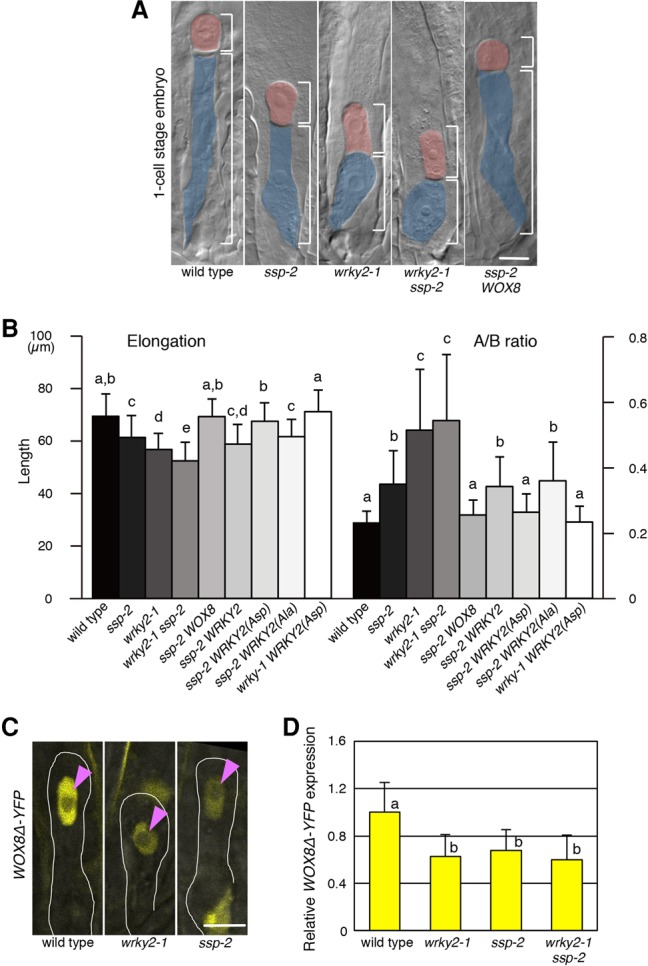
WRKY2 and SSP/MAPK signaling regulate zygote elongation and asymmetric division by square brackets. WOX8 expression. (A) One-cell stage embryos of the indicated genotypes. The apical (red) and basal (blue) cells are color-coded, and their lengths are marked by square brackets. (WOX8) pEASE:WOX8-YFP. (B) The total length of one-cell stage embryos (sum of apical and basal cell lengths), denoted as elongation, and the ratio of apical divided by basal cell lengths, denoted as A/B ratio, are shown. (WRKY2) pWRKY2:WRKY2-YFP; [WRKY2(Ala)] pWRKY2:WRKY2(Ala)-YFP; [WRKY2(Asp)] pWRKY2:WRKY2(Asp)-YFP. (C) WOX8Δ-YFP expression in zygotes of the indicated genotypes. The zygotes are outlined, and the nuclei are indicated by arrowheads. (D) Relative WOX8Δ-YFP signal intensities in the zygote. Wild type is set as 1. Bars, 10 µm. Error bars represent SD. n ≥ 80 (B); n ≥ 22 (D). Letters on columns indicate significantly associated categories. P < 0.05 by the Tukey-Kramer test.
Figure 2.
Figure 2.
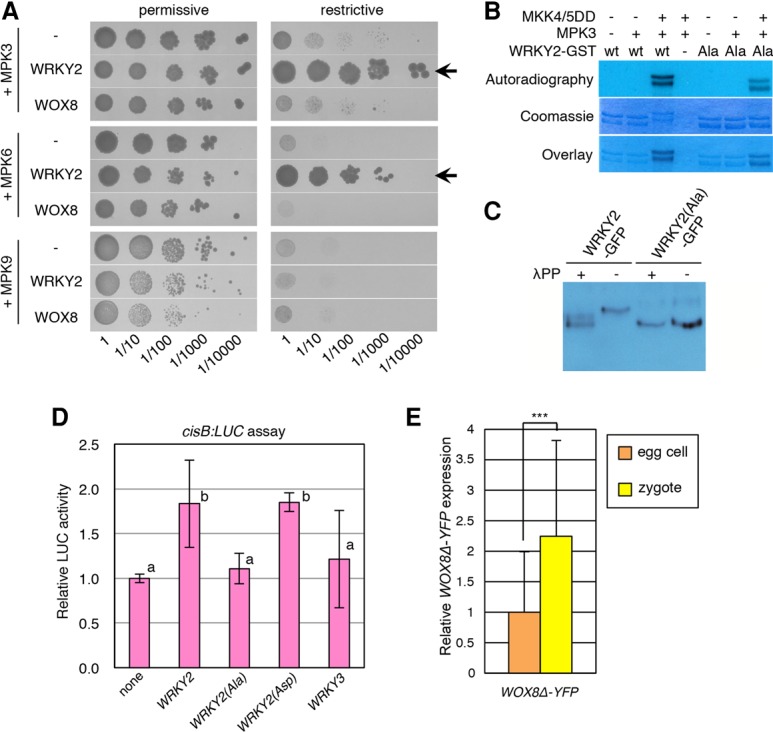
MPK3/6 phosphorylate WRKY2 to promote zygote asymmetry via transcriptional activation of WOX8. (A) Yeast two-hybrid assay of interactions between WRKY2 and MPK3 or MPK6. Panels show serial decimal dilutions of yeast on media with (permissive) and without (restrictive) histidine. Arrows mark growth on the restrictive medium. WOX8 and MPK9 were used as negative controls for WRKY2 and MPK3/6, respectively. (B) In vitro phosphorylation of WRKY2. (+) The presence of constitutively active MKK4 and MKK5 (MKK4/5DD) or MPK3; (−) the absence of constitutively active MKK4 and MKK5 (MKK4/5DD) or MPK3. WRKY2-GST (wt) and WRKY2(Ala)-GST (Ala) expressed in Escherichia coli show two main products, possibly due to partial degradation. An image of the entire gel is shown in Supplemental Figure S1C. (C) In vivo phosphorylation of WRKY2-GFP. Arabidopsis protoplasts were cotransformed with MPK3 and MKK4DD. The five serine residues of the serine–proline motifs (SP cluster) were replaced with alanine in WRKY2(Ala)-GFP. WRKY2-GFP, but not WRKY2(Ala)-GFP, shows a mobility shift due to phosphorylation that disappears after incubation (+) with λ phosphatase (λPP). (D) Luciferase (LUC) assay of the indicated effector proteins on the WOX8 cisB element in protoplasts. Expression of control without effector (none) is set as 1. Unmodified WRKY2, phospho-blocked WRKY2(Ala), and phospho-mimic WRKY2(Asp) variants were used. (WRKY3) Negative control. The characters on the graph indicate the significantly associated categories. P < 0.05 by the Tukey-Kramer test. (E) Relative intensity of WOX8Δ-YFP signals in the zygote and the egg cell. Egg cell is set as 1. (***) P < 0.001, Student's t-test. Error bars represent SD. n ≥ 3 (D); n ≥ 30 (E).
Figure 3.
Figure 3.
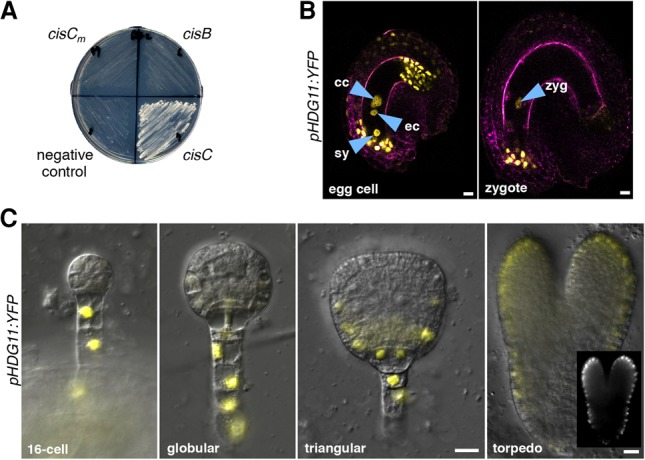
HDG11 binds to the WOX8 cisC fragment and is expressed in the female gametophyte, the zygote, and the embryo. (A) Yeast one-hybrid assay of interactions between HDG11 and the indicated WOX8 cis-regulatory fragments. (B) Two-photon microscope images showing pHDG11:YFP expression in ovules containing a mature embryo sac with the egg cell (female gametophyte) or the zygote. Autofluorescence is shown in magenta. Arrowheads point to the nucleus of the egg cell (ec), synergid cell (sy), central cell (cc), and zygote (zyg). (C) pHDG11:YFP expression during embryogenesis at the indicated stages. (Inset) Enhanced YFP signal without differential interference contrast image. Bars, 10 µm.
Figure 4.
Figure 4.
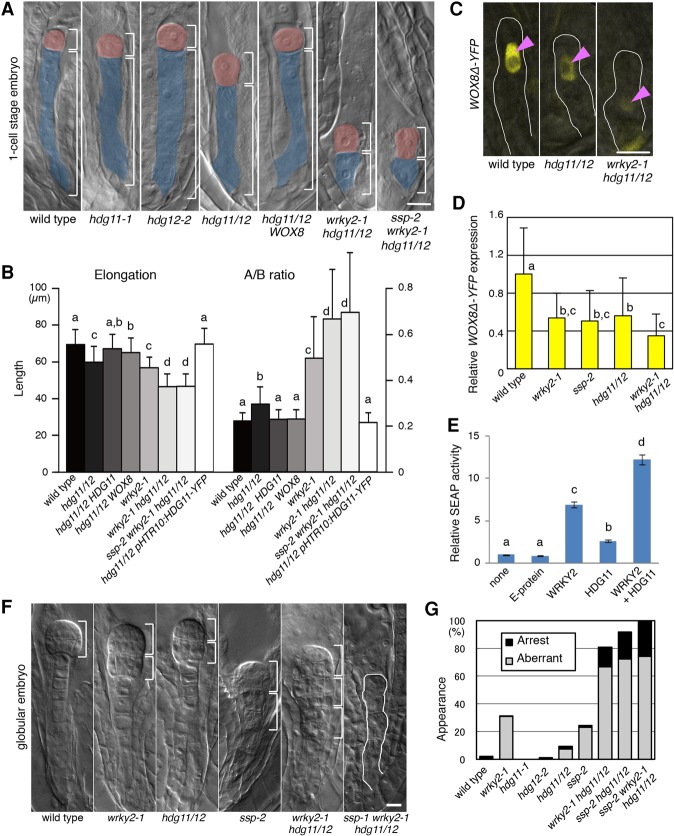
HDG11/12 regulate zygote asymmetry and embryo patterning. (A) One-cell stage embryos of the indicated genotypes. The apical (red) and basal (blue) cells are color-coded, and their lengths are marked by square brackets. (hdg11/12) hdg11-1 hdg12-2 double mutant; (WOX8) pEASE:WOX8-YFP. (B) Elongation and the A/B ratio of one-cell stage embryos of the indicated genotypes. (HDG11) pHDG11:HDG11-YFP. (C) WOX8Δ-YFP expression in zygotes. The zygote is outlined, and arrowheads indicate the nuclei. (D) Relative WOX8Δ-YFP signal intensities in the zygote. Wild type is set as 1. (E) Secreted alkaline phosphatase (SEAP) assay of the indicated effector proteins on the reporter with the WOX8 intron fragment containing cisB and cisC. Mammalian E protein was used as a negative control. (F) Early globular stage embryos of the indicated genotypes. The sphere-like structures are marked by square brackets, and the arrested embryo is outlined. (G) Frequency of mutant embryo phenotypes. (Aberrant) Embryo whose cell division pattern is different from wild type; (arrest) embryo arrested with <10 cells. Bars, 10 µm. Error bars represent SD. n ≥ 80 (B); n ≥ 28 (D); n ≥ 4 (E); n ≥ 238 (G). Wild type and wrky2-1 in B correspond to Figure 1B because these measurements were performed in one experiment. The characters on graphs indicate the significantly associated categories. P < 0.05 by the Tukey-Kramer test in B, D, and E.
Figure 5.
Figure 5.
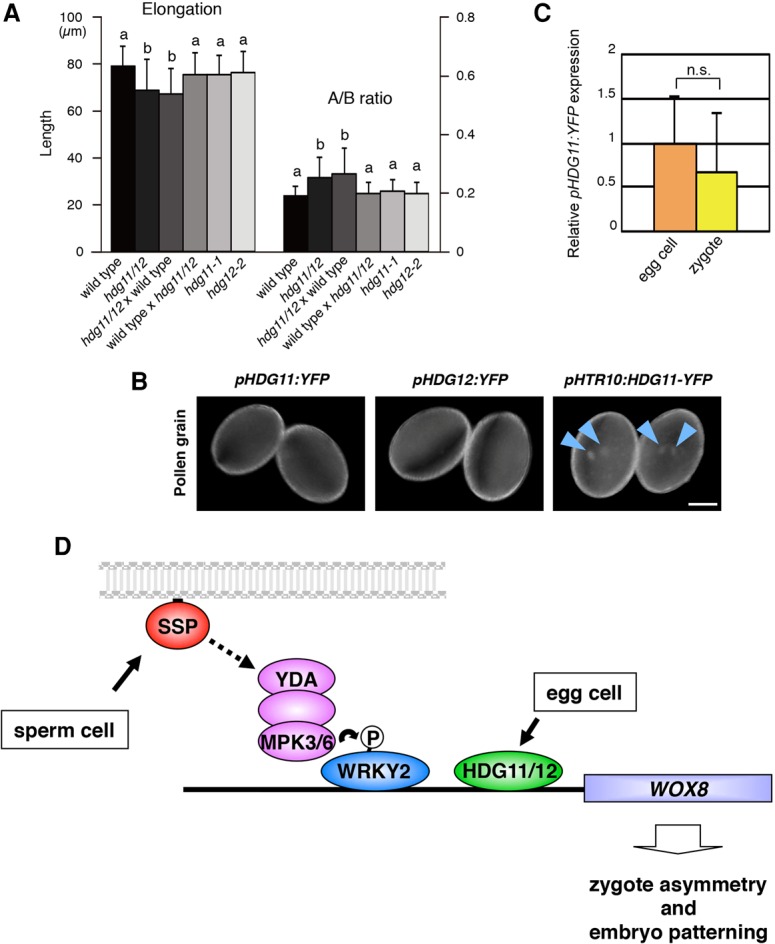
HDG11/12 act as maternal parent-of-origin factors in zygote asymmetry. (A) Elongation and the A/B ratio of one-cell stage embryos of the indicated genotypes. Crosses are denoted as female × male. (hdg11/12) hdg11-1 hdg12-2. (B) Expression of the indicated reporter genes in pollen grains. Arrowheads point to the sperm cell nuclei. (C) Relative intensity of pHDG11:YFP signals in the zygote and the egg cell. Egg cell is set as 1. (D) Model of the regulation of zygote asymmetry. Sperm-derived SSP triggers the YDA–MPK3/6 cascade in the zygote to phosphorylate WRKY2. WRKY2 and maternally derived HDG11/12 directly bind to the WOX8 intron and activate its transcription to regulate elongation and asymmetry of the zygote and embryo patterning. Bar, 10 µm. Error bars represent SD. n ≥ 80 (A); n ≥ 19 (C). The characters on columns indicate the significantly associated categories. P < 0.05 by the Tukey-Kramer test. (n.s) Not significant (Student's t-test).

References

    1. Abe M, Katsumata H, Komeda Y, Takahashi T. 2003. Regulation of shoot epidermal cell differentiation by a pair of homeodomain proteins in Arabidopsis. Development 130: 635–643. - PubMed
    1. Autran D, Baroux C, Raissig MT, Lenormand T, Wittig M, Grob S, Steimer A, Barann M, Klostermeier UC, Leblanc O, et al. 2011. Maternal epigenetic pathways control parental contributions to Arabidopsis early embryogenesis. Cell 145: 707–719. - PubMed
    1. Bayer M, Nawy T, Giglione C, Galli M, Meinnel T, Lukowitz W. 2009. Paternal control of embryonic patterning in Arabidopsis thaliana. Science 323: 1485–1488. - PubMed
    1. Bayer M, Slane D, Jurgens G. 2016. Early plant embryogenesis-dark ages or dark matter? Curr Opin Plant Biol 35: 30–36. - PubMed
    1. Beyer HM, Gonschorek P, Samodelov SL, Meier M, Weber W, Zurbriggen MD. 2015. AQUA cloning: a versatile and simple enzyme-free cloning approach. PLoS One 10: e0137652. - PMC - PubMed

Publication types

MeSH terms

Substances

LinkOut - more resources