


Tuning cancer fate: the unremitting role of host immunity
- PMID: 28404796
- PMCID: PMC5413907
- DOI: 10.1098/rsob.170006
Tuning cancer fate: the unremitting role of host immunity
Abstract
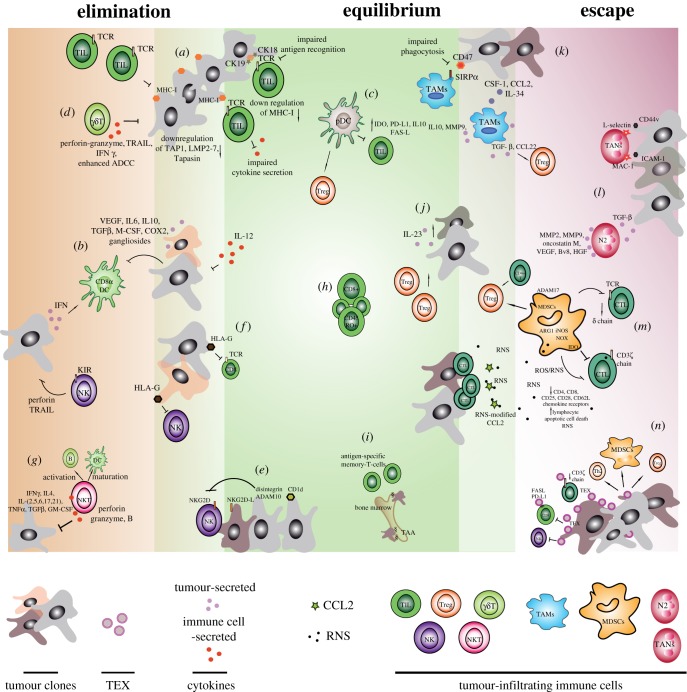
Host immunity plays a central and complex role in dictating tumour progression. Solid tumours are commonly infiltrated by a large number of immune cells that dynamically interact with the surrounding microenvironment. At first, innate and adaptive immune cells successfully cooperate to eradicate microcolonies of transformed cells. Concomitantly, surviving tumour clones start to proliferate and harness immune responses by specifically hijacking anti-tumour effector mechanisms and fostering the accumulation of immunosuppressive immune cell subsets at the tumour site. This pliable interplay between immune and malignant cells is a relentless process that has been concisely organized in three different phases: elimination, equilibrium and escape. In this review, we aim to depict the distinct immune cell subsets and immune-mediated responses characterizing the tumour landscape throughout the three interconnected phases. Importantly, the identification of key immune players and molecules involved in the dynamic crosstalk between tumour and immune system has been crucial for the introduction of reliable prognostic factors and effective therapeutic protocols against cancers.
Keywords: cancer; immune cells; immunotherapy.
© 2017 The Authors.
Conflict of interest statement
The authors declare that the research was conducted in the absence of any commercial or financial relationships that could be construed as a potential conflict of interest.
Figures
References
-
- Burnet FM. 1970. The concept of immunological surveillance. Prog. Exp. Tumor Res. 13, 1–27. (doi:10.1159/000386035) - DOI - PubMed
-
- Burnet M. 1957. Cancer: a biological approach. III. Viruses associated with neoplastic conditions. IV. Practical applications. Br. Med. J. 1, 841–847. (doi:10.1136/bmj.1.5023.841) - DOI - PMC - PubMed
-
- Corthay A. 2014. Does the immune system naturally protect against cancer? Front. Immunol. 5, 197 (doi:10.3389/fimmu.2014.00197) - DOI - PMC - PubMed
-
- Kinlen LJ, Webster ADB, Bird AG, Haile R, Peto J, Soothill JF, Thompson RA. 1985. Prospective study of cancer in patients with hypogammaglobulinaemia. Lancet 1, 263–266. (doi:10.1016/S0140-6736(85)91037-2) - DOI - PubMed
Publication types
MeSH terms
Substances
LinkOut - more resources
Full Text Sources
Other Literature Sources
