


Visual discrimination training improves Humphrey perimetry in chronic cortically induced blindness
- PMID: 28404802
- PMCID: PMC5419988
- DOI: 10.1212/WNL.0000000000003921
Visual discrimination training improves Humphrey perimetry in chronic cortically induced blindness
Abstract
Objective: To assess if visual discrimination training improves performance on visual perimetry tests in chronic stroke patients with visual cortex involvement.
Methods: 24-2 and 10-2 Humphrey visual fields were analyzed for 17 chronic cortically blind stroke patients prior to and following visual discrimination training, as well as in 5 untrained, cortically blind controls. Trained patients practiced direction discrimination, orientation discrimination, or both, at nonoverlapping, blind field locations. All pretraining and posttraining discrimination performance and Humphrey fields were collected with online eye tracking, ensuring gaze-contingent stimulus presentation.
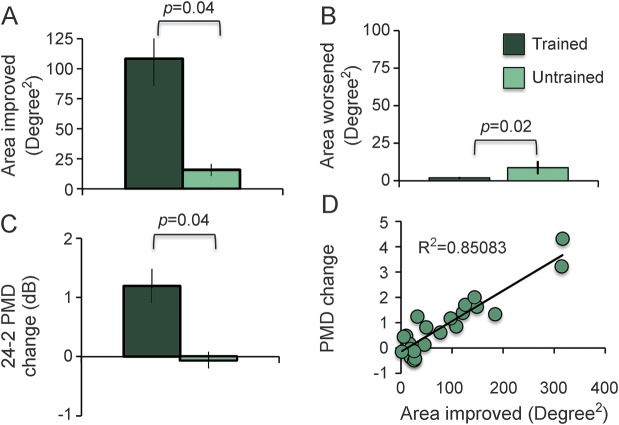
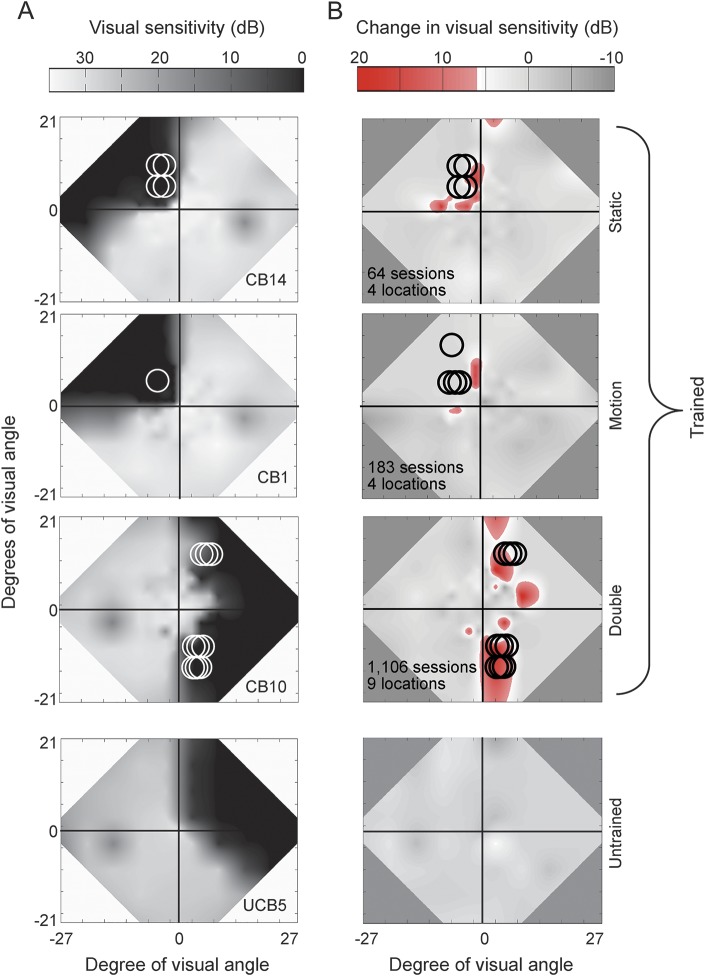
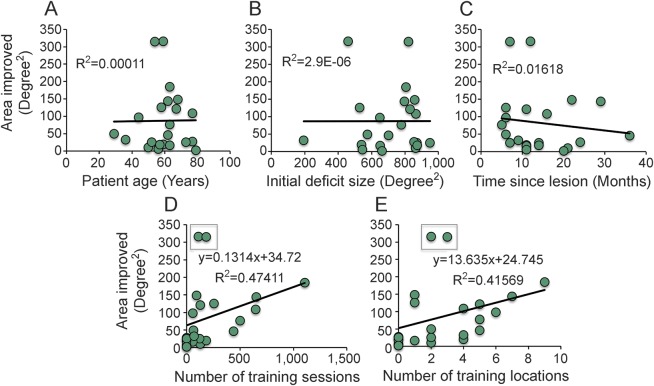
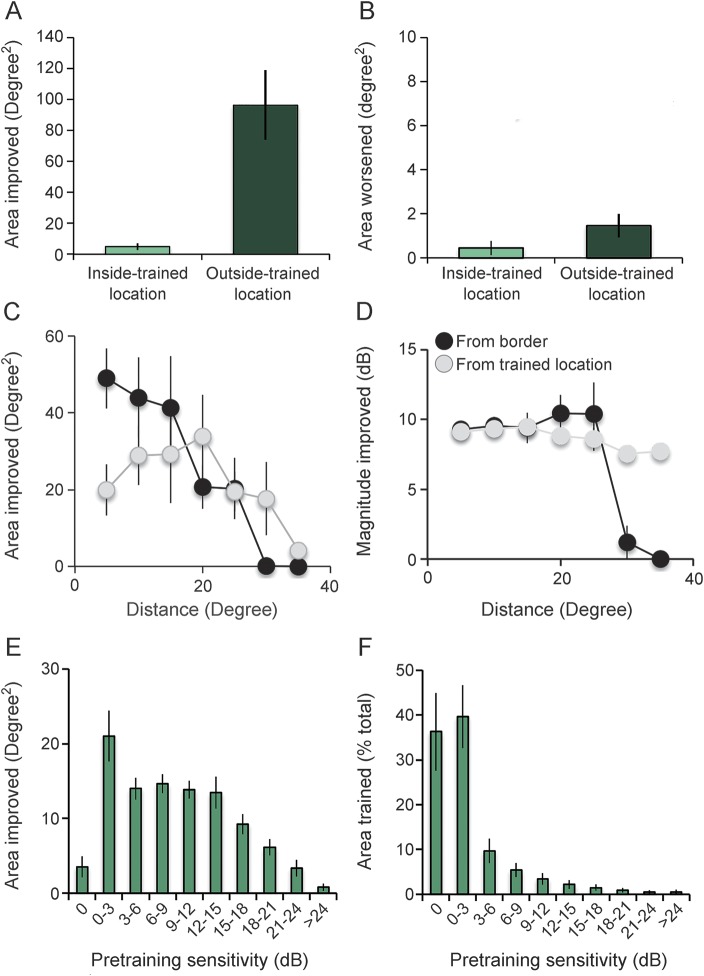
Results: Trained patients recovered ∼108 degrees2 of vision on average, while untrained patients spontaneously improved over an area of ∼16 degrees2. Improvement was not affected by patient age, time since lesion, size of initial deficit, or training type, but was proportional to the amount of training performed. Untrained patients counterbalanced their improvements with worsening of sensitivity over ∼9 degrees2 of their visual field. Worsening was minimal in trained patients. Finally, although discrimination performance improved at all trained locations, changes in Humphrey sensitivity occurred both within trained regions and beyond, extending over a larger area along the blind field border.
Conclusions: In adults with chronic cortical visual impairment, the blind field border appears to have enhanced plastic potential, which can be recruited by gaze-controlled visual discrimination training to expand the visible field. Our findings underscore a critical need for future studies to measure the effects of vision restoration approaches on perimetry in larger cohorts of patients.
Copyright © 2017 The Author(s). Published by Wolters Kluwer Health, Inc. on behalf of the American Academy of Neurology.
Figures
Comment in
-
Reader response: Visual discrimination training improves Humphrey perimetry in chronic cortically induced blindness.Neurology. 2018 Feb 27;90(9):436-437. doi: 10.1212/WNL.0000000000005017. Neurology. 2018. PMID: 29483318 No abstract available.
-
Author response: Visual discrimination training improves Humphrey perimetry in chronic cortically induced blindness.Neurology. 2018 Feb 27;90(9):437. doi: 10.1212/WNL.0000000000005024. Neurology. 2018. PMID: 29483319 No abstract available.
References
-
- Zhang X, Kedar S, Lynn M, Newman N, Biousse V. Natural history of homonymous hemianopia. Neurology 2006;66:901–905. - PubMed
-
- Peli E. Field expansion for homonymous hemianopia by optically induced peripheral exotropia. Optom Vis Sci 2000;77:453–464. - PubMed
-
- Lane AR, Smith DT, Ellison A, Schenk T. Visual exploration training is no better than attention training for treating hemianopia. Brain 2010;133:1717–1728. - PubMed
-
- Pollock A, Hazelton C, Henderson CA, et al. Interventions for visual field defects in patients with stroke. Cochrane Database Syst Rev 2011;10:CD008388. - PubMed
MeSH terms
Grants and funding
LinkOut - more resources
Full Text Sources
Other Literature Sources
Medical
