


Update of the GJB2/DFNB1 mutation spectrum in Russia: a founder Ingush mutation del(GJB2-D13S175) is the most frequent among other large deletions
- PMID: 28405014
- PMCID: PMC5584515
- DOI: 10.1038/jhg.2017.42
Update of the GJB2/DFNB1 mutation spectrum in Russia: a founder Ingush mutation del(GJB2-D13S175) is the most frequent among other large deletions
Abstract
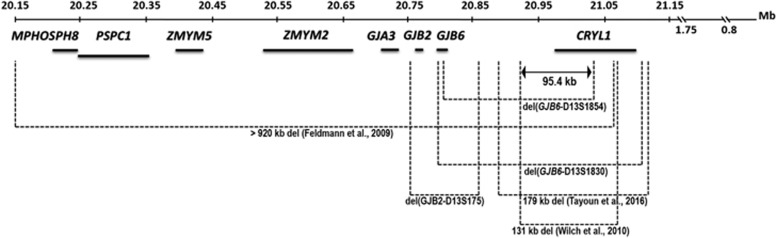
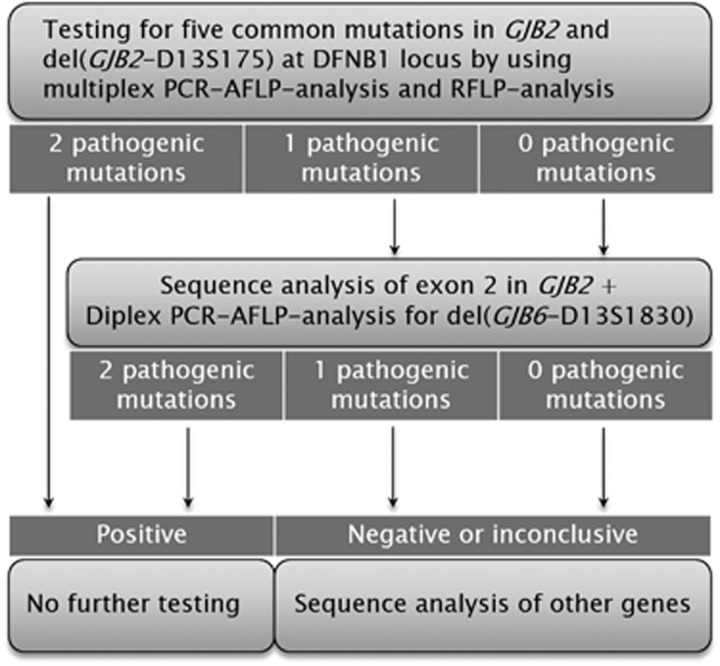
Although mutations in the GJB2 gene sequence make up the majority of variants causing autosomal-recessive non-syndromic hearing loss, few large deletions have been shown to contribute to DFNB1 deafness. Currently, genetic testing for DFNB1 hearing loss includes GJB2 sequencing and DFNB1 deletion analysis for two common large deletions, del(GJB6-D13S1830) and del(GJB6-D13S1854). Here, we report frequency in Russia, clinical significance and evolutionary origins of a 101 kb deletion, del(GJB2-D13S175), recently identified by us. In multiethnic cohort of 1104 unrelated hearing loss patients with biallelic mutations at the DFNB1 locus, the del(GJB2-D13S175) allele frequency of up to 0.5% (11/2208) was determined and this allele was shown to be predominantly associated with profound sensorineural hearing loss. Additionally, eight previously unpublished GJB2 mutations were described in this study. All patients carrying del(GJB2-D13S175) were of the Ingush ancestry. Among normal hearing individuals, del(GJB2-D13S175) was observed in Russian Republic of Ingushetia with a carrier rate of ~1% (2/241). Analysis of haplotypes associated with the deletion revealed a common founder in the Ingushes, with age of the deletion being ~3000 years old. Since del(GJB2-D13S175) was missed by standard methods of GJB2 analysis, del(GJB2-D13S175) detection has been added to our routine testing strategy for DFNB1 hearing loss.
Conflict of interest statement
The authors declare no conflict of interest.
Figures
References
-
- Tsukada, K., Nishio, S. Y., Hattori, M. & Usami, S. Ethnic-specific spectrum of GJB2 and SLC26A4 mutations: their origin and a literature review. Ann. Otol. Rhinol. Laryngol. 124 (Suppl 1), 61S–76S (2015). - PubMed
-
- del Castillo, I., Villamar, M., Moreno-Pelayo, M. A., del Castillo, F. J., Alvarez, A., Telleria, D. et al. A deletion involving the connexin 30 gene in nonsyndromic hearing impairment. N. Engl. J. Med. 346, 243–249 (2002). - PubMed
-
- Lerer, I., Sagi, M., Ben-Neriah, Z., Wang, T., Levi, H. & Abeliovich, D. A deletion mutation in GJB6 cooperating with a GJB2 mutation in trans in non-syndromic deafness: a novel founder mutation in Ashkenazi Jews. Hum. Mutat. 18, 460 (2001). - PubMed
-
- Pallares-Ruiz, N., Blanchet, P., Mondain, M., Claustres, M. & Roux, A. F. A large deletion including most of GJB6 in recessive non syndromic deafness: a digenic effect? Eur. J. Hum. Genet. 10, 72–76 (2002). - PubMed
-
- Del Castillo, I., Moreno-Pelayo, M. A., Del Castillo, F. J., Brownstein, Z., Marlin, S., Adina, Q. et al. Prevalence and evolutionary origins of the del(GJB6-D13S1830) mutation in the DFNB1 locus in hearing-impaired subjects: a multicenter study. Am. J. Hum. Genet. 73, 1452–1458 (2003). - PMC - PubMed
MeSH terms
Substances
LinkOut - more resources
Full Text Sources
Other Literature Sources