


Case Reports
doi: 10.1080/08998280.2017.11929573.
Tularemia presenting as pulmonary nodules in an immunocompromised patient
Affiliations
- PMID: 28405072
- PMCID: PMC5349818
- DOI: 10.1080/08998280.2017.11929573
Item in Clipboard
Case Reports
Tularemia presenting as pulmonary nodules in an immunocompromised patient
Proc (Bayl Univ Med Cent).
2017 Apr.
Abstract
Tularemia is a zoonotic disease caused by Francisella tularensis that can be transmitted to humans when they handle rabbits, receive tick bites, consume contaminated water, or inhale aerosolized particles. We present the case of a 51-year-old white man with rheumatoid arthritis who was taking immunosuppressive medications and presented with tularemia. Our patient acquired the typhoidal form of tularemia, which is a severe systemic illness that manifests with fevers, headaches, myalgias, vomiting, diarrhea, and neurological symptoms, due to his immunocompromised state. The diagnosis was made through biopsy of a pulmonary nodule found incidentally on computed tomography scan.
Figures
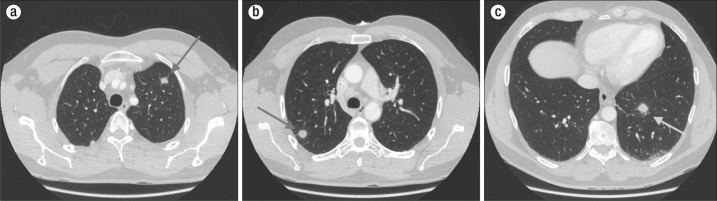
Cross-sectional CT shows pulmonary nodules (arrows) in the (a) left upper lobe measuring 1 cm, (b) right upper lobe measuring 1.3 cm, and (c) left lower lobe measuring 1.6 cm.
References
-
- McCoy GW, Chapin CW. Further observations on a plague-like disease of rodents with a preliminary note on the causative agent Bacterium tularense. J Infect Dis. 1912;10(1):61–72.
-
- Thomas LD, Schaffner W, Tularemia pneumonia. Infect Dis Clin North Am. 2010;24(1):43–55. - PubMed
-
- Francis E. A summary of the present knowledge of tularemia. Medicine. 1928;7(4):411–432.
-
- Centers for Disease Control and Prevention. Tularemia statistics. Available at http://www.cdc.gov/tularemia/statistics/; accessed November 2, 2016.
-
- Evans ME, Gregory DW, Schaffner W, McGee ZA. Tularemia: a 30-year experience with 88 cases. Medicine (Baltimore) 1985;64(4):251–269. - PubMed
Publication types
LinkOut - more resources
Full Text Sources
Other Literature Sources