


Specific dyspeptic symptoms are associated with poor response to therapy in patients with gastroesophageal reflux disease
- PMID: 28405322
- PMCID: PMC5384555
- DOI: 10.1177/2050640616650061
Specific dyspeptic symptoms are associated with poor response to therapy in patients with gastroesophageal reflux disease
Abstract
Introduction: In patients with gastroesophageal reflux disease (GORD), co-existence of functional dyspepsia (FD) is known to be associated with poor response to proton pump inhibitors (PPIs), but the contribution of specific dyspepsia symptoms has not yet been systematically investigated.
Objective: We aimed to characterize the impact of dyspepsia symptoms on response to PPIs in patients with GORD.
Methods: The enrolled subjects were consecutive patients with a diagnosis of GORD. All patients underwent a 24 hour pH-impedance test, while on PPI therapy. Patients were divided into two groups, refractory and responders, according to the persistence of GORD symptoms. A standardized questionnaire for FD was also administered to assess presence of dyspepsia symptoms.
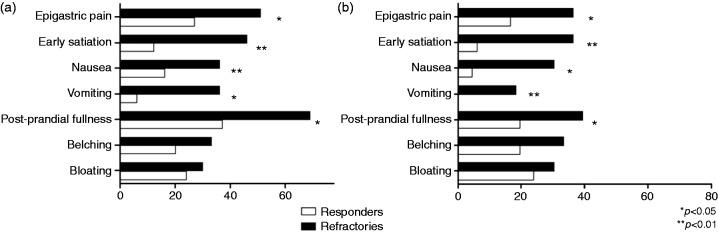
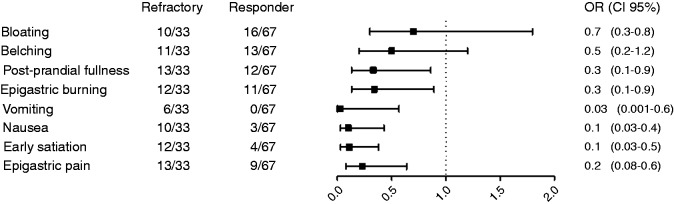
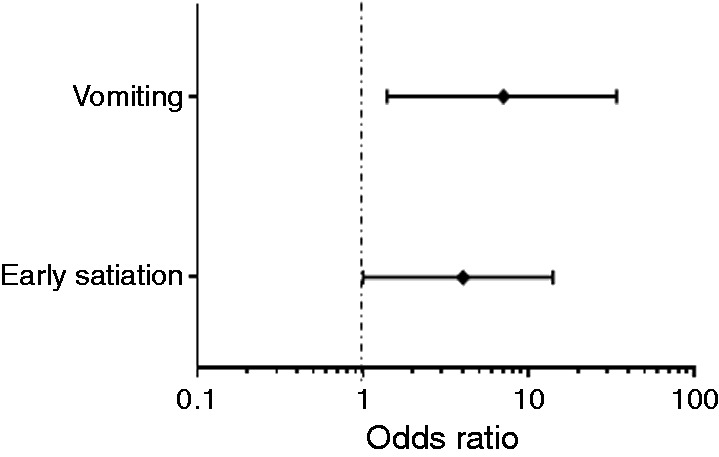
Results: In the subgroup of refractory patients FD was more prevalent than in responders, with post-prandial fullness, nausea, vomiting, early satiation and epigastric pain being significantly prevalent in refractory GORD patients. In the multivariate analysis only early satiation and vomiting were significantly associated with poor response to PPIs.
Conclusion: Co-existence of FD is associated with refractory GORD. We showed that only early satiation and vomiting are risk factors for poor response to therapy with PPIs. Our findings suggest that symptoms of early satiation and vomiting would help to identify the subset of PPI-refractory GORD patients.
Keywords: Refractory GERD; early satiation; functional dyspepsia; pH–impedance monitoring; proton pump inhibitors; vomiting.
Figures
References
-
- Vela MF. Medical treatments of GERD: The old and new. Gastroenterol Clin North Am 2014; 43: 121–133. - PubMed
-
- Sifrim D, Zerbib F. Diagnosis and management of patients with reflux symptoms refractory to proton pump inhibitors. Gut 2012; 61: 1340–1354. - PubMed
-
- Ang D, Sifrim D and Tack J. Mechanisms of heartburn. 2008; Nat Clin Pract Gastroenterol Hepatol 5: 383–392. - PubMed
LinkOut - more resources
Full Text Sources
Other Literature Sources
