Circadian phase resetting by a single short-duration light exposure
- PMID: 28405608
- PMCID: PMC5374060
- DOI: 10.1172/jci.insight.89494
Circadian phase resetting by a single short-duration light exposure
Abstract
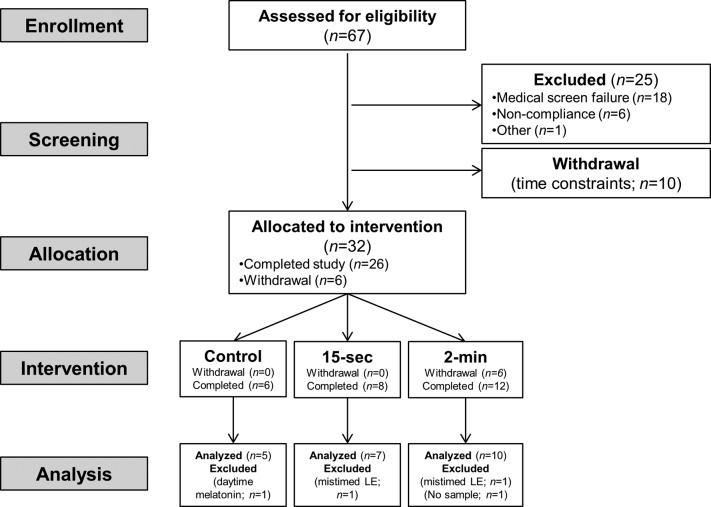
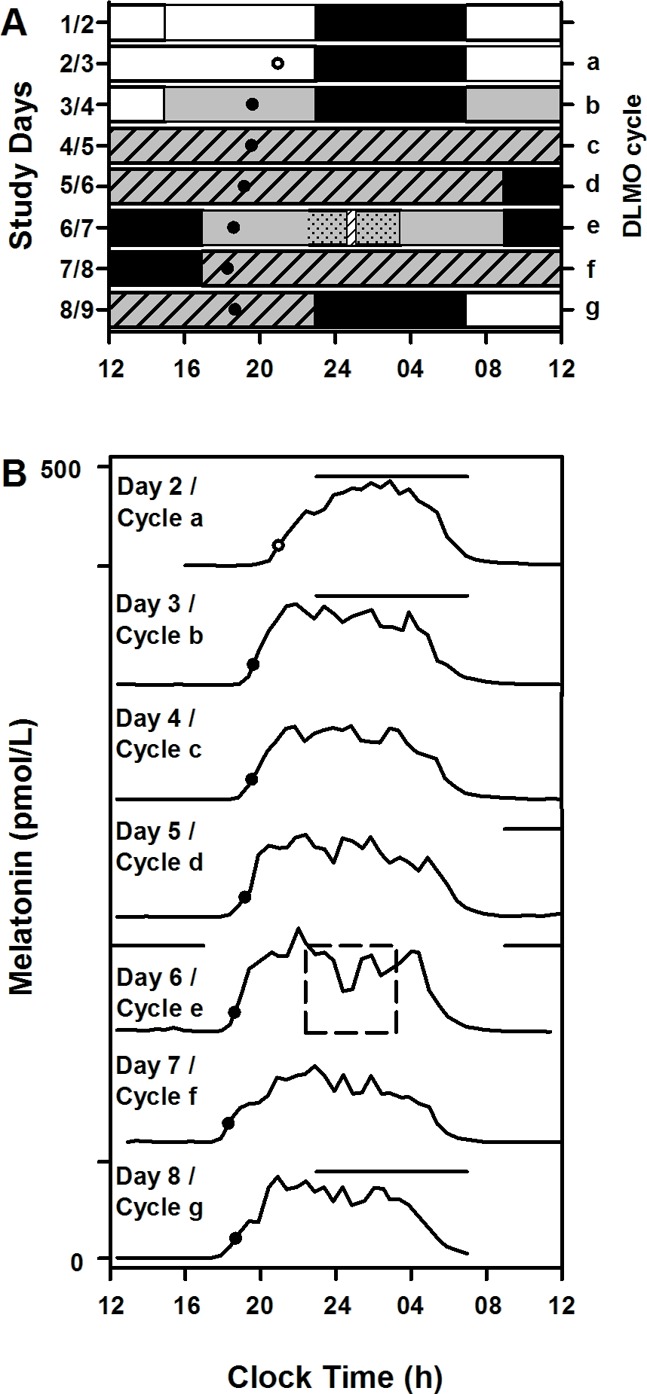
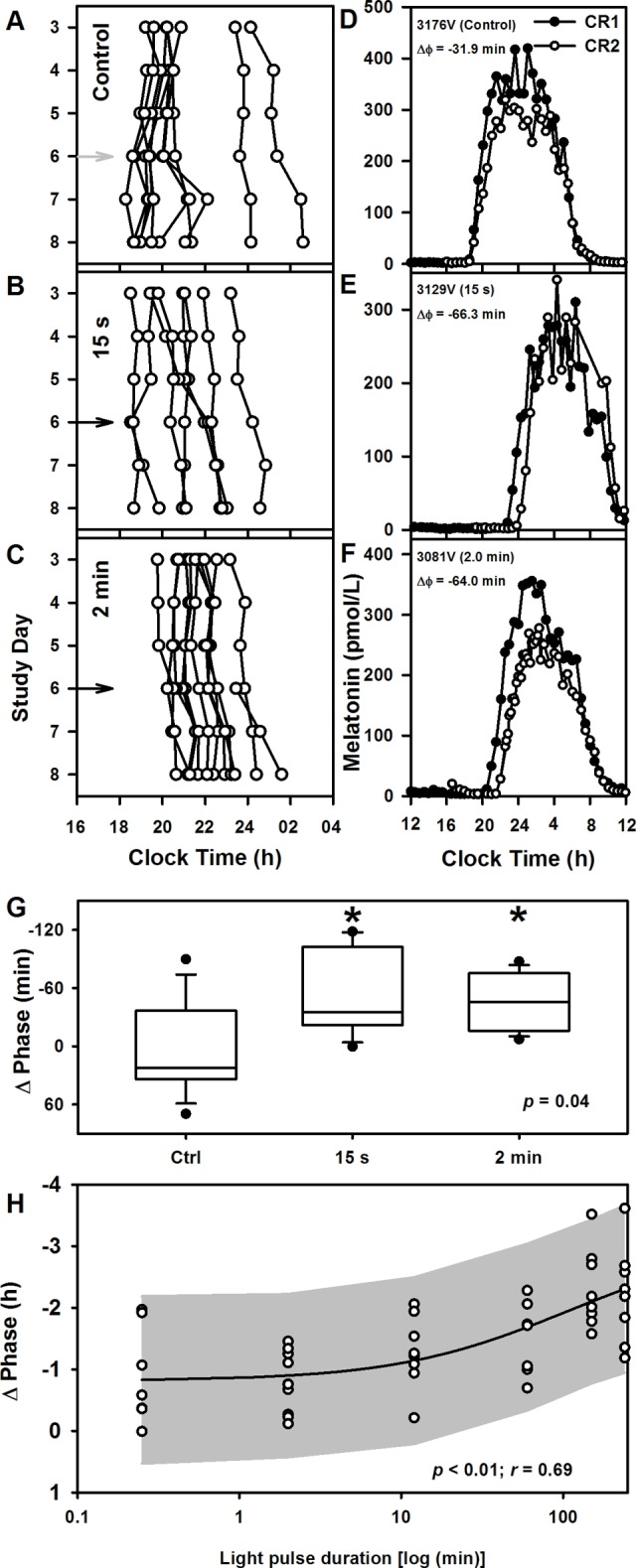
BACKGROUND. In humans, a single light exposure of 12 minutes and multiple-millisecond light exposures can shift the phase of the circadian pacemaker. We investigated the response of the human circadian pacemaker to a single 15-second or 2-minute light pulse administered during the biological night. METHODS. Twenty-six healthy individuals participated in a 9-day inpatient protocol that included assessment of dim light melatonin onset time (DLMO time) before and after exposure to a single 15-second (n = 8) or 2-minute (n = 12) pulse of bright light (9,500 lux; 4,100 K fluorescent) or control background dim light (<3 lux; n = 6). Phase shifts were calculated as the difference in clock time between the two phase estimates. RESULTS. Both 15-second and 2-minute exposures induced phase delay shifts [median (± SD)] of -34.8 ± 47.2 minutes and -45.4 ± 28.4 minutes, respectively, that were significantly (P = 0.04) greater than the control condition (advance shift: +22.3 ± 51.3 minutes) but were not significantly different from each other. Comparisons with historic data collected under the same conditions confirmed a nonlinear relationship between exposure duration and the magnitude of phase shift. CONCLUSIONS. Our results underscore the exquisite sensitivity of the human pacemaker to even short-duration single exposures to light. These findings may have real-world implications for circadian disruption induced by exposure to brief light stimuli at night. TRIAL REGISTRATION. The study was registered as a clinical trial on www.clinicaltrials.org, NCT #01330992. FUNDING. Funding for this study was provided by NSBRI HFP02802 and NIH P01-AG09975, R01-HL114088 (EBK), RC2-HL101340-0 (EBK, SWL, SAR, REK), K02-HD045459 (EBK), K24-HL105664 (EBK), T32-HL07901 (MSH, SAR), HL094654 (CAC), and AG044416 (JFD). The project described was supported by NIH grant 1UL1 TR001102-01, 8UL1TR000170-05, UL1 RR 025758, Harvard Clinical and Translational Science Center, from the National Center for Advancing Translational Science.
Conflict of interest statement
Conflict of interest: Possible conflicts of interest for all authors are disclosed in the online supplement (https://doi.org/10.1172/jci.insight.89494DS1).
Figures
References
-
- Klerman EB, Rimmer DW, Dijk DJ, Kronauer RE, Rizzo JF, Czeisler CA. Nonphotic entrainment of the human circadian pacemaker. Am J Physiol. 1998;274(4 Pt 2):R991–R996. - PubMed
-
- Van Den Pol AN, Cao V, Heller HC. Circadian system of mice integrates brief light stimuli. Am J Physiol. 1998;275(2 Pt 2):R654–R657. - PubMed
Publication types
MeSH terms
Substances
Grants and funding
LinkOut - more resources
Full Text Sources
Other Literature Sources
Research Materials
Miscellaneous