


CSH guidelines for the diagnosis and treatment of drug-induced liver injury
- PMID: 28405790
- PMCID: PMC5419998
- DOI: 10.1007/s12072-017-9793-2
CSH guidelines for the diagnosis and treatment of drug-induced liver injury
Abstract
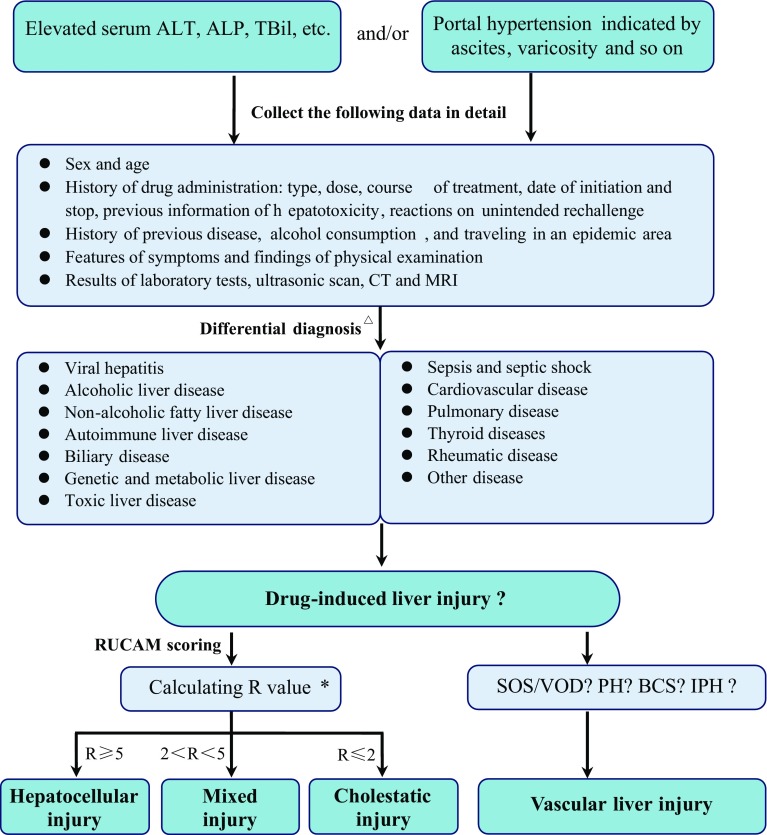
Drug-induced liver injury (DILI) is an important clinical problem, which has received more attention in recent decades. It can be induced by small chemical molecules, biological agents, traditional Chinese medicines (TCM), natural medicines (NM), health products (HP), and dietary supplements (DS). Idiosyncratic DILI is far more common than intrinsic DILI clinically and can be classified into hepatocellular injury, cholestatic injury, hepatocellular-cholestatic mixed injury, and vascular injury based on the types of injured target cells. The CSH guidelines summarized the epidemiology, pathogenesis, pathology, and clinical manifestation and gives 16 evidence-based recommendations on diagnosis, differential diagnosis, treatment, and prevention of DILI.
Keywords: Clinical type; Diagnosis; Differential diagnosis; Drug-induced liver injury; Epidemiology; Pathogenesis; Pathology; Prevention; Recommendations; Treatment.
Conflict of interest statement
Funding
This guideline is supported by the National Major Projects during the Twelfth Five-year Plan Period, Project (No. 2012ZX09303-001).
Conflict of interest
Yue-cheng Yu, Yi-min Mao, Cheng-wei Chen, Jin-jun Chen, Jun Chen, Wen-ming Cong, Yang Ding, Zhong-ping Duan, Qing-chun Fu, Xiao-yan Guo, Peng Hu, Xi-qi Hu, Ji-dong Jia, Rong-tao Lai, Dong-liang Li, Ying-xia Liu, Lun-gen Lu, Shi-wu Ma, Xiong Ma, Yue-min Nan, Hong Ren, Tao Shen, Hao Wang, Ji-yao Wang, Tai-ling Wang, Xiao-jin Wang, Lai Wei, Qing Xie, Wen Xie, Chang-qing Yang, Dong-liang Yang, Yan-yan Yu, Min-de Zeng, Li Zhang, Xin-yan Zhao, Hui Zhuang declare no conflicts of interest.
Ethical approval
This article does not contain any studies with human participants or animals performed by any of the authors.
Figures
References
Publication types
MeSH terms
Substances
LinkOut - more resources
Full Text Sources
Other Literature Sources
Medical
Molecular Biology Databases
Research Materials
Miscellaneous
