Review
. 2017 Dec;10(1):15.
doi: 10.1186/s12245-017-0141-z. Epub 2017 Apr 13.

Angioedema in the emergency department: a practical guide to differential diagnosis and management

Affiliations
Review

Angioedema in the emergency department: a practical guide to differential diagnosis and management

Jonathan A Bernstein et al. Int J Emerg Med. 2017 Dec.

Abstract

Background: Angioedema is a common presentation in the emergency department (ED). Airway angioedema can be fatal; therefore, prompt diagnosis and correct treatment are vital.

Objective of the review: Based on the findings of two expert panels attended by international experts in angioedema and emergency medicine, this review aims to provide practical guidance on the diagnosis, differentiation, and management of histamine- and bradykinin-mediated angioedema in the ED.

Review: The most common pathophysiology underlying angioedema is mediated by histamine; however, ED staff must be alert for the less common bradykinin-mediated forms of angioedema. Crucially, bradykinin-mediated angioedema does not respond to the same treatment as histamine-mediated angioedema. Bradykinin-mediated angioedema can result from many causes, including hereditary defects in C1 esterase inhibitor (C1-INH), side effects of angiotensin-converting enzyme inhibitors (ACEis), or acquired deficiency in C1-INH. The increased use of ACEis in recent decades has resulted in more frequent encounters with ACEi-induced angioedema in the ED; however, surveys have shown that many ED staff may not know how to recognize or manage bradykinin-mediated angioedema, and hospitals may not have specific medications or protocols in place.

Conclusion: ED physicians must be aware of the different pathophysiologic pathways that lead to angioedema in order to efficiently and effectively manage these potentially fatal conditions.

Keywords: Angioedema; Bradykinin-mediated; Emergency department; Guideline; Histamine-mediated.


Figures
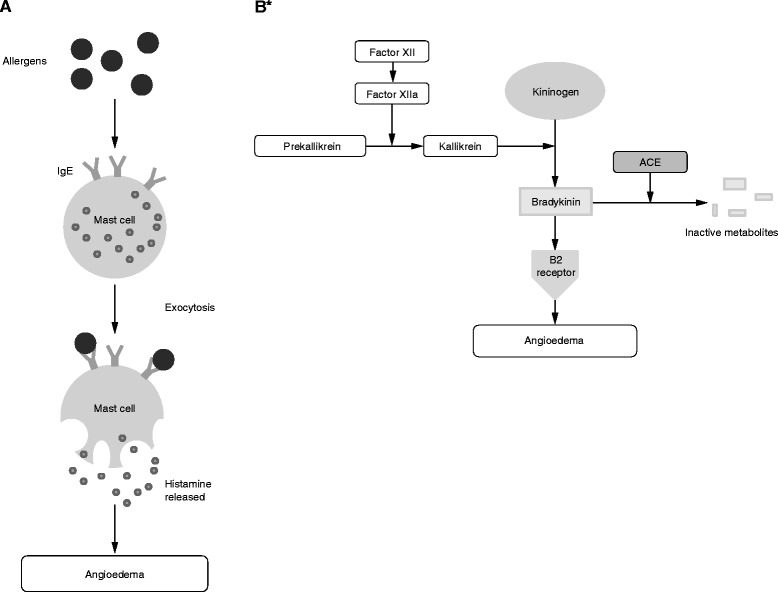
Fig. 1
Fig. 1
Schematic of biochemical pathways responsible for a histamine-mediated angioedema [62] and b bradykinin-mediated angioedema [26]. *C1 esterase inhibitor disrupts the action of factor XIIa and kallikrein. Ecallantide inhibits the action of kallikrein. Icatibant blocks bradykinin B2 receptors. ACE angiotensin-converting enzyme, IgE immunoglobulin E
Fig. 2
Fig. 2
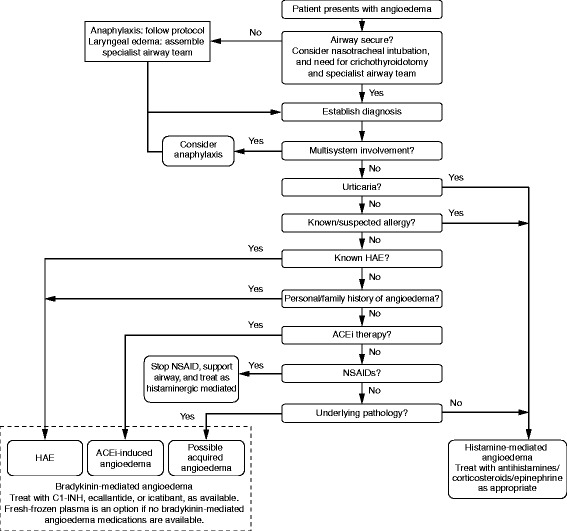
Flow diagram of diagnosis of angioedema in the emergency department [21, 42]. ACEi angiotensin-converting enzyme inhibitor, HAE hereditary angioedema
Fig. 3
Fig. 3
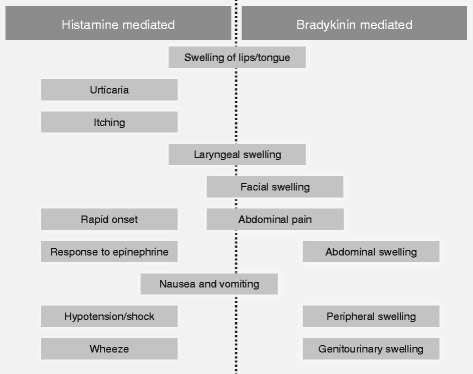
Distinguishing histamine- versus bradykinin-mediated angioedema
Fig. 4
Fig. 4
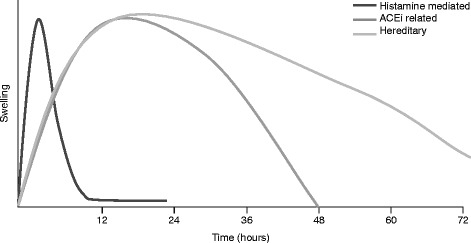
Schematic representation of angioedema attack onset and duration. Histamine-mediated angioedema attacks tend to have rapid onset and resolution. Bradykinin-mediated angioedema usually develops more slowly and can persist for ≤5 days, although angiotensin-converting enzyme inhibitor (ACEi)–induced angioedema will usually resolve ≤48 h once the drug is discontinued
Fig. 5
Fig. 5
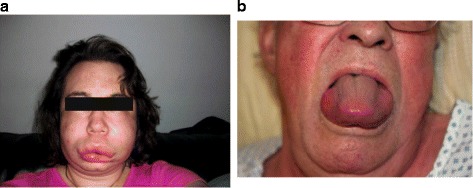
Presentation of angioedema in the emergency department. a Facial/lip edema (Ishoo stage I). b Tongue edema (Ishoo stage III). Image a obtained from www.haeimages.com

References

    1. Bernstein JA, Moellman J. Emerging concepts in the diagnosis and treatment of patients with undifferentiated angioedema. Int J Emerg Med. 2012;5:39. doi: 10.1186/1865-1380-5-39. - DOI - PMC - PubMed
    1. Kelly M, Donnelly JP, McAnnally JR, Wang HE. National estimates of emergency department visits for angioedema and allergic reactions in the United States. Allergy Asthma Proc. 2013;34:150–4. doi: 10.2500/aap.2013.34.3640. - DOI - PubMed
    1. Bernstein JA. HAE update: epidemiology and burden of disease. Allergy Asthma Proc. 2013;34:3–6. doi: 10.2500/aap.2013.34.3623. - DOI - PubMed
    1. Lombardi C, Crivellaro M, Dama A, Senna G, Gargioni S, Passalacqua G. Are physicians aware of the side effects of angiotensin-converting enzyme inhibitors? A questionnaire survey in different medical categories. Chest. 2005;128:976–9. doi: 10.1378/chest.128.2.976. - DOI - PubMed
    1. Zilberberg MD, Jacobsen T, Tillotson G. The burden of hospitalizations and emergency department visits with hereditary angioedema and angioedema in the United States, 2007. Allergy Asthma Proc. 2010;31:511–9. doi: 10.2500/aap.2010.31.3403. - DOI - PubMed

LinkOut - more resources