Impact of Patient Education on Compliance with Positive Airway Pressure Treatment in Obstructive Sleep Apnea
- PMID: 28406882
- PMCID: PMC5398328
- DOI: 10.12659/msm.902075
Impact of Patient Education on Compliance with Positive Airway Pressure Treatment in Obstructive Sleep Apnea
Abstract
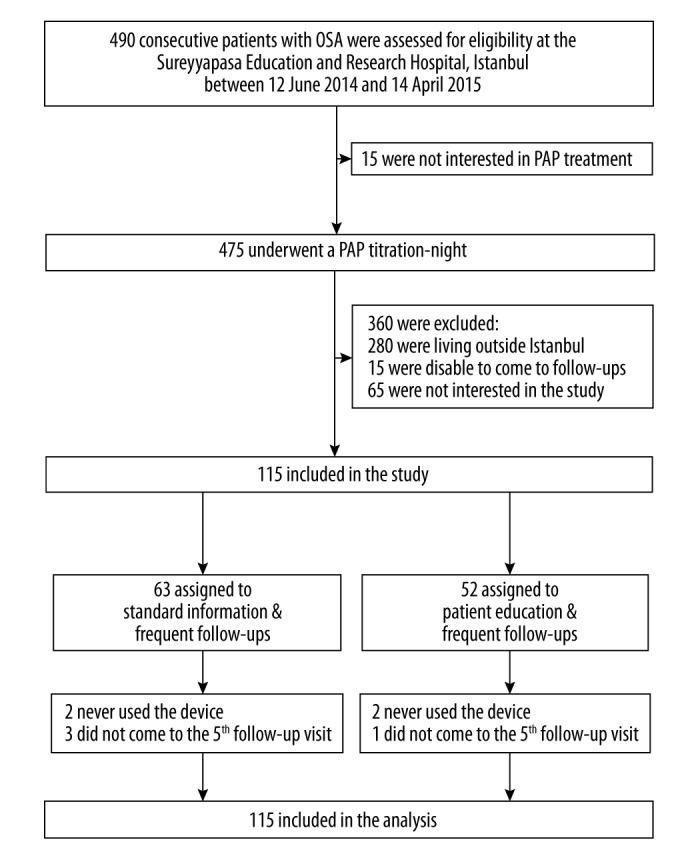
BACKGROUND We addressed the impact of patient education followed by frequent visits on compliance with positive airway pressure (PAP) treatment in patients with obstructive sleep apnea (OSA) in a Turkish sleep clinic cohort. MATERIAL AND METHODS This single-center, randomized, controlled study was conducted in Istanbul, Turkey between June 2014 and April 2015. Among 115 eligible OSA patients (mean age 51.0±9.3 years; 75.5% men), 63 were randomized to standard support (SS) group (general information about OSA and PAP treatment at baseline), and 52 to educational support (ES) group (additional polysomnography chart viewing from both diagnostic and titration nights). All patients were scheduled to five PAP control visits between two weeks and six months after the PAP prescription. Primary outcome was the PAP compliance (4 hours/night for 70% of all the nights) at the last visit. RESULTS Average PAP usage was 4.2±2.5 hours/night in the SS group, and 5.2±2.1 hours/night in the ES group (p=0.027). PAP compliance was achieved among 68.3% in the SS group, and 86.5% in the ES group (p=0.021). In a multivariate analysis, ES strategy followed by frequent visits predicted PAP compliance (odds ratio [OR] 3.6, 95% confidence interval [CI] 1.2-10.6; p=0.020). Other predictors were obesity (OR 3.4, 95% CI 1.2-9.7; p=0.019) and severe OSA (apnea-hypopnea index ≥30/hour) at baseline (OR 4.7, 95% CI 1.2-17.6; p=0.023). Primary school education level was inversely related with PAP compliance (OR 0.3, 95% CI 0.1-0.9; p=0.036). CONCLUSIONS Patient education with polysomnography chart view followed by frequent visits increased long-term compliance with PAP treatment.
Conflict of interest statement
Authors report no conflict of interests related to the current study. Dr Peker reports institutional grants in Sweden from ResMed Foundation outside the current work.
Figures
References
-
- Young T, Palta M, Dempsey J, et al. The occurrence of sleep-disordered breathing among middle-aged adults. New Engl J Med. 1993;328(17):1230–35. - PubMed
-
- Howard ME, Desai AV, Grunstein RR, et al. Sleepiness, sleep-disordered breathing, and accident risk factors in commercial vehicle drivers. Am J Respir Crit Care Med. 2004;170(9):1014–21. - PubMed
-
- Celen YT, Peker Y. Cardiovascular consequences of sleep apnea – II: Cardiovascular mechanisms. Anadolu Kardiyol Derg. 2010;10(1):168–75. - PubMed
Publication types
MeSH terms
LinkOut - more resources
Full Text Sources
Research Materials
Miscellaneous