Review
. 2017 Apr 13;16(1):79.
doi: 10.1186/s12943-017-0648-1.

ROS signaling under metabolic stress: cross-talk between AMPK and AKT pathway

Affiliations
Review

ROS signaling under metabolic stress: cross-talk between AMPK and AKT pathway

Yang Zhao et al. Mol Cancer. .

Abstract

Cancer cells are frequently confronted with metabolic stress in tumor microenvironments due to their rapid growth and limited nutrient supply. Metabolic stress induces cell death through ROS-induced apoptosis. However, cancer cells can adapt to it by altering the metabolic pathways. AMPK and AKT are two primary effectors in response to metabolic stress: AMPK acts as an energy-sensing factor which rewires metabolism and maintains redox balance. AKT broadly promotes energy production in the nutrient abundance milieu, but the role of AKT under metabolic stress is in dispute. Recent studies show that AMPK and AKT display antagonistic roles under metabolic stress. Metabolic stress-induced ROS signaling lies in the hub between metabolic reprogramming and redox homeostasis. Here, we highlight the cross-talk between AMPK and AKT and their regulation on ROS production and elimination, which summarizes the mechanism of cancer cell adaptability under ROS stress and suggests potential options for cancer therapeutics.

Keywords: AKT; AMPK; FOXO; Metabolic stress; Reactive oxygen species; mTOR.


Figures
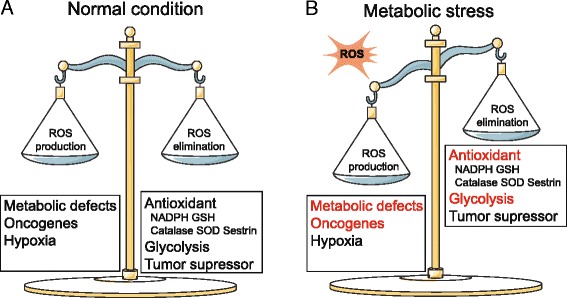
Fig. 1
Fig. 1
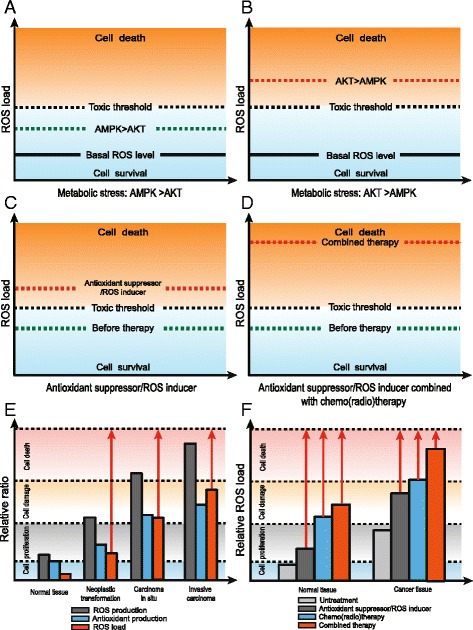
The cellular redox state is determined by ROS production and elimination: a Under normal condition, cancer cells maintain redox homeostasis by balancing ROS production and elimination. b Under metabolic stress, the redox homeostasis is damaged with enhanced ROS production and decreased ROS elimination
Fig. 2
Fig. 2
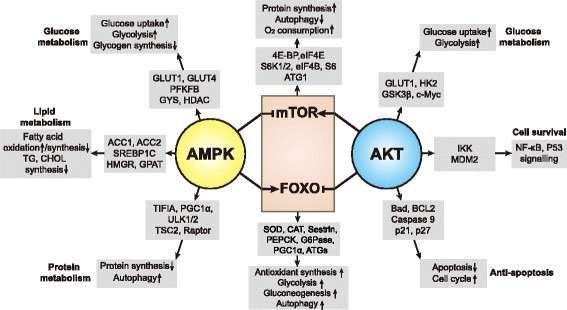
Cross effects of AMPK and AKT on the cellular metabolism and redox state: The targeted proteins regulated by AMPK and AKT and their regulatory effects are depicted, AMPK is a key player in response to metabolic stress by regulating the metabolism of glucose, lipid and protein. AMPK promotes glucose uptake and glycolysis, facilitating antioxidant production. AMPK also stimulates fatty acid oxidation and limits the fatty acid synthesis. mTOR and FOXO are two main downstream effectors of AMPK. AMPK inhibits mTOR activity, which induces protein synthesis inhibition and autophagy activation. AMPK also promotes FOXO activity to maintain the redox balance through enhanced antioxidant production and glucose metabolism. On the other side, AKT exerts antagonistic effect to regulate mTOR and FOXO activity. AKT stimulates mTOR signaling to promote glucose metabolism and protein synthesis, leading to increased ROS production. Meanwhile, it inhibits FOXO activity and renders cells susceptible to ROS toxicity
Fig. 3
Fig. 3
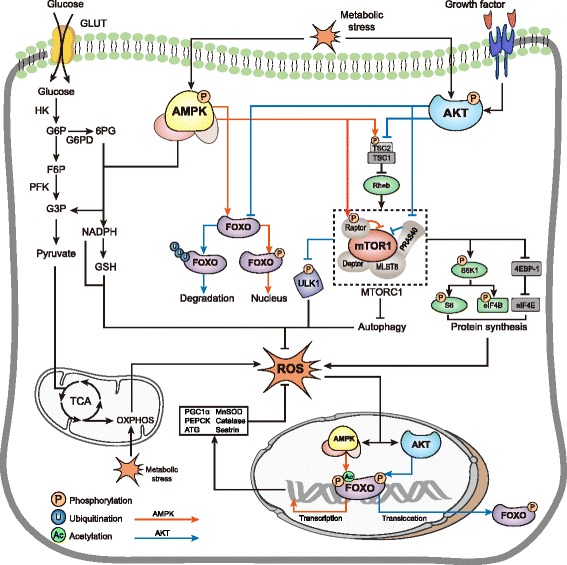
Signaling of AMPK and AKT on the ROS homeostasis via mTOR and FOXO regulation: Under metabolic stress, AMPK inhibits mTOR mainly via two ways:phosphorylates TSC2 at Ser-1387 which stimulates the TSC1-TSC2 complex to inhibit Rheb’s ability to activate mTOR; phosphorylates Raptor at Ser-792/Ser-722 to inhibit mTOR1. AKT activates mTOR reversely: AKT phosphorylates TSC2 at another site and activates mTOR via Rheb; AKT phosphorylates PRAS40 to inhibit its ability to suppress mTOR. Activated mTOR in turn promotes protein synthesis through S6K1 and 4E-BP1. AMPK phosphorylates FOXO, promoting the translocation to nucleus. AMPK also facilitates FOXO acetylation and enhances its transcriptional activity of antioxidant genes: SOD, Catalase, Sestrin. Additionally, AMPK promotes NADPH production via the PPP. On the other hand, AKT phosphorylates FOXO and leads to the translocation from the nucleus to the cytoplasm. By ubiquitination of FOXO, AKT leads to its degradation in cytoplasm
Fig. 4
Fig. 4
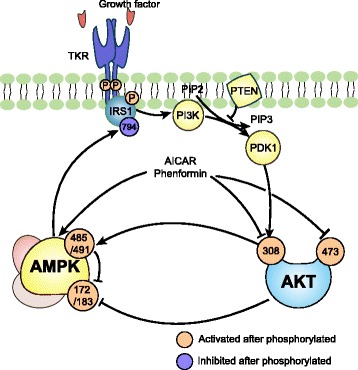
Interaction between AMPK and AKT on the phosphorylation: Growth factor activates TKR and promotes the activation of AKT via IRS1/PI3K/PDK1 signaling. Activated AKT phosphorylates AMPKα on Ser-485/491, preventing the active site Thr-172 to get access to LKB1 or CaMMK. AMPK phosphorylates IRS1 at Ser-794 and inhibits AKT signaling. AMPK activated by AICAR or phenformin dephosphorylates Ser-473 and Thr-308 of AKT, inhibiting AKT activity
Fig. 5
Fig. 5
AMPK and AKT mediate ROS regulation in tumor progression and treatment: a-b Under metabolic stress, AMPK and AKT manipulate ROS regulation and influence cell survival. The basal ROS indicate the ROS level under normal condition. c-d ROS load is increased by inducing ROS production or suppressing antioxidants. The effects are magnified when combined with chemo/radiotherapy. e ROS and antioxidant capacities are increased with tumor progression. f Compared to normal tissues, cancer cells are more susceptible to ROS targeting therapy, chemo/radiotherapy or their combined application

References

    1. Jin S, White E. Role of autophagy in cancer: management of metabolic stress. Autophagy. 2007;3:28–31. doi: 10.4161/auto.3269. - DOI - PMC - PubMed
    1. Gimbrone MA, Leapman SB, Cotran RS, Folkman J. Tumor dormancy in vivo by prevention of neovascularization. J Exp Med. 1972;136:261–76. doi: 10.1084/jem.136.2.261. - DOI - PMC - PubMed
    1. Goel S, Duda DG, Xu L, Munn LL, Boucher Y, Fukumura D, Jain RK. Normalization of the vasculature for treatment of cancer and other diseases. Physiol Rev. 2011;91:1071–121. doi: 10.1152/physrev.00038.2010. - DOI - PMC - PubMed
    1. Stylianopoulos T, Martin JD, Snuderl M, Mpekris F, Jain SR, Jain RK. Coevolution of solid stress and interstitial fluid pressure in tumors during progression: implications for vascular collapse. Cancer Res. 2013;73:3833–41. doi: 10.1158/0008-5472.CAN-12-4521. - DOI - PMC - PubMed
    1. Hay N. Reprogramming glucose metabolism in cancer: can it be exploited for cancer therapy? Nat Rev Cancer. 2016;16(10):635–49. - PMC - PubMed

Publication types

Substances