


Does task shifting yield cost savings and improve efficiency for health systems? A systematic review of evidence from low-income and middle-income countries
- PMID: 28407810
- PMCID: PMC5390445
- DOI: 10.1186/s12960-017-0200-9
Does task shifting yield cost savings and improve efficiency for health systems? A systematic review of evidence from low-income and middle-income countries
Abstract
Background: Task shifting has become an increasingly popular way to increase access to health services, especially in low-resource settings. Research has demonstrated that task shifting, including the use of community health workers (CHWs) to deliver care, can improve population health. This systematic review investigates whether task shifting in low-income and middle-income countries (LMICs) results in efficiency improvements by achieving cost savings.
Methods: Using the PRISMA guidelines for systematic reviews, we searched PubMed, Embase, CINAHL, and the Health Economic Evaluation Database on March 22, 2016. We included any original peer-review articles that demonstrated cost impact of a task shifting program in an LMIC.
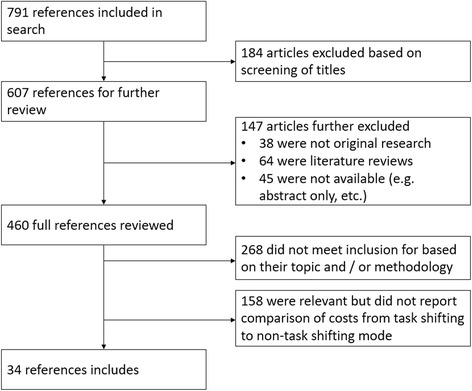
Results: We identified 794 articles, of which 34 were included in our study. We found that substantial evidence exists for achieving cost savings and efficiency improvements from task shifting activities related to tuberculosis and HIV/AIDS, and additional evidence exists for the potential to achieve cost savings from activities related to malaria, NCDs, NTDs, childhood illness, and other disease areas, especially at the primary health care and community levels.
Conclusions: Task shifting presents a viable option for health system cost savings in LMICs. Going forward, program planners should carefully consider whether task shifting can improve population health and health systems efficiency in their countries, and researchers should investigate whether task shifting can also achieve cost savings for activities related to emerging global health priorities and health systems strengthening activities such as supply chain management or monitoring and evaluation.
Keywords: Community health workers; Cost-effectiveness; Efficiency; Health systems; Systematic review; Task shifting.
Figures
References
-
- Grigoli F, Kapsoli J. Waste not, want not: the efficiency of health expenditure in emerging and developing economies. IMF Working Papers. 2013;(187).
-
- Chisholm D, Evans DB. Improving health system efficiency as a means of moving towards universal coverage, in World Health Report Background Paper. Geneva: World Health Organization; 2010.
-
- World Health Organization. First Global Conference on Task Shifting. 2008 [cited 2016 March 15]; Available from: http://www.who.int/healthsystems/task_shifting/en/.
Publication types
MeSH terms
LinkOut - more resources
Full Text Sources
Other Literature Sources
Medical
