Review
. 2017 Jun:44:83-97.
doi: 10.1016/j.semcancer.2017.03.009. Epub 2017 Apr 11.

Cellular determinants and microenvironmental regulation of prostate cancer metastasis

Affiliations
Review

Cellular determinants and microenvironmental regulation of prostate cancer metastasis

Kiera Rycaj et al. Semin Cancer Biol. 2017 Jun.

Abstract

Metastasis causes more than 90% of cancer-related deaths and most prostate cancer (PCa) patients also die from metastasis. The 'metastatic cascade' is a complex biological process that encompasses tumor cell dissociation (from the primary tumor), local invasion, intravasation, transport in circulation, extravasation, colonization, and overt growth in end organs. It has become clear that successful metastasis not only involves many tumor cell-intrinsic properties but also depends on productive interactions between cancer cells and the tumor microenvironment. In this Review, we begin with a general summary on cancer metastasis and a specific discussion on PCa metastasis. We then discuss recent advances in our knowledge of the cellular determinants of PCa metastasis and the importance of tumor microenvironment, especially an immunosuppressive tumor microenvironment, in shaping metastatic propensities. We conclude with a presentation of current and future therapeutic options for patients with PCa metastasis, emphasizing the development of novel, mechanism-based combinatorial strategies for treating metastatic and castration-resistant PCa.

Keywords: Cancer stem cells; Metastasis; Microenvironment; Prostate cancer.


Conflict of interest statement

Conflict of interest

None.

Figures
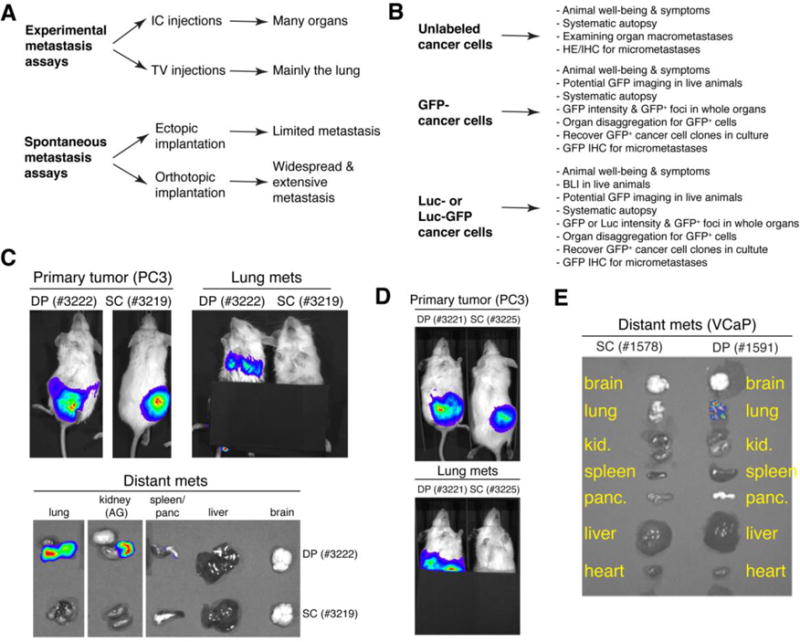
Figure 1
Figure 1
Experimental assays assessing metastasis of human cancer cells. (A) Two major metastasis assays. Experimental metastasis assays can be carried out via IC or TV injection leading to metastasis in many organs or mainly lung metastasis, respectively. Spontaneous metastasis assays can be carried out via ectopic or orthotopic implantation of human cancer cells leading to limited vs. widespread metastasis in many organs, respectively. (B) The level of metastasis can be qualitatively, semi-quantitatively, or quantitatively assessed depending on whether the starting cells are labeled or not. (C) DP-implanted (dorsal prostate) human PCa cells show more widespread metastasis than SC-implanted (subcutaneum) PCa cells. 500,000 PC3-Luc/GFP cells were implanted into the DP or SC in separate NOD/SCID mice. Shown are IVIS images taken at week 7 after injection (top panels). Primary tumors are on the left and corresponding lung metastasis is on the right for both DP and SC implanted mice. Note that DP-implanted PC3-Luc/GFP cells metastasized to the lungs and kidney, whereas SC-implanted PC3-Luc/GFP cells did not metastasize. Distant metastases to the lung, kidney, spleen/pancreas, liver, and brain in these mice are shown (bottom panels). Note that DP-implanted PC3-Luc/GFP cells metastasized to the lung and kidney (AG; adrenal gland) whereas SC-implanted cells did not metastasize. The fluorescence emitted from the lung was much less than from the kidney and thus the exposure time had to be increased to see positivity; however, all other organs remained negative for Luc/GFP expression even after this increase. (D) The experiment was repeated in two additional mice in order to confirm that DP-implanted human PCa cells show more widespread metastasis than SC-implanted PCa cells. (E) 500,000 VCaP-Luc/GFP cells were implanted into the DP or SC in NOD/SCID mice. Shown are representative IVIS images of brain, lung, kidney, spleen, pancreas, liver, and heart from one mouse 11 weeks post injection. Note that DP-implanted VCaP-Luc/GFP cells metastasized to the lungs whereas SC implanted VCaP-Luc/GFP cells did not metastasize.
Figure 2
Figure 2
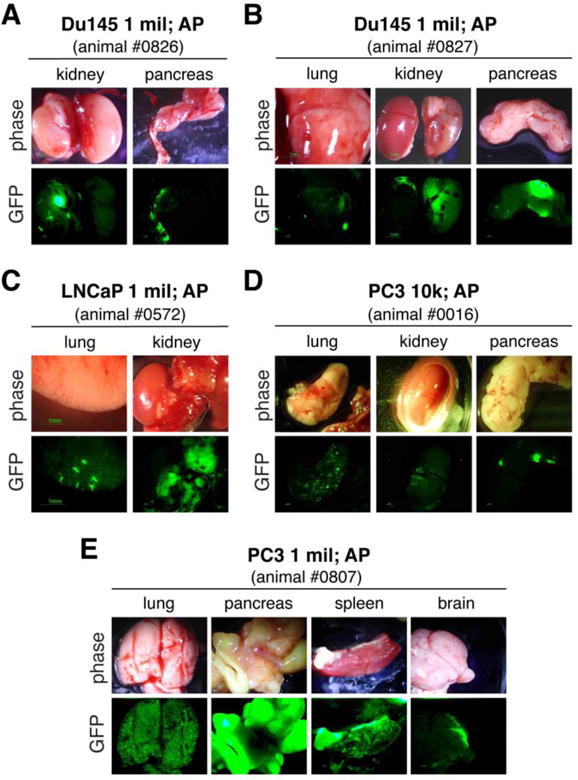
AP-implanted PCa cells metastasize to multiple organs. Shown are representative organ images (upper panels, phase; lower panels, GFP) of 1 million Du145-GFP cells (A and B), 1 million LNCaP-GFP cells (C) and 10,000 (D) or 1 million (E) of PC3-GFP cells implanted in the AP of NOD/SCID mice and harvested ~60 days post implantation. Animal tag numbers are indicated.
Figure 3
Figure 3
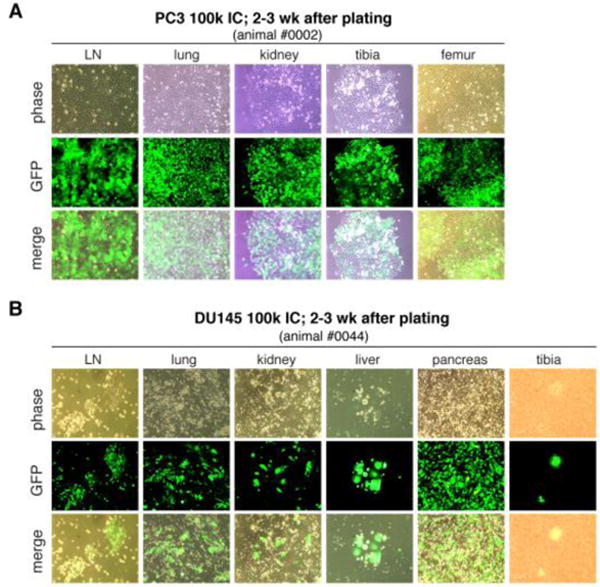
IC-injected PCa cells recovered from end organs formed colonies. Shown are representative images of PC3-GFP (A) and DU145-GFP (B) cells cultured (2–3 weeks after plating) from the organs indicated. Animals were injected with 100,000 GFP-tagged PCa cells and terminated ~4 months post injection. Organs were disaggregated into single cells, which were plated and cultured in RPMI1640 containing 7% FBS. The GFP cells on the background in some images are the host cells. Original magnifications, ×200.

References

    1. Fidler IJ. The pathogenesis of cancer metastasis: the ‘seed and soil’ hypothesis revisited. Nat Rev Cancer. 2003;3:453–8. - PubMed
    1. Kreso A, Dick JE. Evolution of the cancer stem cell model. Cell Stem Cell. 2014;14:275–91. - PubMed
    1. Massague J, Obenauf AC. Metastatic colonization by circulating tumour cells. Nature. 2016;529:298–306. - PMC - PubMed
    1. Rycaj K., TD . Metastasis and metastatic cells: a historical perspective and current analysis. In: Huiping L LJ, editor. Cancer Stem Cells: Targeting the Roots of Cancer, Seeds of Metastasis, and Sources of Therapy Resistance. Academic Press/Elsevier; 2016. pp. 317–40.
    1. Labelle M, Begum S, Hynes RO. Direct signaling between platelets and cancer cells induces an epithelial-mesenchymal-like transition and promotes metastasis. Cancer Cell. 2011;20:576–90. - PMC - PubMed

Publication types

MeSH terms