Review
. 2017 Apr 15;45(2):465-475.
doi: 10.1042/BST20160022.

Tspan2: a tetraspanin protein involved in oligodendrogenesis and cancer metastasis

Affiliations
Review

Tspan2: a tetraspanin protein involved in oligodendrogenesis and cancer metastasis

Ibrahim H Yaseen et al. Biochem Soc Trans. .

Abstract

Tetraspanin 2 (Tspan2) is one of the less well-characterised members of the tetraspanin superfamily, and its precise function in different human tissue types remains to be explored. Initial studies have highlighted its possible association in neuroinflammation and carcinogenesis. In the central nervous system, Tspan2 may contribute to the early stages of the oligodendrocyte differentiation into myelin-forming glia. Furthermore, in human lung cancer, Tspan2 could be involved in the progression of the tumour metastasis by modulating cancer cell motility and invasion functions. In this review, we discuss the available evidence for the potential role of Tspan2 and introduce possible strategies for disease targeting.

Keywords: TEMs; Tspan2; metastasis; oligodendrocytes; tetraspanin 2; transmembrane proteins.


Conflict of interest statement

The Authors declare that there are no competing interests associated with the manuscript.

Figures
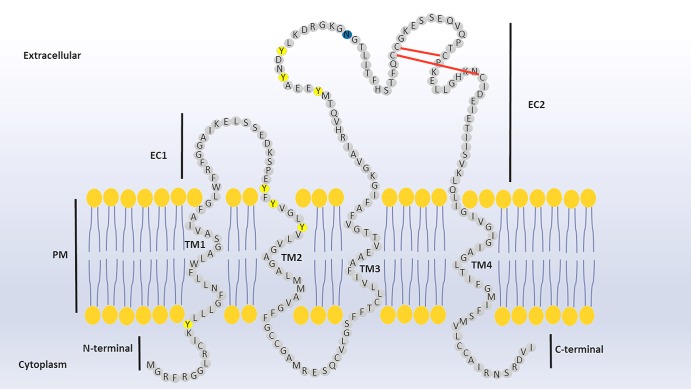
Figure 1.
Figure 1.. Prediction of Tspan2 secondary structure.
The predicted disulphide bonds between the CCG motif and the other two cysteines in the EC2 region are highlighted with red colour bonds. The seven tyrosines are illustrated with yellow colour, whereas the blue colour is the potential glycosylation site at asparagine 139. The aa arrangement and their topological hydrophobicity/hydrophilicity are extracted from the UniProt database, accession number: UniProtKB — O60636 (TSN2_HUMAN). PM: plasma membrane; EC1: extracellular domain 1; EC2: extracellular domain 2; TM: transmembrane.
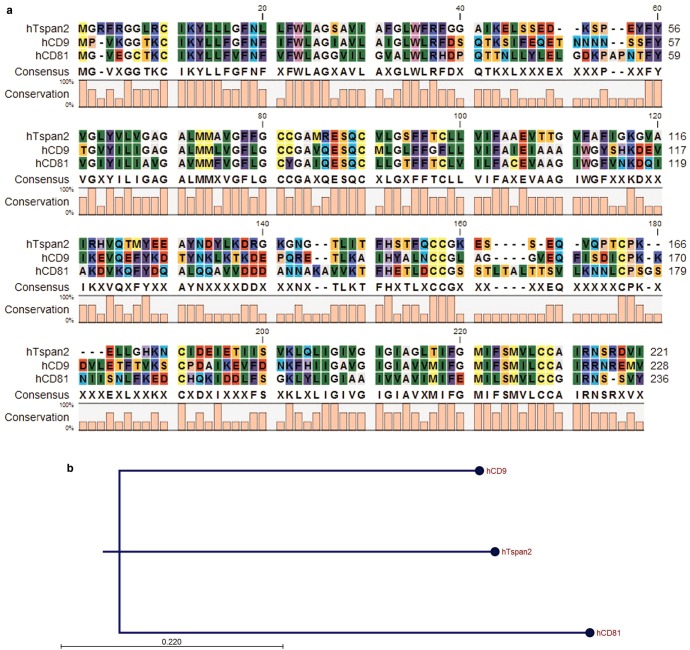
Figure 2.
Figure 2.. Tspan2 protein sequence alignment and dendrogram.
(a) The protein sequence alignment of human Tspan2 along with CD9 and CD81. The bar graph represents the conservation percentages between each single aa of the concerned tetraspanins. (b) The tree phylogeny of human Tspan2, CD9 and CD81 based on their protein sequence alignment. The phylogram constructed by the RapidNJ plugin, and the Juke-Cantor evolution model used for distance calculation. Scale bar indicates the branch length. All the analysis was performed on CLC Sequence Viewer platform version 7.7.1 (QIAGEN, Aarhus, Denmark).

References

    1. Garcia-España A., Chung P.-J., Sarkar I.N., Stiner E., Sun T.-T. and Desalle R. (2008) Appearance of new tetraspanin genes during vertebrate evolution. Genomics 91, 326–334 doi: 10.1016/j.ygeno.2007.12.005 - DOI - PubMed
    1. Oren R., Takahashi S., Doss C., Levy R. and Levy S. (1990) TAPA-1, the target of an antiproliferative antibody, defines a new family of transmembrane proteins. Mol. Cell. Biol. 10, 4007–4015 PMID: - PMC - PubMed
    1. Hemler M.E. (2003) Tetraspanin proteins mediate cellular penetration, invasion, and fusion events and define a novel type of membrane microdomain. Annu. Rev. Cell Dev. Biol. 19, 397–422 doi: 10.1146/annurev.cellbio.19.111301.153609 - DOI - PubMed
    1. Yáñez-Mó M., Barreiro O., Gordon-Alonso M., Sala-Valdés M. and Sánchez-Madrid F. (2009) Tetraspanin-enriched microdomains: a functional unit in cell plasma membranes. Trends Cell Biol. 19, 434–446 doi: 10.1016/j.tcb.2009.06.004 - DOI - PubMed
    1. Charrin S., Jouannet S., Boucheix C. and Rubinstein E. (2014) Tetraspanins at a glance. J. Cell Sci. 127, 3641–3648 doi: 10.1242/jcs.154906 - DOI - PubMed

Publication types