


Potential of Native Rhizobia in Enhancing Nitrogen Fixation and Yields of Climbing Beans (Phaseolus vulgaris L.) in Contrasting Environments of Eastern Kenya
- PMID: 28408912
- PMCID: PMC5374200
- DOI: 10.3389/fpls.2017.00443
Potential of Native Rhizobia in Enhancing Nitrogen Fixation and Yields of Climbing Beans (Phaseolus vulgaris L.) in Contrasting Environments of Eastern Kenya
Abstract
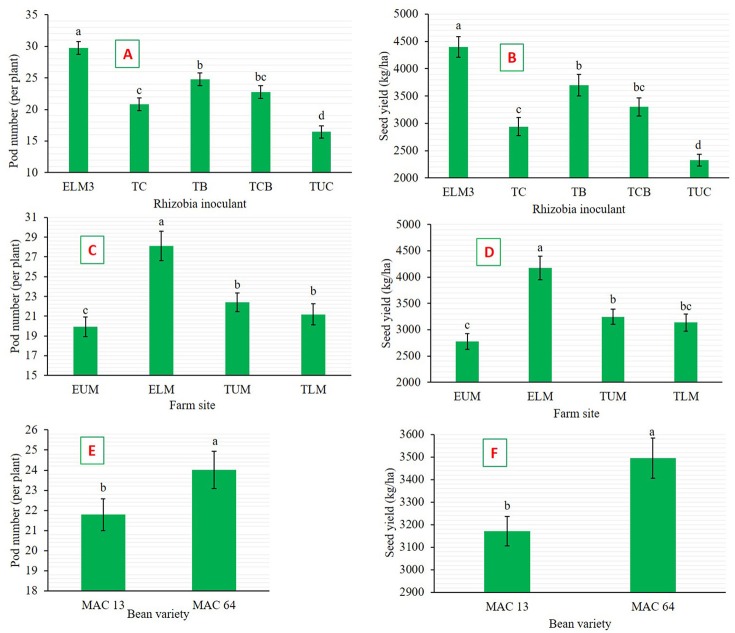
Climbing bean (Phaseolus vulgaris L.) production in Kenya is greatly undermined by low soil fertility, especially in agriculturally prolific areas. The use of effective native rhizobia inoculants to promote nitrogen fixation could be beneficial in climbing bean production. In this study, we carried out greenhouse and field experiments to evaluate symbiotic efficiency, compare the effect of native rhizobia and commercial inoculant on nodulation, growth and yield parameters of mid-altitude climbing bean (MAC 13 and MAC 64) varieties. The greenhouse experiment included nine native rhizobia isolates, a consortium of native isolates, commercial inoculant Biofix, a mixture of native isolates + Biofix, nitrogen treated control and a non-inoculated control. In the field experiments, the treatments included the best effective native rhizobia isolate ELM3, a consortium of native isolates, a commercial inoculant Biofix, a mixture of native isolates + Biofix, and a non-inoculated control. Remarkably, four native rhizobia isolates ELM3, ELM4, ELM5, and ELM8 showed higher symbiotic efficiencies compared to the Biofix. Interestingly, there was no significant difference in symbiotic efficiency between the two climbing bean varieties. Field results demonstrated a significant improvement in nodule dry weight and seed yields of MAC 13 and MAC 64 climbing bean varieties upon rhizobia inoculation when compared to the non-inoculated controls. Inoculation with ELM3 isolate resulted to the highest seed yield of 4,397.75 kg ha-1, indicating 89% increase over non-inoculated control (2,334.81 kg ha-1) and 30% increase over Biofix (3,698.79 kg ha-1). Farm site significantly influenced nodule dry weight and seed yields. This study, therefore, revealed the potential of native rhizobia isolates to enhance delivery of agroecosystem services including nitrogen fixation and bean production. Further characterization and mapping of the native isolates will be imperative in development of effective and affordable commercial inoculants.
Keywords: Eastern Kenya; biological nitrogen fixation; climbing beans; ecosystem services; native rhizobia.
Figures
References
-
- Aliyu I. A., Yusuf A. A., Abaidoo R. C. (2013). Response of grain legumes to rhizobial inoculation in two savanna soils of Nigeria. Afr. J. Microbiol. Res. 7, 1332–1342. 10.5897/AJMR12.1127 - DOI
-
- Anglade J., Billen G., Garnier J. (2015). Relationships for estimating N2 fixation in legumes: incidence for N balance of legume-based cropping systems in Europe. Ecosphere 6, 1–24. 10.1890/ES14-00353.1 - DOI
-
- Beck D. P., Materon L. A., Afandi F. (1993). Practical Rhizobium-Legume Technology Manual. Technical Manual. Aleppo: International Center for Agricultural Research in the Dry Areas.
-
- Beebe S., Rao I., Mukankusi C., Buruchara R. (2012). Improving resource use efficiency and reducing risk of common bean production in Africa, Latin America and the Caribbean, in Eco-efficiency: From Vision to Reality, ed Hershey C. (Cali, DC: International Center for Tropical Agriculture; ).
LinkOut - more resources
Full Text Sources
Other Literature Sources
Research Materials
