


Prevalence of sucretolerant bacteria in common soils and their isolation and characterization
- PMID: 28409237
- PMCID: PMC5511755
- DOI: 10.1007/s10482-017-0873-z
Prevalence of sucretolerant bacteria in common soils and their isolation and characterization
Abstract
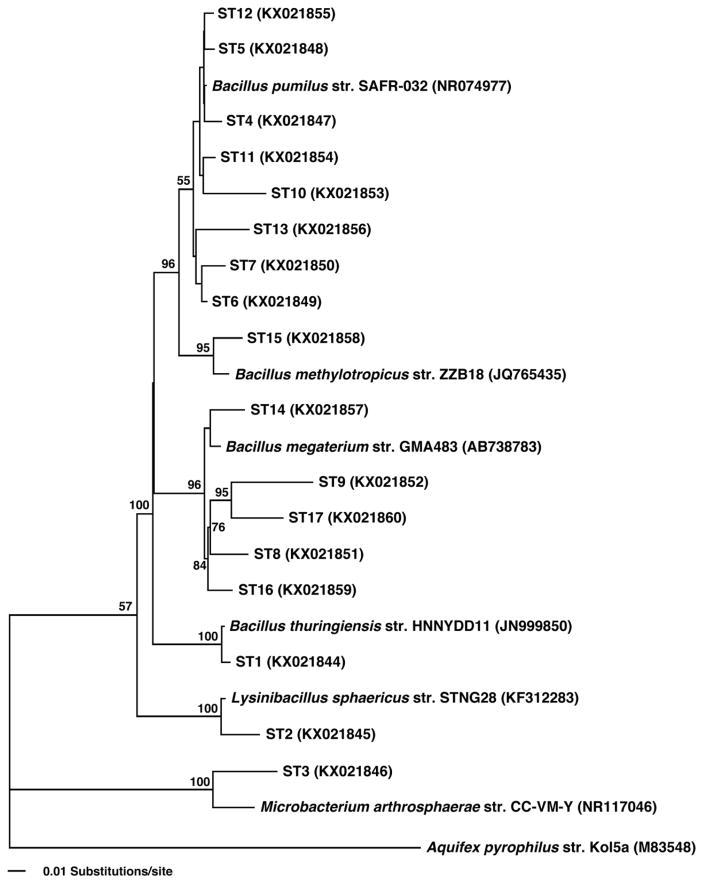
Sucretolerant microbes grow in the presence of sugar concentrations high enough to substantially lower water activities. Natural habitats high in sugars are mainly limited to dried fruit, floral nectar, honey, sugarcane, and associated soils. Organisms that tolerate extremes of solute concentration, high enough to lower water activities, might not be expected in common oligoosmotic soils. We report on the isolation of sucretolerant bacteria from common soils using media supplemented with 50% sucrose (a w 0.91) and their physiological characterization and identification by 16S rRNA gene phylogeny. Fifteen of these sucretolerant isolates from common soils were related to four Bacillus spp. A Lysinibacillus and a Microbacterium (actinomycete) also were collected. All grew at 50% sucrose and 13 grew at 60% sucrose. Most probable number counts were used to determine the abundance of sucretolerant microbes in several common soil types, including agricultural, managed turf, and native prairie. Microbial abundance (with fungicides) was about 105 and 103 cells g-1 soil in media containing 50 or 70% sucrose, respectively. The abundances of sucretolerant bacteria in common soils mirror those of halotolerant bacteria that grow at 10 and 20% NaCl. However, there is not a correlation between halotolerance and sucretolerance in our isolates, nor can predictions be made based on taxonomy. Specific solute effects may be at work, rather than biological responses to a single physicochemical parameter such as a w. The occurrence of spore-forming sucretolerant bacteria in common soils has relevance to forward planetary protection and astrobiology. Extraterrestrial habitable regions are defined in part by tolerance to high solute concentrations and osmotolerant soil microbes may contaminate spacecraft.
Keywords: Bacteria; Extremophiles; Halotolerance; Hypersaline; Soil; Sucretolerance; Sugar.
Figures
References
-
- Álvarez-Pérez S, Herrera CM, de Vega C. Zooming-in on floral nectar: a first exploration of nectar-associated bacteria in wild plant communities. FEMS Microbiol Ecol. 2012;180:591–602. - PubMed
-
- Altschul SF, Gish W, Miller W, Myers EW, Lipman DJ. Basic local alignment search tool. J Mol Biol. 1990;215:403–410. - PubMed
-
- Belamri M, Mekkaoui AK, Tantaoui-Elaraki A. Saccharolytic bacteria in beet juices. Int Sugar J. 1991;93:210–212.
-
- Beuchat LR. Microbial stability as affected by water activity. Cereal Foods World. 1981;26:345–349.
-
- Brysch-Herzberg M. Ecology of yeasts in plant-bumblebee mutualism in Central Europe. FEMS Microbiol Ecol. 2004;50:87–100. - PubMed
MeSH terms
Substances
Grants and funding
LinkOut - more resources
Full Text Sources
Other Literature Sources
Miscellaneous
